
Key Takeaways
Community-based organizations (CBOs) are nonprofit workforce development partners that connect federal contractors to skilled, job-ready candidates from underrepresented communities—including protected veterans, individuals with disabilities, and more. Effective CBO engagement goes beyond compliance: it builds authentic talent pipelines, strengthens your employer brand in local communities, and gives you access to candidates that traditional recruiting channels miss entirely. For federal contractors, meaningful outreach must also be documented to satisfy outreach requirements under VEVRAA, Section 503, and scalable enough to reach across every market where you’re hiring. DirectEmployers’ Local Job Distribution tool and Partner Relationship Manager (PRM) make both possible, automating job syndication to a vetted national directory of CBOs while centralizing outreach tracking in one audit-ready platform. The result: hiring practices that don’t just check a box—they build a more competitive, community-centric, and resilient workforce.
The answer is more valuable than many employers realize. Community-based organizations are not just compliance resources. They are active bridges between employers and talent—talent that is skilled, motivated, and often overlooked by traditional recruiting channels. For federal contractors in particular, building authentic partnerships with CBOs can transform the way you source candidates, strengthen your employer brand in local communities, and fulfill your legal obligations in a way that actually moves the needle forward, without adding extra work to your plate. Sounds like a win–win, right?
Let’s dive into what CBOs are, how federal contractors can engage with them meaningfully, and why nationwide outreach through tools like DirectEmployers’ Local Job Distribution offer a strategic advantage in talent acquisition and compliance.
What Is a Community-Based Organization (CBO)?
A community-based organization (CBO) is a nonprofit or non-governmental organization that provides educational, employment, or related services and support within a specific community or geographic area. These organizations are built around a singular purpose: helping individuals who face barriers to employment gain the skills, resources, and connections they need to secure sustainable work.
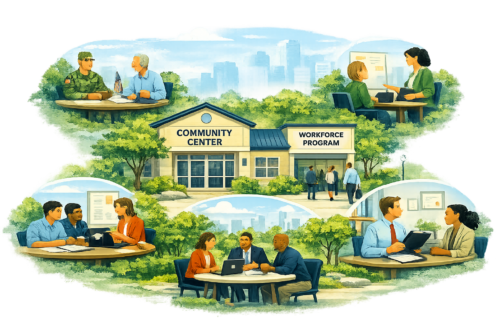
Community-based organizations help connect employers with local talent through workforce support, training, outreach, and employment readiness programs.
What makes CBOs especially relevant to federal contractors is their role in workforce development. CBOs don’t just counsel job seekers. They partner with employers to align training programs with real labor market needs, facilitate job placements, organize hiring events, and advocate for broader hiring practices. They bring labor market insight from the community side of the equation, which is something no job board or staffing agency can fully replicate.
CBOs commonly serve populations that overlap with federal contractors’ outreach and hiring priorities, including:
- Protected veterans, including disabled veterans and recently separated service members
- Individuals with disabilities, as covered under Section 503 of the Rehabilitation Act
Or other organizations supporting:
- Women, particularly in industries and roles where they are historically underrepresented
- Minorities, again particularly in industries and roles where they are historically underrepresented
- Individuals reentering the workforce, including those transitioning from incarceration or long-term unemployment
When you engage with a CBO, you’re not just accessing a referral network. You’re connecting with an organization that has spent years building trust within a community, and that trust extends to the candidates they connect you with, helping build your recruitment brand presence further in local communities.
How Federal Contractors Can Engage with CBOs
Understanding what CBOs are is one thing. Knowing how to work with them effectively is where the real value lies. There are several practical pathways federal contractors can use to build meaningful CBO partnerships.
1. Start with a Relationship, Not a Transaction
The most common mistake employers make when approaching CBOs is treating the relationship as purely transactional. Sending a job listing and expecting referrals in return is a common misstep for example. CBOs are community organizations first. They need to know that your company is a trustworthy employer who will treat their clients with respect and provide genuine opportunities.
This is where relationship building comes into play. Start by introducing yourself. Reach out to the CBO’s workforce development staff or employment program coordinator to understand who they serve, what their placement goals look like, and what they need from employer partners. Ask how you can be a resource to them, not just the other way around.
2. Share Job Opportunities Consistently & Accessibly
One of the most direct ways to work with a CBO is to ensure they receive your job openings in a timely, accessible format. This means more than forwarding a careers page URL. It means distributing job information in a way that CBO staff can quickly share with clients—clear job titles, inclusive descriptions, accessible application instructions, and a point of contact when questions arise.
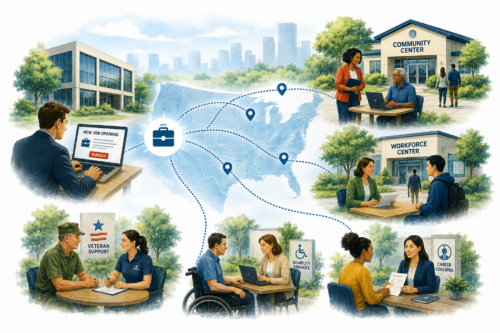
Local Job Distribution helps employers extend opportunities across local workforce networks and community organizations nationwide.
This is where technology can make a meaningful difference. DirectEmployers’ Local Job Distribution tool enables Member employers to distribute job opportunities directly to a growing directory of local CBOs across the country. Rather than manually identifying and contacting individual CBOs, DirectEmployers Partnership team has already done the heavy lifting to find CBOs and provide accurate, up-to-date contact information. The tool does the heavy lifting, distributing your open jobs to vetted local organizations that serve veterans, individuals with disabilities, and other underrepresented job seekers, leaving you to add the human-factor and relationship building efforts into the mix. It’s a scalable way to get your opportunities into the hands of the CBO staff and counselors who can connect you with qualified candidates.
3. Establish Linkage Agreements
Once you’ve identified a CBO partner and begun building a relationship, the next step is formalizing it. That’s where linkage agreements come in, and they’re simpler than the name might suggest.
Linkage agreements are documented recruiting partnerships between federal contractors and the CBO that support outreach to protected groups. These partnerships help contractors further demonstrate commitment to and proactive outreach efforts under Section 503 and VEVRAA requirements. In practice, linkage agreements support candidate referrals, recruiting events, workforce partnerships, and broader outreach efforts beyond standard job postings and conversations.
A linkage agreement does not require a complicated legal contract, but rather in practice, it is often:
- A memorandum of understanding (MOU)
- An email exchange confirming partnership and continued connection
- A documented recruiting relationship or commitment
- Participation in coordinated referral programs
Evidence is a key element of an ongoing relationship intended to increase outreach to protected groups, and a linkage agreement can serve as a solid foundation to illustrate the contractor’s efforts to connect with CBOs and varying communities
While the linkage agreement can serve as proof of relationship and outreach efforts, federal contractors should also continue evaluating whether these relationships are effective and are continuing to produce meaningful engagement or recruiting results.
4. Participate in CBO-Led Events
Job fairs, hiring events, career readiness workshops, and community resource days are a staple of CBO programming. These events give employers a face-to-face opportunity to engage with job seekers in a setting where candidates already feel supported and prepared. Showing up consistently, not just once, signals to both the CBO and the community that your commitment is genuine.
Many CBOs also host employer panels, where HR professionals and hiring managers share insight on how to navigate the application process, what skills are in demand, and what workplace culture looks like at your organization. These engagements build your employer brand within communities that may not have previously considered your company as a place to work.
5. Collaborate on Workforce Development and Training
Some of the most impactful CBO partnerships go beyond recruiting. Federal contractors with recurring talent needs in specific roles, like skilled trades, technology, healthcare support, and logistics, for example, can work directly with CBOs to co-develop or sponsor training programs that prepare candidates for those exact positions. This kind of sector-based partnership creates a genuine talent pipeline, not just a one-time referral relationship.
When you invest in training and workforce readiness, you also invest in retention. Candidates who enter your workforce through CBO-supported pathways often arrive with stronger soft skills, clearer expectations, and deeper community ties—all factors that contribute to longer tenure and greater workplace integration.
6. Document Your Outreach Efforts
For federal contractors, documentation of outreach is not optional, it’s a regulatory requirement. Under the Vietnam Era Readjustment Assistance Act (VEVRAA) and Section 503 of the Rehabilitation Act, contractors must conduct outreach to organizations serving veterans and individuals with disabilities, and they must be able to demonstrate those efforts if audited by the Office of Federal Contract Compliance Programs (OFCCP).
Platforms like DirectEmployers’ Partner Relationship Manager (PRM) allow you to centralize, track, and document all of your outreach activities in one place—logging interactions, communications, and job distributions in a format that supports compliance reporting and demonstrates activity and outreach actions taken by your team. When outreach is well-documented, it not only satisfies regulatory requirements; it also helps you evaluate which partnerships are generating the most value over time.
Why Nationwide CBO Outreach Matters: More Than Compliance, It’s a Competitive Advantage
It’s easy to frame CBO outreach as a compliance obligation and stop there. But federal contractors who take that narrow view are leaving significant business value on the table.
Access to Talent You Won’t Find Anywhere Else
The candidates who come through CBO networks are often invisible to traditional recruiting channels. They may not be actively searching job boards, attending industry networking events, or following your company on LinkedIn. But they are skilled, motivated, and ready to work—they simply need a connection point, and CBOs provide exactly that.
When you distribute your jobs through CBO networks, you reach talent pools that your competitors likely aren’t accessing. That’s a real edge in tight labor markets.
Expanding Your Employer Brand Beyond Traditional Channels
Employer branding is often thought of in terms of digital presence, think careers sites, LinkedIn profiles, Glassdoor reviews, recruitment marketing efforts, and more. But brand visibility in local communities is equally powerful, especially for positions that draw from regional talent. When a CBO casually mentions your company as a good employer to work for, that word-of-mouth carries enormous weight with the people they serve.
DirectEmployers’ Local Job Distribution tool helps you extend your brand reach into community networks that digital advertising simply doesn’t penetrate. As your jobs circulate through local organizations, your company name becomes familiar territory in communities where you may be actively hiring, but previously unknown as an employer.
Equitable Hiring Is Good Business
There is a growing body of evidence that teams composed of people from different backgrounds and environments outperform homogenous ones on key performance indicators, such as innovation, problem-solving, customer satisfaction, and employee retention among them. Hiring through CBO networks isn’t a charitable act; it’s a talent strategy rooted in sound business logic, helping you create a team that is reflective of the community where you are located.
Federal contractors are in a unique position to model these hiring practices at scale. The obligations established by VEVRAA and Section 503 exist precisely because Congress and federal regulators recognized that without proactive effort, systemic barriers prevent qualified candidates from accessing opportunities. Meaningful CBO engagement is how you turn policy intent into hiring reality, using tools like the Partner Relationship Manager (PRM) to help you track and measure your successes.
National Reach with Local Relevance
One of the real challenges for large federal contractors hiring across multiple states and regions is maintaining consistent, locally relevant outreach. What works in one city may not translate to another. CBOs are inherently local. They know their communities, their candidates, and their regional labor markets in ways that a centralized HR team cannot replicate.

Let’s chat!
Fill out this form to indicate which solutions you’re interested in and we'll contact you shortly to schedule a demo.