
Key Takeaways
The Department of Labor’s latest batch of FLSA opinion letters (FLSA2026-5 through FLSA2026-8) signals a sharp return to clear, scenario-specific compliance assistance as shared by Administrator Rogers at DEAMcon26. Key rulings confirm that salaried exempt employees can safely work secondary hourly shifts if their primary duty remains exempt, and that calculating nondiscretionary bonuses as a percentage of total individual-to-group earnings satisfies overtime laws. Additionally, voluntary travel time across an employer’s secure facility during a meal break is non-compensable. Crucially, employers are warned that electronic clock-rounding policies that consistently shave off paid time while employees perform regular, predictable pre-shift work (such as patient handoffs) violate the FLSA.
End of summary box.
Reflecting on his career path, Administrator Rogers emphasized that while the agency will aggressively pursue willful violators who “cheat the system,” the vast majority of employers are doing their level best to get it right. He noted that the regulations enforce statutes written decades ago using language we don’t naturally use today.
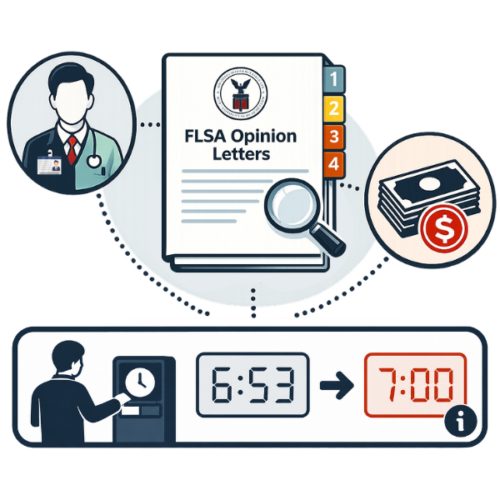
The Department of Labor’s latest FLSA opinion letters provide guidance on dual-role employees, bonus calculations, meal-break considerations, and timekeeping practices.
“To bring those laws to people who need to actually apply them and abide by them, that’s the responsibility of the agency,” Rogers stated. “A fact sheet will give you a shortcut… but to answer a particular question, that’s the advantage of what the opinion letters provide.”
True to that vision, the WHD has released four major opinion letters (FLSA2026-5 through FLSA2026-8). These letters move past generalities to deliver binding, actionable guidance on complex everyday scenarios. Here is what HR compliance professionals need to know about the new perspectives.
Dual-Role Scheduling: Hourly Shifts for Salaried Exempt Workers
FLSA2026-5
The Issue: Can a bona fide white-collar exempt employee (under FLSA §13(a)(1)) pick up additional shifts in a secondary, non-exempt role paid at an hourly rate without losing their exempt status? If so, does the hourly work trigger overtime obligations on their primary salary?
The WHD Conclusion: Yes, this arrangement is entirely permissible, and it does not intrinsically trigger overtime requirements for the primary salary. The WHD clarified that an employer may pay a salaried exempt employee extra compensation on any basis—including hourly—without destroying the exemption, provided two ironclad conditions are met:
- The employee’s primary duty over the course of the workweek remains the performance of exempt work (the WHD notes that spending more than 50% of their time on exempt tasks is a strong baseline indicator)./li>
- The employee continues to receive their full, guaranteed base salary (minimum $684/week) regardless of the quantity or quality of the secondary work performed.
Employer Takeaway: Dual-role scheduling is a great way to solve staffing shortages (e.g., an exempt clinical specialist picking up extra weekend shifts as an hourly staff nurse). However, tracking is vital. You must maintain separate, meticulous time records for both roles to prove that the employee’s core “primary duty” didn’t quietly shift to non-exempt work over time.
Simplifying Bonus Calculations and Overtime Compliance
FLSA2026-6
The Issue: Does a quarterly bonus structure calculated by comparing an individual employee’s total earnings (both straight-time and overtime) against the aggregate total earnings of all bonus-eligible employees qualify as a “percentage of total earnings” bonus under 29 C.F.R. §778.210? Does it satisfy the FLSA’s overtime pay requirements simultaneously?
The WHD Conclusion: Yes. Under standard FLSA rules, when an employer pays a nondiscretionary bonus, they normally have to retroactively recalculate the employee’s “regular rate” for every single workweek in that quarter and pay a trailing overtime premium on the bonus. However, 29 C.F.R. §778.210 provides a mathematical shortcut: if a bonus is paid as a predetermined percentage of an employee’s total earnings (including both straight-time and overtime), the bonus automatically pays the overtime due on itself simultaneously. The WHD confirmed that using a ratio of individual-to-group total earnings meets this standard.
Employer Takeaway: This ruling validates a highly efficient math mechanism. By building both straight-time and overtime earnings directly into the baseline calculation of the bonus, you eliminate the administrative nightmare of retroactively recomputing the regular rate across historical weeks.
Unpaid Meal Breaks and the Logistics of Leaving the Premises
FLSA2026-7
The Issue: If an employer provides a standard 30-minute unpaid meal break, is the time an employee spends traversing a massive facility or passing through controlled security access gates to leave the property considered compensable work time?
The WHD Conclusion: No. The WHD re-anchored its guidance to the “predominant benefit” test. For a meal period to be non-compensable, the employee must simply be completely relieved from job duties for the purpose of eating. The WHD explicitly noted that regulations do not require employers to let employees leave the premises during a break, provided they are free from work tasks. Therefore, if an employee voluntarily chooses to go off-site, the transit time through secure gates and parking lots is for the employee’s benefit—not the employer’s—and does not convert a bona fide meal break into paid time.
Employer Takeaway: You are not penalized for having thorough physical security frameworks or expansive worksites. As long as your workers are genuinely off the clock and relieved of duties during their 30 minutes, you do not owe them compensation for the minutes it takes them to walk to their cars or travel offsite. Note: State laws can be more restrictive regarding meal break control; always verify local statutes.
Pre-Shift Activities, Rounding Policies, and the Flaw of “De Minimis”
FLSA2026-8
The Issue: Are mandatory or routine pre-shift activities (like hospital respiratory therapists logging in early to receive patient handoff reports and assignments) compensable? Can an employer use a “7-minute rounding rule” to automatically shift an early clock-in forward to the official shift start time?
The WHD Conclusion: The WHD drew a sharp line here, warning that this specific public hospital practice raised substantial non-compliance red flags.
- Integral and Indispensable: Activities that are essential to safely executing core job duties—such as receiving critical patient handoffs—constitute compensable work the moment they occur. Waiting in line at a time clock is not compensable, but performing job-related prep is.
- The Rounding Trap: Clock-rounding practices (e.g., rounding a 6:53 a.m. punch to 7:00 a.m.) are only lawful if they are facially neutral and average out over time. Because this hospital rounded early punches up to the start time while employees simultaneously performed actual work, the policy exclusively benefited the employer and resulted in underpayment.
- No De Minimis Defense: The “de minimis” doctrine (ignoring negligible fractions of minutes) does not apply when the pre-shift work is regular, predictable, and easily capturable by modern electronic timekeeping systems.
Employer Takeaway: If your timekeeping system rounds time punches in a way that consistently shaves off minutes while employees are performing necessary prep work, your policy is structurally broken. Audit your operational floors: are employees performing “integral” tasks before their scheduled shift officially begins? If they are, they must be paid for every minute of it.
Following the June 2025 announcement of the return of Opinion Letters across five agencies, six additional Opinion Letters released in January 2026, focused on addressing and/or clarifying the following:
- FLSA2026-1: Whether an employee’s role meets the criteria for the learned professional exemption under section 13(a)(1) of the FLSA, and, if so, whether an employer is nevertheless permitted to reclassify the employee as non-exempt.
- FLSA2026-2: Whether section 7(e) of the FLSA permits an employer to exclude certain bonus payments from an employee’s regular rate of pay. The letter also addresses how to include these payments in the calculation of employee overtime premiums if the payments must be included in an employee’s regular rate of pay.
- FLSA2026-3: Whether a union and employer can enter into a collective bargaining agreement that mandates a 15-minute “roll call” prior to each scheduled shift but excludes that time when calculating overtime premiums under the FLSA.
- FLSA2026-4: Whether, for purposes of the overtime exemption for certain commissioned employees in section 7(i) of the FLSA, an employer in a jurisdiction in which the state minimum wage exceeds the federal minimum wage must use the federal minimum wage, or alternatively, the higher state minimum wage, to determine whether it has satisfied the minimum pay standard in section 7(i)(1), and whether tips are deemed compensation for purposes of section 7(i)(2)’s requirement that more than half the employee’s compensation consist of commissions.
- FMLA2026-1: How a school closure of less than a full week impacts the amount of leave a school employee uses under the FMLA.
- FMLA2026-2: Whether FMLA leave may be used for time spent traveling to or from medical appointments, including where an employee provided the employer with medical certification from a health care provider that confirms the employee’s need for the appointment, but the certification does not address travel to or from the appointment.
Next Steps for Employers
As Administrator Rogers highlighted at DEAMcon26, clear regulatory guidance gives businesses the predictability they need to plan their workforces with confidence. It also signals what the agency is looking at closely during audits.
In light of these four new opinion letters, HR professionals should proactively take the following actions:
- Review dual-role staff allocations to ensure exempt employees picking up hourly side shifts maintain their primary exempt duties.
- Audit automated rounding configurations in your timekeeping software to verify that they are operating neutrally and not stripping compensable pre-shift work.
- Confirm that nondiscretionary bonus plans are properly accounting for overtime calculations, or utilizing the validated total-earnings percentage shortcut.
With compliance assistance being the crux of support and guidance, Opinion Letters provide a powerful safe-harbor defense for employers who align their practices with the DOL’s documented interpretations in good faith. Take this opportunity to review your current payroll and break policies with your in-house or external legal counsel to ensure your organization is completely aligned with these updated federal standards.
Do you have questions? Employers are encouraged to request an Opinion Letter, first selecting the topic ranging from Wage and Hour, Workplace Safety and Health, Workplace Retirement and Health Benefits, Mine Safety and Health, and veteran and service member employment.
THIS COLUMN IS MEANT TO ASSIST IN A GENERAL UNDERSTANDING OF THE CURRENT LAW AND PRACTICE RELATING TO OFCCP. IT IS NOT TO BE REGARDED AS LEGAL ADVICE. COMPANIES OR INDIVIDUALS WITH PARTICULAR QUESTIONS SHOULD SEEK ADVICE OF COUNSEL.

Let’s chat!
Fill out this form to indicate which solutions you’re interested in and we'll contact you shortly to schedule a demo.