
Key Takeaways
On June 2, 2026, President Trump signed an Executive Order 14409 titled Promoting Advanced Artificial Intelligence Innovation and Security, directing federal agencies to accelerate AI-enabled cybersecurity defenses, establish an AI cybersecurity clearinghouse in voluntary coordination with industry, and create a classified benchmarking framework for advanced AI models—while expressly prohibiting mandatory licensing or preclearance requirements for AI development. For federal contractors, the order signals a broader operating environment in which government systems, contractor-facing infrastructure, and AI-assisted employment tools are all part of an evolving national security framework. No new compliance obligations attach directly to contractors at this time, but the order’s direction of travel is worth understanding.
End of summary box.
Artificial intelligence (AI) has been a fixture of federal policy headlines all year. From the administration’s AI Action Plan to its National Cyber Strategy, the Trump administration has consistently framed AI leadership as inseparable from national security. On June 2, 2026, that framework moved from strategy to directive.
President Trump signed Executive Order 14409 focused on Promoting Advanced Artificial Intelligence Innovation and Security and released a corresponding fact sheet promoting the advanced artificial intelligence and innovation and security, setting a series of concrete timelines for federal agencies to harden government information systems, establish collaborative cybersecurity mechanisms with the private sector, and develop tools to assess the national security implications of the most powerful AI models on the market. For HR compliance and talent acquisition professionals working within the federal contracting community, this order doesn’t create new requirements—but it reshapes the broader environment in which those obligations operate.
What the Executive Order Does
The Executive Order is organized around three core objectives: upgrading federal systems against AI-enabled threats, establishing a framework for secure deployment of advanced AI models, and directing enforcement against criminal misuse of AI.
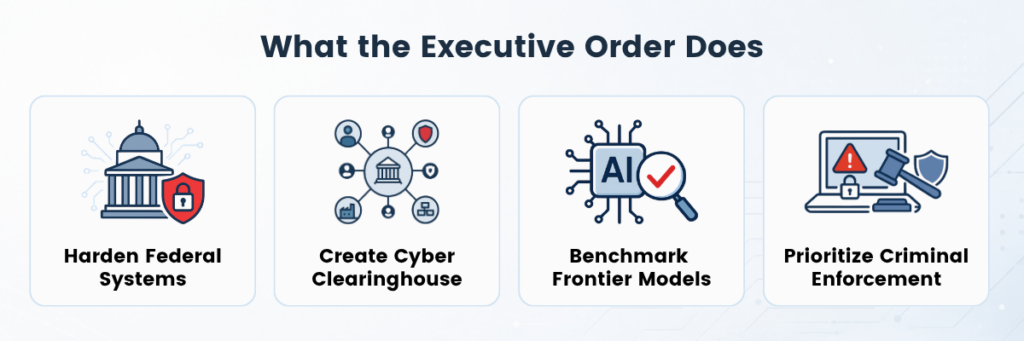
The Executive Order outlines four major actions: strengthening federal systems, creating a cyber clearinghouse, benchmarking frontier AI models, and prioritizing criminal enforcement.
Hardening government and critical infrastructure systems. The order directs the Cybersecurity and Infrastructure Security Agency (CISA), working with the Office of Management and Budget (OMB) and the National Cyber Director, to issue binding operational directives within 30 days prioritizing the cyber defense of civilian federal systems. Notably, the order extends the reach of these AI-enabled cybersecurity tools and services to state and local authorities and critical infrastructure operators—including rural hospitals, community banks, and local utilities. For contractors whose systems touch federal networks or support government operations, this represents a policy signal that the baseline security posture expected across the federal ecosystem is rising.
An AI cybersecurity clearinghouse. The Secretary of the Treasury, in coordination with the National Security Agency (NSA) and Cybersecurity and Infrastructure Security Agency (CISA), is directed to establish an AI cybersecurity clearinghouse within 30 days. This voluntary body—developed in collaboration with AI industry partners and critical infrastructure operators—will coordinate scanning for software vulnerabilities, validate those vulnerabilities, and prioritize remediation and patching efforts. The clearinghouse model reflects the administration’s preference for public-private partnership over top-down regulation: industry participation is voluntary, but the expectation of engagement is clear.
A framework for “covered frontier models.” Within 60 days, NSA, CISA, and the Treasury Department are directed to develop a classified benchmarking process to identify AI models with advanced cyber capabilities—designating them as “covered frontier models.” The order also calls for a voluntary framework through which AI developers can engage with the federal government before releasing these models, providing the government with a window of secure early access for trusted partners. Critically, the order expressly states that nothing in this section authorizes any mandatory licensing, preclearance, or permitting requirement for AI model development or release. The administration is drawing a deliberate line between security collaboration and regulatory gatekeeping.
Criminal enforcement. The Attorney General is directed to prioritize enforcement of existing federal criminal statutes against anyone who uses AI to illegally access or damage computer systems, steal data, or further other criminal activity.
What This Means for Federal Contractors
The order does not directly amend the Federal Acquisition Regulation (FAR), add new OFCCP obligations, or alter existing EEO requirements. However, federal contractors should read it in context.
First, the order accelerates the federal government’s adoption of AI-assisted cybersecurity tools across civilian agencies. Contractors whose systems interface with federal networks—through data sharing, system integrations, or software services—should expect their agency partners to begin operating under updated cybersecurity guidance issued pursuant to this order within the near term.
Second, contractors that are themselves developing or deploying AI tools—including AI-assisted applicant screening, video interviewing, resume review, or workforce planning products—are operating in a policy environment where the federal government is actively building frameworks to assess the security implications of advanced models. While the voluntary framework for “covered frontier models” is aimed at the most advanced AI systems and directed at AI developers, the broader trajectory of federal AI policy is toward greater scrutiny of how powerful models are built and deployed.
Third, the order’s emphasis on protecting American intellectual property from adversarial exploitation is directly relevant to contractors handling sensitive federal data or working in national security-adjacent industries. Data governance and cybersecurity hygiene remain areas where contractors should ensure their internal practices keep pace with federal expectations.
The Bigger Picture of the Federal Government’s Relationship with AI
This Executive Order is not an isolated action. It builds on the administration’s AI Action Plan from July 2025, its National Cyber Strategy released in March 2026, and national legislative framework for AI policy introduced earlier this year. The consistent throughline is an America First approach to AI leadership: prioritize innovation, resist unnecessary regulation, and address national security risks through coordinated public-private partnerships rather than prescriptive government mandates.
For HR compliance professionals, the practical takeaway is this: the federal government’s relationship with AI is maturing rapidly, and the infrastructure it is building—clearinghouses, benchmarking frameworks, expanded cybersecurity hiring pathways—will shape how agencies operate and what they expect from their contractor partners in the years ahead. Staying informed now means fewer surprises as those expectations become embedded in procurement and program requirements.
DirectEmployers will continue tracking developments as agencies begin implementing this order’s timelines. Members with questions about how evolving federal AI and cybersecurity policy may intersect with their HR compliance programs are encouraged to connect with their Membership Team, engage with peers in the DE Connect discussion forum, or attend upcoming Member Office Hours for real-time insights and support.
THIS COLUMN IS MEANT TO ASSIST IN A GENERAL UNDERSTANDING OF THE CURRENT LAW AND PRACTICE RELATING TO OFCCP. IT IS NOT TO BE REGARDED AS LEGAL ADVICE. COMPANIES OR INDIVIDUALS WITH PARTICULAR QUESTIONS SHOULD SEEK ADVICE OF COUNSEL.

Let’s chat!
Fill out this form to indicate which solutions you’re interested in and we'll contact you shortly to schedule a demo.