
Key Takeaways
- Programmatic job advertising uses software and data to automatically place, bid on, and optimize job ads across multiple channels in real time.
- The programmatic job advertising platform market is projected to more than double, from roughly $2.3 billion in 2025 to $5.7 billion by 2031, growing at about 16% annually.
- Growth is driven by shrinking recruitment budgets, tighter labor markets, and pressure to prove ROI on every advertising dollar.
- Employers using programmatic typically pay for performance (clicks or applies) instead of flat fees, often lowering cost-per-apply by 25–50% compared to traditional postings.
- Teams that wait risk competing for the same candidates against employers whose budgets are already optimizing themselves around the clock.
End of summary box.
If you buy job advertising the way most teams do, you know the routine: pick a job board, pay a flat fee, post the role, and hope. Maybe the posting delivers 40 qualified applicants. Maybe it delivers 400 clicks and three resumes. Either way, you paid the same price, and you probably won’t find out which outcome you got until the invoice has long since cleared.
That model is losing ground fast, and the numbers tell the story. Programmatic job advertising, once a niche tactic used mostly by high-volume employers, is becoming the default way recruitment media gets bought. Understanding why it’s growing, and what that growth means for your own strategy, is quickly moving from “nice to know” to “need to know” for high-performing talent acquisition leaders.
What Is Programmatic Job Advertising?
Programmatic job advertising is the use of software to automatically buy, place, and optimize job ads across job boards, aggregators, and other channels based on real-time performance data. Instead of a recruiter manually choosing where to post and paying a flat fee, algorithms decide where each job appears, how much to bid, and when to shift budget toward the sources producing actual applicants.
If that sounds familiar, it should. It’s the same logic behind the display ads that follow you around the web after you browse for running shoes. Consumer marketers stopped buying fixed ad placements years ago and let algorithms chase performance instead. Recruitment advertising is now going through the same shift, just a decade later.
How Fast Is Programmatic Job Advertising Growing?
The market data points one direction. According to Mordor Intelligence’s 2026 market analysis, the programmatic job advertising platform market is projected to grow from about $2.7 billion in 2026 to $5.7 billion by 2031, a compound annual growth rate of roughly 16%. North America leads adoption, generating close to 39% of global revenue, supported by mature applicant tracking system ecosystems and early uptake of AI-driven recruitment marketing. The shift toward automation runs deeper than media buying: the same analysis found 84% of talent acquisition leaders plan to deploy agentic AI in their workflows by 2026.
For context, programmatic already dominates consumer digital advertising. Basis reports that US programmatic digital display spending surpassed $187 billion in 2025, nearly 95% of all digital display ad spend, and is projected to top $220 billion in 2026. Recruitment is following the same curve. When a buying model wins in the broader ad economy, job advertising rarely stays exempt for long.
Why Is Programmatic Recruitment Growing So Quickly?
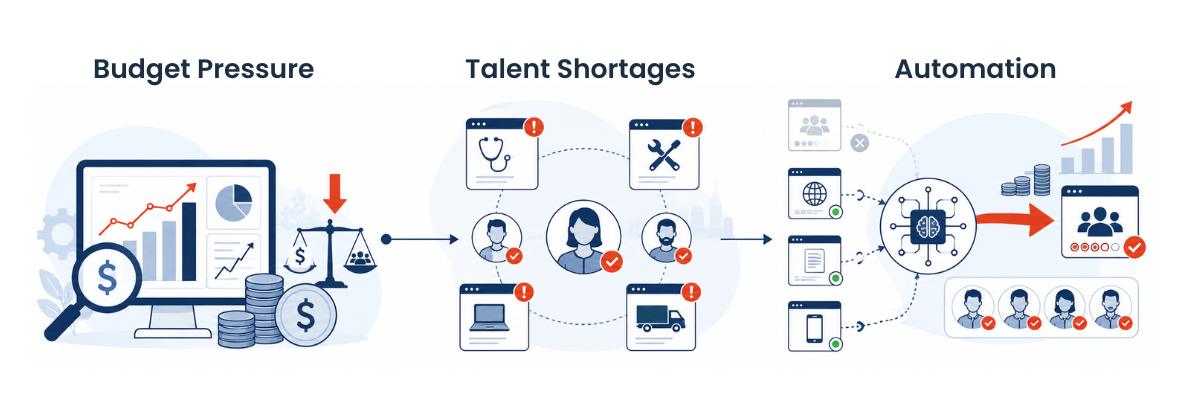
Three market forces are accelerating the adoption of programmatic job advertising: tighter recruiting budgets, ongoing talent shortages, and automated campaign optimization.
Three forces are converging, and fast.
Budgets are under a microscope
CFOs are asking talent acquisition the same question they ask marketing: what did we get for the money? Flat-fee postings can’t answer that. Programmatic platforms report cost-per-click, cost-per-apply, and in many cases cost-per-hire by channel, giving TA leaders the defensible numbers finance expects, and the results they need to move the hiring needle forward.
Labor markets stay stubbornly competitive
Specialized roles in hospitality, healthcare, technology, skilled trades, and logistics remain hard to fill. When candidates are scarce, spraying jobs across a few boards and waiting doesn’t work. Automated job distribution puts hard-to-fill roles in front of candidates wherever they actually search, and boosts spend on the postings that need help most.
Manual media buying can’t keep up
Picture a recruiter managing 60 open requisitions across a dozen job boards. Manually, she might review performance monthly and reallocate budget quarterly. A programmatic platform reviews performance continuously and reallocates in real time. In the manual scenario, an underperforming channel might quietly burn the budget for eight weeks. In the automated one, that spend shifts to a producing channel within days. Multiply that difference across every role and every channel, and the gap becomes a hiring advantage.
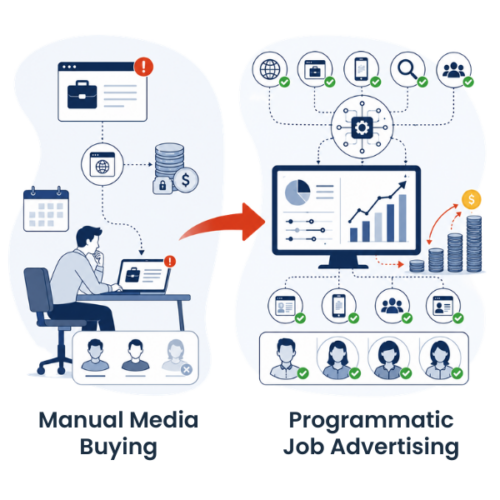
Programmatic job advertising replaces manual media buying with continuous optimization, automatically shifting recruitment spend toward the channels delivering the best results.
What Does This Mean for Your Recruitment Strategy?
The strategic implication is simple: your competitors’ job ad budgets are increasingly self-optimizing, and yours may not be. Every week a flat-fee posting underdelivers, an employer running programmatic recruitment is capturing the candidates you paid to reach.
That doesn’t mean ripping up your current approach overnight, or starting over entirely from scratch. It means asking better questions of your spend. Do you know your true cost-per-apply by channel? Can you shift budget mid-campaign when a source stops producing? Are you paying for outcomes or for placement?
What Should You Look for in a Programmatic Platform?
Evaluate vendors on four things:
- Pay-for-performance pricing tied to real outcomes
- Full-funnel reporting (clicks through applies and hires)
- Automated budget reallocation
- Transparency about where every dollar goes.
Finally, contract flexibility matters too; the market is moving fast, and long lock-ins work against you.
Incentives deserve special scrutiny. Ask each vendor how they make money and whether they profit when your spend goes up. This is one reason DE Amplify, the programmatic job advertising platform from DirectEmployers, stands out in vendor evaluations. As an employer-owned nonprofit founded to reduce online recruitment costs, DirectEmployers built DE Amplify around pay-for-performance pricing, complete spend transparency, and no long-term contracts. It’s also a return to the organization’s roots, as DirectEmployers has been helping employers navigate online recruitment since 2001.
Programmatic job advertising is growing because it fixes the core flaw in traditional recruitment advertising: paying fixed prices for variable results. With the market on pace to more than double by 2031, the question for TA leaders is no longer whether programmatic becomes standard, but whether your team adopts it before or after your competitors do.
Ready to see what optimized recruitment spend looks like for your open roles? Talk to the DirectEmployers team about DE Amplify and find out how far your budget can actually go.

Let’s chat!
Fill out this form and we'll contact you shortly to schedule a demo.