
Key Takeaways
- VEVRAA requires covered federal contractors to provide equal employment opportunity and take affirmative action for protected veterans.
- Protected veterans include disabled veterans, recently separated veterans, active-duty wartime or campaign badge veterans, and Armed Forces service medal veterans.
- Covered contractors must monitor veteran hiring and assess performance against the annual OFCCP hiring benchmark (5.1% for 2026).
- VEVRAA compliance obligations remain in effect despite changes affecting Executive Order 11246 requirements.
- Successful programs combine compliance activities—such as self-identification, outreach, and recordkeeping—with veteran recruitment, retention, and inclusion initiatives.
- Organizations can strengthen veteran hiring outcomes through partnerships, mentoring, employee resource groups, manager education, and veteran-focused recruiting strategies.
End of summary box.
Overview of VEVRAA Compliance
The Vietnam Era Veterans’ Readjustment Assistance Act (VEVRAA) requires covered federal contractors and subcontractors to provide equal employment opportunity for protected veterans and to take affirmative action to recruit, hire, retain, and promote qualified protected veterans. Many veterans may qualify as protected veterans under VEVRAA, depending on their military service history and discharge status. The specific categories of protected veterans are as follows:
- Disabled veterans
- Recently separated veterans
- Active-duty wartime or campaign badge veterans
- Armed forces service medal veterans
Audit and Review Process
Under the VEVRAA regulations, covered federal contractors and subcontractors must establish an annual benchmark for hiring protected veterans. For 2026, OFCCP has set the national protected veteran hiring benchmark at 5.1%. Most companies adhere to this guidance, but contractors have the option to come up with their own threshold using the guidelines provided in the regulations, though most use the national benchmark.
It’s not just about tracking how many veterans are hired. Covered federal contractors also need to meet VEVRAA requirements for outreach, ongoing recruitment, veteran self-identification, data collection and recordkeeping, as shared in DirectEmployers’ previous guide on VEVRAA compliance. What really makes sense is to have a good hard look at the VEVRAA compliance program at present, identify gaps in compliance, and keep the details of policies, procedures, tests, and actions on file to validate efforts to create equal opportunity and affirmative action-centered workplaces for protected veterans. Keeping all that paperwork on hand is key to showing they’re meeting regulatory demands and helps with internal review of how their program is working.
Understanding VEVRAA Obligations
By having a federal contract that meets the VEVRAA jurisdictional thresholds, updated from $150,000 to $200,000 for basic coverage in October 2025, organizations should conduct internal reviews to ensure their contractual obligations are being met. Beyond government compliance evaluations, which review policies and practices associated with VEVRAA amongst other areas, many organizations have participated in benchmarking efforts via surveys to monitor their efforts to support veterans in the workplace. In addition, many veteran-focused organizations have arisen, which help companies recruit, hire, and retain veteran talent. DirectEmployers is one of those entities that has a robust program to support not only the VEVRAA mandatory job listing component, but also by providing its Member companies with access to vetted partner organizations serving transitioning servicemembers, veterans, and military spouses.
Why Internal VEVRAA Process Reviews Matter
It’s important to note that the recent changes affecting affirmative action requirements related to race and gender under the now-rescinded Executive Order 11246 do not eliminate affirmative action obligations under VEVRAA (or Section 503 of the Rehabilitation Act). Those compliance obligation efforts should be ongoing, which include the collection of protected veteran self-identification data at the pre-offer, post-offer, and periodic (at least every 5 years) required by VEVRAA regulations.
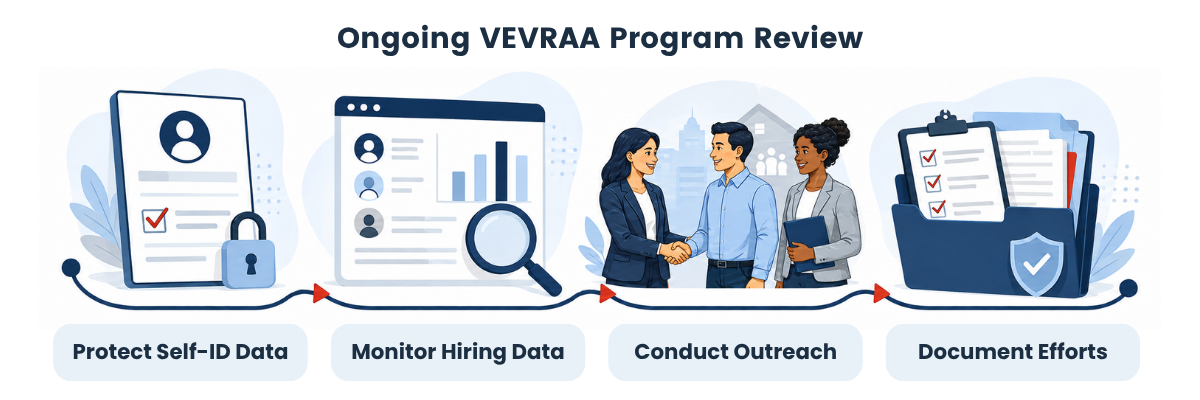
Organizations should closely monitor their veteran hiring efforts throughout the year, collecting veteran self-id information, monitoring against the annual hiring benchmark, and identifying and responding to any barriers to inclusion for veterans and documenting outreach efforts and their effectiveness. Conducting consistent internal reviews of the VEVRAA compliance program will assist in identifying focus areas and opportunities for improvement.
Six Strategies to Strengthen Veteran Hiring and Inclusion
Through my experience managing disability inclusion and VEVRAA compliance programs, I have participated in hundreds of compliance audits, many of which included a focus on VEVRAA compliance. As a veteran, former spouse of a retired veteran, and former OFCCP compliance officer, I bring both personal insight and regulatory experience to veteran inclusion. That perspective has helped me manage compliance programs that not only meet regulatory expectations but also strengthen workplace belonging for veterans. The strategies below reflect approaches I have found useful for supporting veteran hiring and inclusion; otherwise, organizations risk ongoing veteran turnover. In my experience managing veteran inclusion programs, veterans often demonstrate strong retention when organizations provide effective onboarding, mentoring, and support during their transition to civilian employment. While the list is not exhaustive, it offers a practical roadmap for strengthening veteran hiring and inclusion efforts.
1. Maintain Confidentiality of Veteran Self-Identification Data
There is only one permissible use of information collected during the self‑ID process is for the required government reporting—ONLY. As a result, access should be limited to individuals responsible for VEVRAA compliance or others with a legitimate business reason need to know. Not all veterans choose to self-identify, therefore, trust in the confidentiality of the process is essential. Clearly defining the protected veteran categories is also important, as many veterans may not view themselves as “protected”, or may be unfamiliar with the definitions. Consider including a description of each category of protected veteran or include a link to the government definitions so veterans can review the categories during the self‑ID process. As mentioned before, conducting an annual analysis of progress toward the hiring benchmark can be helpful in identifying opportunities within your strategy. And finally, monitor veteran hiring in a way that aligns with the company’s organizational structure, rather than limiting the analysis to Affirmative Action job groups previously established under the now-rescinded Executive Order 11246.
 2. Build a Veteran-Inclusive Workplace Culture
 2. Build a Veteran-Inclusive Workplace Culture
Use self‑ID information only for required government reporting, and limit access to individuals responsible for VEVRAA compliance or others with a legitimate need to know. Not all veterans may choose to self-identify, therefore, trust in the confidentiality of the process is essential. Clearly defining the protected veteran categories is also important, as many veterans may not view themselves as “protected”, or may be unfamiliar with the definitions. Consider including a link to the government definitions so veterans can review the categories during the self‑ID process. As mentioned before, conducting an annual analysis of progress toward the hiring benchmark can be helpful in identifying opportunities within your strategy. And finally, monitor veteran hiring in a way that aligns with the company’s organizational structure, rather than limiting the analysis to job groups previously established under the now-rescinded Executive Order 11246.
Recruitment and Career Site Experience
Ensuring your corporate career site is welcoming to veterans and their families can go a long way. Tools like Recruit Rooster’s military occupational specialty/code (MOS/MOC) crosswalk can help veterans connect their military experience to civilian roles and recruiters better evaluate transferable skills. When possible, identify recruiters with military experience or train the teams to effectively help interpret military terminology in applications and resumes.
Manager Awareness and Compliance
Ensure managers who supervise employees in the National Guard or Reserves understand and support Uniformed Services Employment and Reemployment Rights Act (USERRA) requirements, particularly when employees are called to report for drill, training, maneuvers as a Reservist, National Guard service, or active military service or deployment. It is also vitally important that Manager’s understand their company’s policies and procedures relating to military absences and leaves of absence programs available to Active and Reservist personnel.
A Year-round Focus on Belonging
Military-friendly organizations build programs and practices that consistently reinforce that veterans belong. While Memorial Day and Veterans Day activities are meaningful, veteran-focused engagement should extend throughout the year. Celebrating veterans through employee spotlights or even commemorating military branch birthdays internally act as great ways to recognize your efforts to establish belonging and support for veteran employees.
3. Support Veteran Employee Resource Groups
Has your organization created an employee veteran resource group? Many organizations use employee resource groups (ERGs), while more established groups may be called business resource groups (BRGs). In either case, their mission should align with the organization’s broader strategy and focus on supporting veterans. Less formal groups may simply be called affinity groups. Like other resource groups, veteran groups should be open to all employees regardless of military service, guided by a clear mission, and focused on the support the group is intended to provide. Intentionally including military spouses, children, Gold Star families and other family members are valuable allies that can significantly strengthen support for veterans.
4. Develop Veteran Recruitment Partnerships
Many military, veteran support, military-to-civilian transition service organizations operate at both local and national levels and can serve as valuable sources for veteran candidates. Employers should intentionally identify organizations in their recruiting areas, as well as national partners that can support veteran outreach. DirectEmployers Members can take advantage of the Association’s dedicated partnerships team and Partner Relationship Manager (PRM) tools to help with these outreach efforts. They should also strategically participate in veteran-focused job fairs, whether hosting in-person or virtually. For employers located near military installations, building relationships with military transition teams can help create a consistent pipeline of veteran candidates.
5. Review Job Requirements and Qualifications
 5. Review Job Requirements and Qualifications
Periodically assess job descriptions and qualification standards to ensure requirements are current, job-related, skills-based, and not unnecessarily exclusionary. As with reviews intended to support individuals with disabilities, employers should consider how requirements may affect veterans, including veterans with disabilities. Recruit Rooster’s military occupational specialty/code (MOS/MOC) crosswalk can also be a useful tool during the recruiting process to help align your open roles with military service occupations and/or specialties.
6. Create Veteran Mentorship or Alliance Programs
Consider establishing mentors or sponsors to help veterans transition into corporate roles and navigate career growth. Advancement in a corporate environment is often unfamiliar, less structured and transparent than in the military, which can make promotions, transfers, and role changes difficult to understand for employees who are new to civilian workplaces. Cross-mentoring programs can also help leaders better understand the value veterans bring to the workforce. An alliance program may also be very helpful to the transitioning service member. A ‘Battle Buddy’ may be assigned to your new employee to assist with day-to-day questions or navigating the things that may be new for the Vet. Veterans often contribute strengths such as teamwork, leadership, structure, discipline, attention to detail, creativity, and other skills developed through military service that may not be immediately recognized by those without military experience.
Like with anything, consistency is key! If you have any questions regarding the information provided, or wish to learn more about my experience managing hundreds of compliance audits, I would be happy to serve as a resource to discuss veteran hiring programs and your efforts to comply, in more detail. While the list above offers a starting foundation for VEVRAA compliance and veteran inclusion activities, it’s simply that, a starting point for inspiration and continued evolution. For further details on VEVRAA requirements as well as veteran hiring-specific education, I recommend reviewing the plethora of blog posts and resources available in DE Connect.

Alicia Wallace
Consultant, AHall Consult, LLC
Alicia Wallace, MBA, SHRM-CP, Sr. CAAP, is an accomplished HR compliance and EEO/AA professional with more than 25 years of experience guiding organizations through complex regulatory landscapes. Now stepping into the role of Consultant with DirectEmployers Association, Alicia brings deep expertise in corporate-level compliance, affirmative action, and diversity, equity, and inclusion–particularly in the areas of disability and veteran initiatives. Throughout her career, she has successfully managed hundreds of OFCCP audits, including multiple Glass Ceiling (Corporate Management) reviews and complaint investigations, earning a reputation as a trusted subject matter expert and strategic advisor.
Alicia has extensive experience partnering with business leaders, HR teams, and internal and external counsel to navigate EEO requirements, affirmative action planning, charge investigations, and diversity strategy. Her background also includes state-level EEO compliance, pay reporting, diversity analytics, and supporting procurement and sourcing teams with RFP and RFI data reviews. Known for her energetic, “can-do” approach, Alicia thrives in disciplined, fast-paced environments that demand change management, thoughtful risk-taking, and continuous improvement. Guided by a commitment to lifelong learning, she approaches her work with the belief that there is always an opportunity to be better every day–both for herself and for the organizations she supports.