
Key Takeaways
- Many everyday tools—closed captioning, typewriters, curb cuts, ergonomic handles, and texting—were originally designed to solve a specific disability-related need, then went mainstream because they made life easier for everyone.
- This pattern is known as the “curb-cut effect”: solutions built for accessibility often become universal upgrades.
- Workplace accommodations shouldn’t be viewed as compliance costs. They frequently function as process improvements that reduce friction, streamline workflows, and benefit entire teams.
- People with disabilities bring lived problem-solving experience that can uncover blind spots in product design, hiring processes, and workplace systems.
- This National Disability Employment Awareness Month (NDEAM), talent and EEO leaders have an opportunity to reframe disability inclusion as a driver of innovation and competitive advantage, not just a regulatory checkbox.
End of summary box.
Look around your desk, your kitchen, or the street outside your office.
Chances are high that you have tapped a keyboard, held a comfortably contoured tool, utilized talk-to-text when you’re in a hurry, or used closed captioning to follow along better. We often take these conveniences for granted, viewing them as triumphs of consumer design or modern convenience. Yet a surprising number of our most ubiquitous tools share a common origin: they were created by or for individuals with disabilities.
Each October, National Disability Employment Awareness Month (NDEAM) encourages organizations to reflect on the value individuals with disabilities bring to the workforce. While workplace discussions around disability often center on legal compliance or accommodations, that lens misses a much larger truth. Designing for accessibility drives breakthrough innovation that improves life for everyone.
Here are five everyday innovations born from disability-centered design, and what their origins teach us about inclusion in today’s workforce.
Closed Captioning: From Niche Accommodation to Everyday Essential
Closed captioning debuted in the 1970s through broadcast experiments and gained broad adoption after the Television Decoder Circuitry Act of 1990 required built-in caption decoders in U.S. televisions. The goal was straightforward: ensure that millions of deaf and hard-of-hearing viewers could access news, entertainment, and emergency broadcasts.
Over the past decade, caption use has exploded across the general population. From patrons watching muted screens in noisy airports and gym lobbies to office workers reviewing social video clips with sound turned off, captions have become the default mode of video consumption. Recent surveys show that a clear majority of younger viewers regularly keep subtitles switched on, relying on text to catch rapid dialogue, track complex accents, and retain information more effectively.
The Typewriter: A Private Voice for the Blind
Long before computer keyboards and smartphones, writing was an entirely manual, ink-and-quill endeavor. In the early 1800s, Italian inventor Pellegrino Turri wanted to solve a specific problem for his friend, Countess Carolina Fantoni da Fivizzano, who had lost her sight.
At the time, visually impaired individuals could not write letters independently; they had to dictate their private thoughts to an assistant. To restore the Countess’s privacy and independence, Turri built an early mechanical typing machine paired with blackened paper that transferred ink onto the page, an early precursor to carbon paper.
Turri’s solution allowed someone without sight to compose legible text without a pen. Decades later, commercial inventors refined the mechanical keyboard concept into standard office typewriters, revolutionizing global business administration and paving the way for the digital input devices powering modern work.
Curb Cuts: The Architecture of Universal Ease
If you have ever wheeled luggage through an airport, pushed a stroller down the street, or rolled a cart of office supplies between buildings, you have benefited from the “curb-cut effect.”
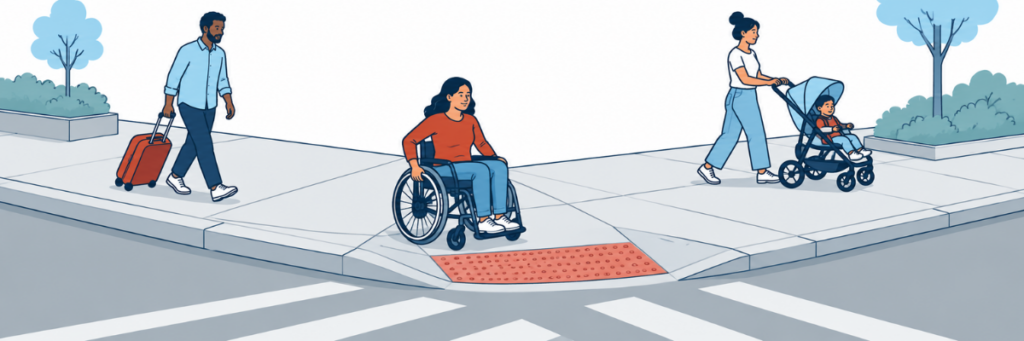
The curb-cut effect: removing barriers for wheelchair users also makes everyday travel easier for people pushing strollers or pulling luggage.
Until the mid-20th century, sidewalks ended in sheer vertical drops of several inches. For wheelchair users, crossing a street meant navigating a dangerous physical barrier or relying on bystanders for assistance. In the late 1960s and early 1970s, disability rights activists at UC Berkeley, including Ed Roberts and the student activist group known as the “Rolling Quads,” demanded change. Activists even went so far as to pour makeshift asphalt ramps in the middle of the night to prove how necessary they were.
Their advocacy led Berkeley to install the first municipal curb cuts in 1972, laying the groundwork for federal mandates under the Americans with Disabilities Act (ADA). Once those concrete ramps were cut into the curbs, urban planners discovered that nearly everyone used them. What began as an accommodation for a specific group permanently upgraded the baseline of public infrastructure.
OXO Good Grips: Rethinking the Handle
In the late 1980s, Sam Farber, a retired housewares executive, was cooking in France with his wife Betsey, who had arthritis in her hands. She struggled with their metal vegetable peeler, its thin handle digging painfully into her joints. Rather than accept that as a fact of life, Farber partnered with the design firm Smart Design to build a peeler with a soft, wide, oval handle that was easy to grip regardless of hand strength or size.
The 1990 launch of OXO’s Good Grips line proved something the housewares industry hadn’t fully believed: tools designed for people with limited hand mobility could outsell the “standard” versions, because it turns out nobody actually enjoys a tool that hurts to hold. OXO never marketed Good Grips as an adaptive or medical product. It marketed comfort, and comfort sold.
Their advocacy led Berkeley to install the first municipal curb cuts in 1972, laying the groundwork for federal mandates under the Americans with Disabilities Act (ADA). Once those concrete ramps were cut into the curbs, urban planners discovered that nearly everyone used them. What began as an accommodation for a specific group permanently upgraded the baseline of public infrastructure.
Text-Based Communication: More Than Convenience
Long before “text me” was a common phrase, the Deaf community was already texting. In 1964, Deaf scientist Robert Weitbrecht invented the TTY, a teletypewriter that let Deaf and hard-of-hearing people type messages to one another over phone lines, using shorthand like GA for “go ahead” the same way we now use LOL or BRB. For decades, TTY was the primary way Deaf people communicated remotely, building the norms and expectations around real-time text conversation that SMS would later scale to the entire population. When cell phone texting finally went mainstream in the early 2000s, it gave the Deaf community something TTY never could: the ability to text anyone, anywhere, without special equipment, dramatically reducing dependence on relay operators for something as simple as scheduling an appointment.
What This Means for Workplace Talent and Innovation
These examples reflect a foundational principle of universal design: solving a constraint for one group of people often uncovers a better solution for everyone.
When we carry this lesson into talent acquisition and workforce planning, the implications are profound:
-

Including people with disabilities in design and decision-making brings perspectives that can uncover barriers and improve how teams work.
Accommodations aren’t burdens; they are process improvements meant to level the environment. Flexible schedules, asynchronous communication tools, screen-reader compatible platforms, and adjustable workstations are often introduced to accommodate specific employees. In practice, these adaptations streamline workflows, reduce burnout, and clarify communication across entire teams.
- Lived experience creates unique problem-solving. People with disabilities navigate a world built without their needs in mind every single day. That constant friction fosters creative adaptability, resilience, and analytical problem-solving. When you bring those perspectives into product development, software architecture, marketing, and leadership roles, your organization identifies blind spots that others overlook, creating opportunities for advancement and growth.
- Disability inclusive systems attract broader talent pools. Accessible application processes, transparent and inclusive job descriptions, and supportive onboarding do not merely help candidates with disabilities; they remove unnecessary barriers for career changers, caregivers, and candidates from varied backgrounds participate in the workforce.
Reframing Disability Employment This NDEAM
NDEAM reminds us that disability inclusion is not a checklist item, a one-time-of-year activity, or an act of corporate goodwill. It is a vital driver of organizational agility, design thinking, and lasting competitive advantage.
When employers actively recruit, hire, and advance individuals with disabilities, they aren’t just opening doors to valuable talent. They are inviting the kind of insight that challenges legacy assumptions, rethinks old tools, and invents the workplace solutions of tomorrow.
The roles of talent and EEO leaders go beyond meeting regulatory benchmarks. It is about recognizing that when we design our organizations for accessibility, everyone works, collaborates, and succeeds more effectively.