
Key Takeaways
The traditional hiring model is no longer broken—it is outdated. While employers struggle to fill roles, the core issue is not a lack of talent, but the reliance on legacy signals like degrees and job titles that fail to capture modern, non-linear skill development. By transitioning to a skills-based hiring model, organizations can unlock vast untapped talent pools, reduce hiring risk, and see measurable performance gains, including retention rates up to 10 percentage points higher. Modernizing your approach means moving beyond proxies to evaluate demonstrated capability, ensuring your hiring strategy evolves as fast as the roles themselves.
This article was originally published on Inside INdiana Business on Friday, April 17, 2026.
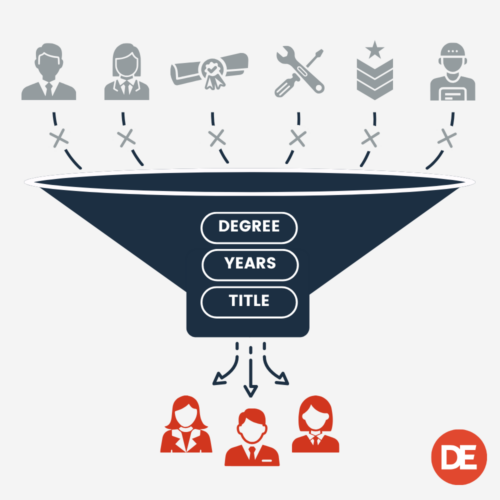 Across industries, employers are raising the same concern: they can’t find the talent they need.
Open roles persist. Hiring timelines are extending. Workforce shortages continue to dominate business conversations. But there is a more fundamental issue beneath that narrative. The challenge is not simply the availability of talent. It is whether the systems used to evaluate that talent reflect how work—and workers—have changed.
Millions of jobs remain unfilled across the country. At the same time, individuals are working, training, and actively seeking opportunities to advance. Employers are investing in workforce development. States are expanding training programs. Education providers are building pathways into high-demand industries.
The supply of talent has not disappeared. The system used to identify it has not kept pace.
For decades, hiring has relied on a consistent set of signals: degrees, job titles, years of experience, and institutional pedigree.
Historically, those signals provided an efficient way to evaluate candidates at scale. Today, they are increasingly imprecise.
Skills are no longer developed through a single, linear pathway. They are built through certifications, work-based learning, military experience, short-term training programs, and on-the-job application. At the same time, roles themselves are evolving more quickly, shaped by technology and shifting business needs. Yet many hiring systems continue to filter candidates based on assumptions and outdated job requirements that no longer reflect how capability is developed. The result is measurable.
Qualified candidates are screened out before they are evaluated. Employers narrow their own talent pools in an already competitive market. Workforce investments struggle to translate into hiring outcomes. This is not a broken system; it is an outdated one, and employers are beginning to recognize the need for change.
Seventy percent of employers report using some form of skills-based hiring, according to the National Association of Colleges and Employers. At the same time, traditional screening tools are already losing relevance. In 2019, nearly three-quarters of employers screened candidates based on GPA. Today, that number has dropped to 42 percent.
These shifts signal movement, but they also reveal a gap.
Removing degree requirements or adjusting screening criteria is only a first step. In many cases, hiring practices have not fundamentally changed. Evaluation methods still rely on proxies rather than demonstrated capability. The result is a disconnect between hiring strategy and hiring execution—and the urgency of this shift is increasing.
Roles are evolving more rapidly, driven by technology, automation, and changing business models. Employers need workers who can adapt, not just meet static requirements. At the same time, expectations around hiring are becoming more complex. Federal contractors, who employ roughly one in five U.S. workers, must meet requirements related to documentation, transparency, accessibility, and nondiscrimination under federal oversight.
In this environment, imprecise hiring systems are no longer just inefficient. They introduce risk.
Employers are expected not only to fill roles but to demonstrate how hiring decisions are made and to ensure those decisions are consistent, defensible, and effective. That is difficult to achieve when hiring relies on outdated signals.
Updating hiring systems does not mean lowering standards. It means defining them more clearly.
A modern approach requires:
- Clear definition of skills and competencies tied to job performance.
- Evaluation methods that measure capability, not just credentials.
- Consistency in hiring practices supported by data and documentation.
- Alignment between training pathways and job requirements.
This is where skills-based hiring becomes operational. Research shows that skills-based approaches can expand talent pools by identifying qualified candidates who would otherwise be overlooked.
The business case is also becoming clearer. Employers that effectively implement skills-based hiring are seeing higher retention rates among non-degree hires—by as much as 10 percentage points—along with measurable wage growth. This is not simply a workforce strategy. It is a performance strategy.
The issue isn’t that talent is missing. It’s that hiring hasn’t kept up.
In a labor market that’s changing this quickly, how companies evaluate talent matters more than ever.
Organizations that rethink how they define roles, assess candidates, and connect people to work will have an advantage. They’ll move faster, compete more effectively, and build stronger teams. Those that don’t will keep running into the same problem—struggling to fill roles while qualified talent goes overlooked.

About the Author
Jeff Gill
Executive Director, DirectEmployers
A seasoned business executive, Jeff brings a wealth of experience to the Association through his expansive career in information technology. He is currently responsible for leading a team of over 60 people across eight departments, helping to propel DirectEmployers’ mission and impact to new heights. Prior to joining DirectEmployers, Jeff served as Chief Information Technology Officer at HR Logics, a company specializing in compliance management solutions and software that support HR efficiency.