
Key Takeaways
On June 4, 2026, the EEOC formally approved a new National Enforcement Plan (NEP) covering fiscal years 2025–2029, replacing the agency’s previous Strategic Enforcement Plan. The NEP reaffirms the EEOC’s three-pronged approach to eliminating workplace discrimination: prevention through education and outreach, voluntary dispute resolution, and strong merit-based enforcement through litigation. Critically, the plan signals a sharpened focus on intentional discrimination, cases with broad industry-wide impact, and the application of recent Supreme Court precedent—areas directly relevant to federal contractors managing hiring, promotion, and employment policies at scale. EEOC enforcement authority has not changed; the NEP is an internal compass that tells compliance professionals where the agency’s investigative and litigation resources are most likely to be directed through 2029.
End of summary box.
Between the proposed rescission of EEO-1 reporting requirements and ongoing leadership shifts across federal contractor oversight agencies, it would be easy to assume the Equal Employment Opportunity Commission (EEOC) is in a period of quiet. However, the agency’s June 4 release of a new National Enforcement Plan (NEP) puts that notion to rest.
The NEP is the agency’s foundational roadmap for how it deploys its enforcement and litigation resources. It reaches into every corner of EEOC operations—outreach and education, mediation and conciliation, investigation, and federal court litigation. When the EEOC publishes a new plan, it is telling employers, advocates, and legal practitioners alike what it will be looking for—and where it is willing to go to court.
For federal contractors, that signal is worth reading carefully.
What the NEP Is & What Changed
The EEOC’s new National Enforcement Plan replaces the FY 2024–2028 Strategic Enforcement Plan. The name change is not merely cosmetic. It reflects a deliberate repositioning of the document as an operational enforcement guide rather than a broader strategic framework.
In announcing the plan, EEOC Chair Andrea Lucas described the document as sharpening the agency’s focus on protecting equal opportunity for all Americans by prioritizing intentional discrimination and ensuring every worker is treated as an individual under the law. The NEP reaffirms the agency’s three-pronged approach:
- prevention through education and outreach;
- voluntary resolution of disputes through Alternative Dispute Resolution, pre-determination settlements, and conciliation agreements;
- and strong, evenhanded enforcement and litigation.
The plan remains in effect until superseded, modified, or withdrawn by a majority vote of the Commission—so absent a change in agency composition or priorities, the priorities outlined here will guide EEOC activity through at least FY 2029.
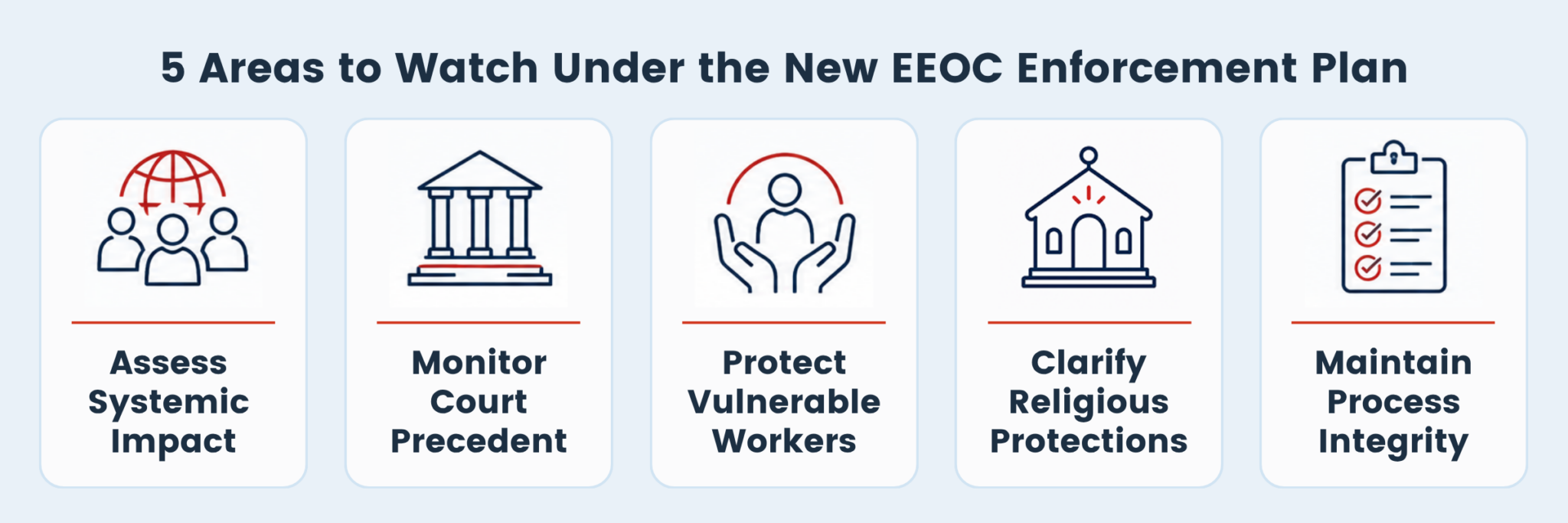
The Enforcement Priorities Federal Contractors Should Note
The NEP identifies several categories of substantive enforcement priorities. Taken together, they paint a clear picture of where the EEOC intends to concentrate investigative and litigation resources:
- Cases with broader impact: The EEOC will prioritize matters that extend beyond the individual parties, including repeated, overt, or facially discriminatory policies and broad-based employment programs or practices that result in intentional discrimination. For contractors with enterprise-wide hiring systems, performance management frameworks, or AI-assisted screening tools, this is a meaningful signal.
- Supreme Court precedent and unresolved legal questions: The plan explicitly calls out cases involving recent Supreme Court decisions and unresolved issues of statutory interpretation, including conflicts among federal circuits. Given the significant employment discrimination rulings of recent years, contractors should expect the EEOC to actively test the boundaries of those decisions in litigation.
- Protecting vulnerable workers: Cases involving workers who may face heightened barriers to asserting their rights remain a stated priority. For contractors operating in industries with diverse, distributed, or contingent workforces, this warrants attention.
- Religious organizations and employers: The NEP’s appellate program will focus on cases that clarify constitutional and statutory limitations on liability for religious organizations and religious employers—a notable inclusion that aligns with broader themes of this administration’s approach to workplace religious protections, as we also saw in the appointment of OFCCP Director Kenneth J. Wolfe, who is serving in dual roles as both the Director of the Center for Faith and the Director of the OFCCP.
- Enforcement process integrity: The plan also prioritizes cases involving the effectiveness of the Commission’s own investigative and conciliation processes. Contractors should understand that delays, incomplete document production, or failure to engage meaningfully in conciliation can itself become a focus of agency attention.
What This Means for Federal Contractors
Federal contractors are subject to the EEOC’s authority just like any other private employer—and in many cases, their employment practices operate at a scale that makes them more likely to surface the kind of broad-based, systemic discrimination patterns the NEP explicitly targets.
Several practical considerations follow from this plan:
- Audit hiring and promotion policies for facially neutral practices with disparate impact. The NEP’s emphasis on broad-based policies affecting large groups of workers is a direct cue to review enterprise-wide employment practices—from job qualifications and screening criteria to compensation structures—for unintentional discrimination exposure.
- Document your conciliation engagement. The NEP’s emphasis on enforcement process integrity signals that the EEOC will be paying close attention to how employers respond during the charge investigation and conciliation phase. Contractors should ensure their HR and legal teams are responding thoroughly and in good faith to agency inquiries.
- Keep pace with Supreme Court developments. With the NEP explicitly directing resources toward cases shaped by recent high court precedent, contractors should work with counsel to understand how those rulings affect their current employment policies—particularly in the areas of disparate treatment and religious accommodations.
The EEOC’s National Enforcement Plan is a document worth bookmarking. It is not a new law, and it does not alter existing compliance obligations—but it tells federal contractors precisely where the agency intends to look, litigate, and set legal precedent for the next several years.
In a regulatory environment that has been anything but static, the NEP is a rare piece of clarity. HR compliance professionals should use it as a planning tool: map your highest-exposure employment practices against these stated priorities and address any gaps proactively, in consultation with in-house or external counsel.
DirectEmployers will continue monitoring EEOC developments and issuing updates as the agency’s enforcement activity evolves under this new plan. Members with questions are encouraged to connect with their Membership Team, engage with peers in the DE Connect discussion forum, or attend upcoming Member Office Hours for real-time HR compliance insights and support.
THIS COLUMN IS MEANT TO ASSIST IN A GENERAL UNDERSTANDING OF THE CURRENT LAW AND PRACTICE RELATING TO OFCCP. IT IS NOT TO BE REGARDED AS LEGAL ADVICE. COMPANIES OR INDIVIDUALS WITH PARTICULAR QUESTIONS SHOULD SEEK ADVICE OF COUNSEL.

Let’s chat!
Fill out this form to indicate which solutions you’re interested in and we'll contact you shortly to schedule a demo.