
Key Takeaways
On June 9, 2026, the Department of Justice’s Office of Legal Counsel (OLC) issued a formal opinion letter to the Equal Employment Opportunity Commission (EEOC) concluding that its longstanding guidelines on disparate-impact liability under Title VII of the Civil Rights Act are unconstitutional. The OLC found that EEOC’s current interpretation—which can hold employers liable for unequal hiring or promotion outcomes across demographic groups without regard to intent—effectively pressures employers into race-based decisionmaking. The opinion reframes what disparate-impact liability actually requires: a demonstrated link between a specific employment practice and the unequal outcome, a lower bar for the business-necessity defense, and a stricter burden on plaintiffs to identify a workable alternative. This is not a change in federal law—Title VII remains in effect—but it is a significant shift in how the federal government interprets and intends to apply it. Federal contractors using broad screening tools, automated selection systems, or enterprise-wide hiring criteria should treat this opinion as a timely prompt to review their practices in consultation with legal counsel.
End of summary box.
The regulatory landscape for federal contractors in 2026 has been anything but static. Between the EEOC’s new National Enforcement Plan, proposed rescissions of EEO-1 reporting requirements, and the growing patchwork of artificial intelligence (AI) regulations, HR compliance professionals have had no shortage of developments to track. Add the latest to the list: on June 9, 2026, the Department of Justice issued a press release and a formal opinion letter to the Equal Employment Opportunity Commission (EEOC) concluding that its guidelines on disparate-impact liability under Title VII of the Civil Rights Act are unconstitutional if solely applied.
This is a consequential signal—not because the law has changed overnight, but because it tells employers, including federal contractors, precisely how the current administration views one of the most debated doctrines in employment discrimination law.
What the Opinion Is & What It Isn’t
The Department of Justice’s Office of Legal Counsel (OLC) serves as the authoritative legal advisor to the President and executive branch agencies. When OLC issues a formal opinion, it carries significant weight in shaping how federal agencies interpret and enforce the law.
The June 9 opinion letter was issued directly to EEOC Chair Andrea Lucas, who had formally requested OLC’s analysis of whether disparate-impact provisions under Title VII—as currently interpreted and applied by the EEOC, particularly through its Uniform Guidelines on Employee Selection Procedures (UGESP)—are constitutional. The OLC’s answer: they are not, as currently applied. UGESP remains codified at 29 C.F.R. Part 1607. The OLC opinion doesn’t repeal it—it’s still on the books. OLC is an executive branch advisor, not a court or legislature.
It’s important to note: this opinion does not repeal Title VII. Congress enacted disparate-impact liability into statute through the Civil Rights Act of 1991, and courts—not the DOJ—have the final say on constitutional questions. What the opinion does do is formally position the executive branch against the EEOC’s existing interpretive framework and set the stage for revised agency guidance, regulatory action, and a changed posture in federal enforcement.
The Core Legal Argument, in Plain Language
At the heart of the OLC’s opinion is this finding: the EEOC’s guidelines treat unequal outcomes as sufficient, on their own, to create liability—without requiring evidence that the employer acted with discriminatory intent. The OLC argues this approach effectively functions as a “racial-proportionality mandate,” pressuring employers to make hiring decisions based on demographic composition rather than individual merit.
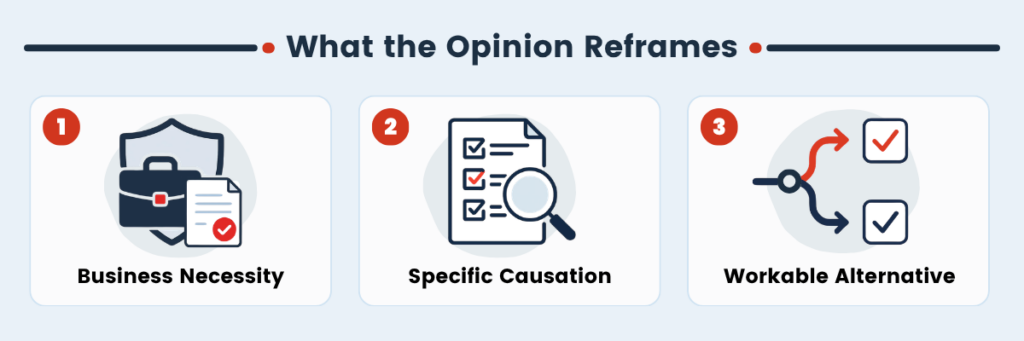
The opinion outlines three specific corrections to how disparate-impact liability should be understood:
- Business necessity is a lower bar than the EEOC has set. Employment practices, including aptitude tests, background checks, knowledge-based assessments, and SAT scores, are presumptively job-related. To avoid liability, employers need only show that a challenged practice is rational, useful, or serves a valid business purpose. Only irrational or arbitrary practices with no plausible job-relatedness can give rise to a disparate-impact claim.
- Plaintiffs must establish specific causation. A plaintiff cannot point to unequal aggregate outcomes and call it a day. Under the opinion’s framework, the plaintiff must demonstrate that the specific employment practice being challenged—not external factors, not other policies—directly caused the unequal outcome at issue.
- Plaintiffs must identify a workable alternative. To succeed on a disparate-impact claim, a plaintiff must also show that an equally effective alternative practice exists and would produce fewer unequal outcomes. Vague assertions that a better approach “could” exist are not enough.
The opinion also takes direct aim at two categories of EEOC regulations it finds unlawful under this framework: existing validation-study requirements and certain affirmative-action regulations tied to disparate-impact compliance.
What This Means for Federal Contractors
Federal contractors already navigate a layered HR compliance environment—Title VII, Section 503, VEVRAA, and OFCCP oversight, among others. The DOJ’s opinion adds a new dimension to that picture.
A few practical considerations are worth noting:
Screening tools, preemployment assessments, and selection procedures. Federal contractors who rely on standardized assessments, automated screening tools, or uniform qualification thresholds should understand that the OLC’s opinion shifts the legal framing in their favor—but does not eliminate the need for validation testing and documentation. If a challenged practice is subject to a disparate-impact claim, the ability to articulate a clear, rational business justification remains essential.
Don’t mistake a favorable opinion for a green light to stop monitoring outcomes. The EEOC’s National Enforcement Plan (NEP), released just days before this opinion, continues to direct resources toward intentional discrimination and broad-based employment practices affecting large groups of workers. The agency’s enforcement authority has not changed, and federal contractors operating at scale remain a natural focus for systemic investigations
Litigation uncertainty remains. The OLC’s opinion reflects the executive branch’s legal view. Until federal courts weigh in—and the opinion itself acknowledges ongoing circuit-level legal tensions—employers should assume the question is not fully settled. Seeking in-house or external legal counsel engagement on any high-exposure hiring practices remains the right move.
What’s Next?
This opinion is part of a broader pattern: the current administration is methodically recalibrating how federal agencies interpret and enforce anti-discrimination law, and doing so through formal legal mechanisms that carry real operational weight. For federal contractors, the directive is neither to panic nor to stand firmly in place.
The right response is informed, proactive engagement: understand how your organization’s selection procedures and employment practices map to this shifting framework, document the business rationale for every major hiring criterion, and work with in-house or external legal counsel under privilege to evaluate whether any existing policies carry exposure under either the old or the new interpretive standard, and document, evidence, or memorialize any changes that are made.
DirectEmployers will continue tracking developments as the EEOC responds to this opinion and as courts address the constitutional questions it raises. Members with questions are encouraged to connect with their Membership Team, engage with peers in the DE Connect discussion forum, or attend upcoming Member Office Hours for real-time compliance insights.
THIS COLUMN IS MEANT TO ASSIST IN A GENERAL UNDERSTANDING OF THE CURRENT LAW AND PRACTICE RELATING TO OFCCP. IT IS NOT TO BE REGARDED AS LEGAL ADVICE. COMPANIES OR INDIVIDUALS WITH PARTICULAR QUESTIONS SHOULD SEEK ADVICE OF COUNSEL.

Let’s chat!
Fill out this form to indicate which solutions you’re interested in and we'll contact you shortly to schedule a demo.