
Key Takeaways
A Stanford study of 3.4 million real job applicants found that more than 25% of applications from Black candidates and nearly 15% from Asian candidates were directed to positions that produced adverse impact under Title VII standards. That risk was not visible in aggregate data and only surfaced through position-by-position analysis, which is the same standard U.S. employment law already requires. The study also found that when multiple employers rely on the same algorithmic vendor, candidates rejected in one role face systematically higher rejection rates across others, a pattern researchers call “algorithmic monoculture.” For employers, the compliance implications are clear: accountability for AI-driven hiring decisions remains with the organization under the Americans with Disabilities Act and Title VII, regardless of whether a vendor or a human made the decision. Governance, not technology, is the most urgent gap most organizations need to close.
End of summary box.
Most organizations didn’t set out to create an HR compliance problem when they adopted AI hiring tools. They set out to move faster, hire better, and create a stronger workforce.
Resume screening that once took days now takes minutes. Applicant scoring[1], candidate matching, and interview analysis are embedded across the hiring pipeline at the majority of large employers. According to the World Economic Forum, over 90% of U.S. employers now rely on hiring algorithms to screen job applicants. The efficiency gains are real. But a landmark new study from Stanford University suggests the risk accumulating beneath those gains is just as real—and far less visible.
The study, Algorithmic Monocultures in Hiring, published by researchers at Stanford, Chapman University, and Northeastern University, is the largest empirical analysis of deployed algorithmic hiring to date. Examining 3.4 million applicants submitting 4 million applications to 156 employers across 11 market sectors, the researchers identified patterns that compliance professionals at large enterprises need to understand—not as a warning about AI in the abstract, but as a direct operational challenge.
What the Stanford Study Actually Found
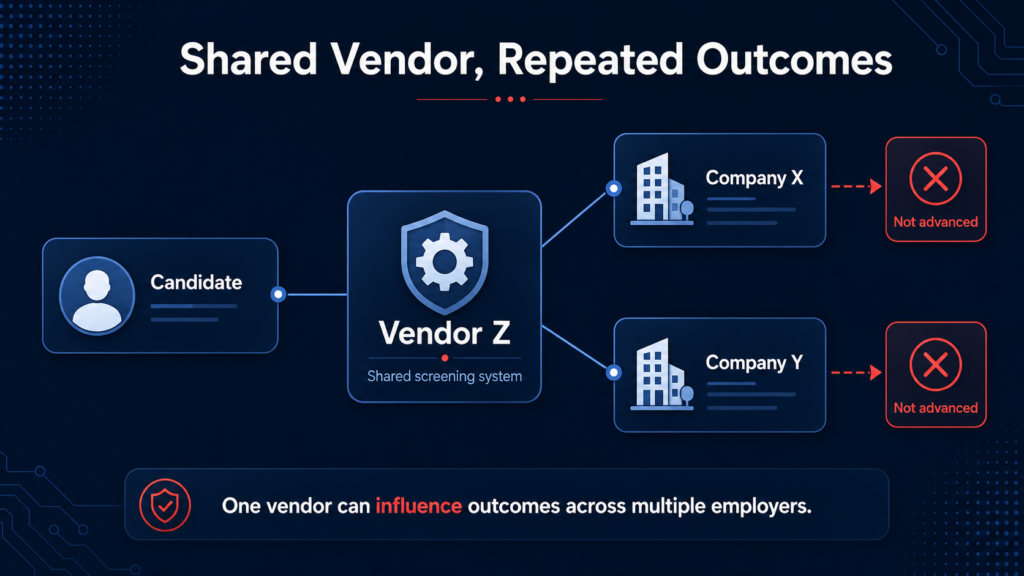
The researchers focused on a specific dynamic they call algorithmic monoculture: the condition that emerges when large numbers of employers rely on algorithms from the same small group of vendors. One example illustrated how more than 60% of Fortune 100 companies, for example, use a single vendor’s video interviewing hiring algorithms. When that vendor’s system mediates decisions across dozens of employers simultaneously, outcomes can become correlated in ways that have nothing to do with individual candidate qualifications.
The findings are direct.
On Adverse Impact
More than 25% of applications submitted by Black candidates—and nearly 15% of those submitted by Asian candidates—were directed to positions that produce adverse impact under the four-fifths rule, the standard measure applied under Title VII of the Civil Rights Act. The study is the first to demonstrate adverse impact in deployed algorithmic hiring at scale.
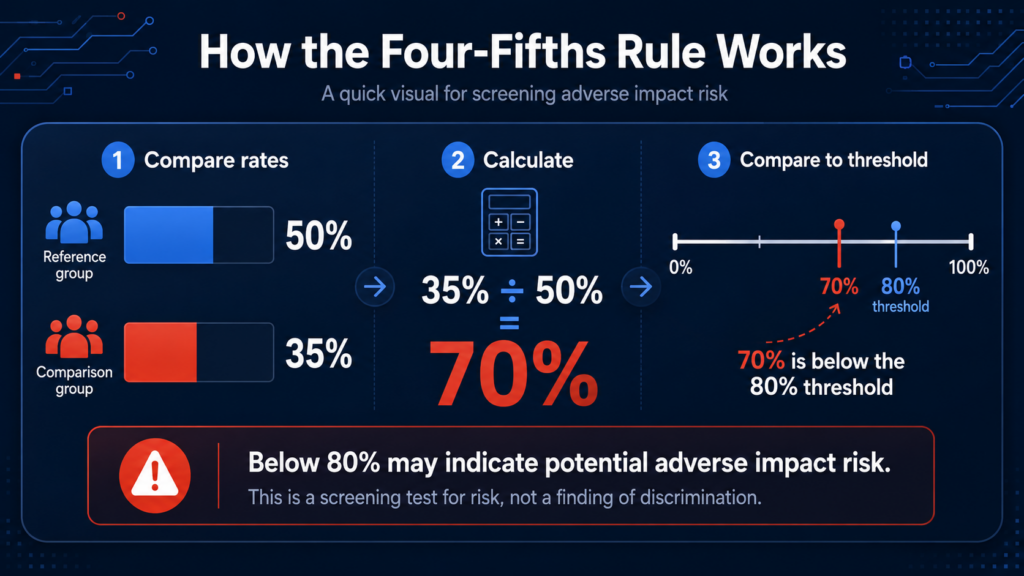
Let’s break this down further:
What is adverse impact? Under Title VII, employers often use the “four-fifths rule” as a screening test for discrimination risk.
If one group is selected at a substantially lower rate than another group, specifically less than 80% of the highest selected group, there may be evidence of adverse impact. An example of this is:
- White applicants pass a screening assessment at 50%
- Black applicants pass at 35%
35% ÷ 50% = 70%
Since 70% is below 80%, the process would fail the four-fifths rule and could create legal risk.
What is the study saying? The study is not saying: “25% of Black applicants suffered discrimination.” It is, however, saying: “More than 25% of applications submitted by Black candidates were to jobs where the hiring algorithm produced outcomes that met the definition of adverse impact.”
Think of it this way. If 100,000 applications were submitted by Black candidates:
- More than 25,000 of those applications went into hiring processes where Black candidates were being screened out at disproportionately higher rates than comparison groups.
For Asian candidates:
- Nearly 15,000 out of every 100,000 applications were routed into hiring processes showing adverse impact.
For HR risk professionals, that shifts the conversation from, “Could this happen?” to “How are we monitoring for it, documenting it, and validating our vendors to ensure it isn’t happening in our organization?”
That is the HR compliance significance of the finding. The study moves AI bias from a theoretical concern into an operational risk management issue.
On Why it Wasn’t Caught Sooner
Prior studies of algorithmic hiring data found minimal adverse impact. The Stanford team identified the reason: those studies examined vendor data in aggregate. When the researchers analyzed each position separately—which is exactly how Title VII requires adverse impact to be evaluated—a very different picture emerged. Disparities that disappear in blended averages become visible at the job level.
On Systemic Rejection
Among applicants who submitted four applications through the same algorithmic system, 10% were rejected across all four. That rate significantly exceeds what would be expected if each decision were made independently. The researchers confirmed that in comparable hiring data where no centralized algorithm was involved, the baseline model accurately predicted outcomes. The excess homogeneity is distinctive to algorithmic monoculture. In practical terms: a candidate flagged as a non-recommend by one employer’s AI system faces substantially higher odds of the same outcome everywhere else—not because of their qualifications, but because the same system is making the call.
The Compliance Implications Are Not Theoretical
Employers reviewing this research through an HR compliance lens should focus on a few specific realities.
Position-level analysis is already required. Title VII’s Uniform Guidelines on Employee Selection Procedures evaluate adverse impact at the level of specific jobs, not blended aggregates. If your organization is monitoring AI-driven hiring decisions through aggregate vendor reports alone, your current approach may not reflect the standard to which you’ll be held during an EEOC review or OFCCP audit. The Stanford study’s methodology isn’t novel—it’s what the law already requires. The gap is in how most employers are currently monitoring their tools.
Employer accountability does not transfer to the vendor. The ADA, Title VII, and related federal employment law do not distinguish between human and automated decisions. When an algorithm narrows the candidate pool, that narrowing is part of the employer’s selection process. Vendor contracts, audit documentation, and bias disclosure reports matter—but they do not transfer accountability. The organization using the tool remains responsible for the outcomes it produces.
What you can’t explain, you can’t defend. Many hiring AI tools produce scores or rankings without giving employers clear visibility into how those results were generated. Vendor documentation may exist, but it doesn’t always translate into operational understanding of how decisions affecting specific positions are made. That creates precisely the kind of blind spot that surfaces during compliance reviews. If hiring decisions cannot be explained consistently and accurately, they cannot be defended.
Governance Is the Gap
The pattern the Stanford researchers identified is not primarily a technology failure. It is an oversight failure. Systems were adopted, deployed, and scaled without the governance infrastructure required to monitor what they were producing.
For employers, the lesson is clear: implementing AI is not the finish line. AI readiness must come before deployment. Organizations should understand the business purpose, decision points, risks, accountability structures, and regulatory obligations associated with any AI-enabled hiring tool before it goes live.
Deployment is only the beginning. AI systems require ongoing monitoring, not one-time validation. Selection rates, adverse impact outcomes, candidate experience metrics, and vendor performance should be reviewed regularly to identify emerging risks. A tool that performs well at implementation may produce different outcomes as applicant pools, labor markets, and model inputs evolve.
Human oversight remains essential. Human-in-the-Loop (HITL) controls should enable recruiters and hiring managers to review, challenge, and override automated recommendations when appropriate. AI should support employment decisions, not replace meaningful human judgment and accountability.
Documentation is equally important. Employers should maintain records of vendor due diligence, validation studies, risk assessments, adverse impact analyses, governance reviews, monitoring activities, and corrective actions. If regulators, auditors, or litigants scrutinize an organization’s use of AI, evidence of ongoing oversight may be just as important as the technology itself.
This maps directly onto what many HR compliance teams already recognize in other parts of the hiring process. Accommodation requests handled inconsistently across teams. Job descriptions that include requirements no longer tied to essential functions. Screening criteria applied differently by different managers. Each of these reflects a gap between what policy states and what systems produce. The introduction of AI doesn’t eliminate that gap, but rather scales it.
Organizations making progress on this issue are asking operational questions that go beyond adoption:
- Where is technology influencing which candidates advance, and at what stage?
- Are we evaluating adverse impact at the position level, as Title VII requires?
- Do we understand what inputs drive our vendor’s scoring decisions?
- Who in the organization is accountable for how these tools perform—not just who selected them?
These are not questions for IT or procurement alone. They require coordination across HR, legal, compliance, and technology functions. Ownership of how hiring decisions are made, day to day, needs to be clearly defined.
Monoculture Has Business Consequences, Too
The HR compliance case for governance is clear. But there is also a workforce performance dimension that deserves attention.
The Stanford simulation findings show that under typical application behavior, candidates navigating an algorithmic monoculture need to submit 25 applications to achieve the same probability of a recommendation that would require only 10 applications in a system without centralized algorithmic assessment. Qualified candidates are not disappearing from the labor market. They are being screened out—repeatedly—by systems operating without adequate oversight.
For employers already struggling to fill roles, investing in skills-based hiring initiatives, and expanding outreach through platforms like DirectEmployers’ outreach management and job distribution tools, that is a meaningful drag on outcomes. The same tools intended to improve efficiency may be quietly narrowing the talent pools those other investments are trying to widen.
The researchers’ counterfactual analysis reinforces what skills-based hiring advocates have argued on other grounds: the issue is not talent availability. It is whether hiring systems are designed to accurately identify the talent that exists.
The Right Question Has Changed
For years, the primary question organizations asked about AI in hiring was: Are we using it?
Then the question became: Are we auditing it—who is managing the oversight, and how actively are we doing our due diligence?
The Stanford study points to a more precise series of questions for compliance leaders in 2026: Are we monitoring adverse impact at the position level, do we understand what our vendor’s system is actually measuring, and can we account for the outcomes it produces?
Those questions are harder to answer. But it is what determines whether AI in hiring becomes a genuine operational advantage—or a liability that surfaces when the cost of not asking is highest.
HR compliance confirms that processes are in place. What the Stanford research makes clear is that having a process in place is not the same as understanding what that process is producing. That gap is where risk grows.
Organizations that treat AI hiring tools as part of a governed decision system—with clear ownership, position-level monitoring, and defensible documentation—will be better positioned to manage that risk. Those that treat adoption as the end of the work have more exposure than their current compliance posture reflects.
Footnotes
[1] Scoring or a rubric of sorts may cause an Fair Credit Reporting Act (FCRA) violation, as seen in the on-going Eightfold lawsuit.

Let’s chat!
Fill out this form to indicate which solutions you’re interested in and we'll contact you shortly to schedule a demo.