
Originally published June 24, 2026. Last updated October 12, 2026.
Key Takeaways
Federal contractors with contracts of $200,000 or more are covered by VEVRAA, and more than $20,000 by Section 503—both of which remain fully enforceable despite the January 2025 rescission of Executive Order 11246. Contractors with 50 or more employees must maintain written Affirmative Action Plans, written and updated annually. VEVRAA requires mandatory job listing with Employment Service Delivery Systems (ESDS), and VEVRAArequires pre-offer and post-offer self-identification invitations. Active, documented outreach to veterans’ service organizations and disability-serving partners is required, as passive recruitment is not enough. Career sites must be accessible to individuals with disabilities, and HR compliance records must be retained for a minimum of three years. Emerging requirements around AI in hiring, pay transparency, and state AAP obligations are evolving rapidly and require ongoing attention. Federal contractor HR compliance is not a one-time project, and should be considered a living, evolving effort that demands continuous management as regulations, case law, and administrations change.
End of summary box.
If your company holds a federal contract, HR compliance isn’t optional, it’s an obligation. But for many HR, compliance and talent acquisition professionals, the first challenge isn’t staying compliant. It’s figuring out where to even begin.
The landscape of federal contractor HR compliance requirements are layered, constantly evolving, and full of overlapping regulations that can be difficult to interpret without expert guidance. This post breaks down the core requirements, the most commonly missed obligations, and how to build a compliance program that actually works, not just one that looks good on paper.
Who Do Federal Contractor HR Compliance Requirements Apply To?
To get started, two key laws govern a large portion of what federal contractors must do from an HR compliance and outreach standpoint.
The Vietnam Era Veterans’ Readjustment Assistance Act (VEVRAA) applies to any employer with a federal contract of $200,000 or more, regardless of employee count. It requires contractors to take affirmative action to recruit, hire, promote, and retain protected veterans.
Section 503 of the Rehabilitation Act applies to any employer with a federal contract of more than $20,000. It requires affirmative action and nondiscrimination on behalf of qualified individuals with disabilities.
Written AAP requirements have higher thresholds. Employers with 50 or more employees must maintain a written VEVRAA AAP if they have a covered federal contract or subcontract of $200,000 or more, and a written Section 503 AAP if they have a covered federal contract or subcontract of more than $20,000.
If your organization crosses either of these jurisdictional thresholds, you have real, enforceable obligations. The Office of Federal Contract Compliance Programs (OFCCP) is the government agency responsible for enforcing VEVRAA and Section 503 regulations.
Some state and local governments impose separate affirmative action, workforce analysis, reporting, or related requirements on employers that contract with them. Employers may also have affirmative action or equal opportunity obligations incorporated into government contracts, subcontracts, grants, funding agreements, or other contractual provisions. Employers should review applicable state and local laws as well as the specific terms and clauses of their contracts to determine whether additional affirmative action requirements apply.
One important clarification: Executive Order 11246 was rescinded in January 2025, eliminating federal contractor affirmative action requirements for women and minorities under that authority. However, the rescission did not eliminate federal nondiscrimination protections. Title VII continues to prohibit employment discrimination based on race, color, religion, sex, including sexual orientation and gender identity, and national origin
Just as importantly, affirmative action did not disappear for federal contractors. Section 503 affirmative action requirements for individuals with disabilities and VEVRAA affirmative action requirements for protected veterans remain in effect.
The takeaway: EO 11246 is gone, but federal contractor compliance obligations are not.
The Biggest Mistake: Not Knowing Where to Start
When companies first discover they’re covered by VEVRAA or Section 503, the most common reaction isn’t defiance, it’s paralysis and uncertainty of where to even begin, especially as the requirements continue to change.
Recent changes to Section 503 are a good example. Effective September 2026, contractors are no longer required to invite applicants and employees to self-identify as individuals with disabilities, conduct the related applicant and employee data analysis, or measure their workforce against the 7% disability utilization goal. Form CC-305 has also been retired.
But Section 503 affirmative action did not go away. Covered contractors must still maintain required AAPs and comply with applicable nondiscrimination, outreach and recruitment, personnel process, audit and reporting, recordkeeping, and other affirmative action requirements. VEVRAA affirmative action requirements also remain in effect.
Even still, there are so many overlapping regulations, interpretations, and guidance documents that it’s genuinely difficult to know what to tackle first without support from people who live and breathe this space.
That’s where organizations like DirectEmployers Association make a real difference—connecting HR, compliance practitioners and talent acquisition teams to compliance tools, community, and subject matter experts who can help them build a solid foundation and identify gaps as they grow.
The Compliance Requirements You Can’t Afford to Get Wrong
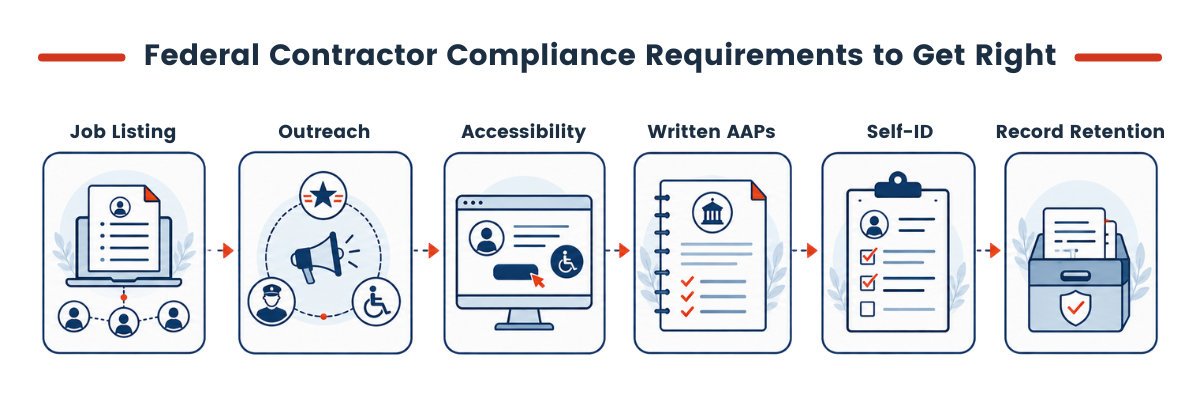
Federal contractors should review core HR compliance requirements, including job listing, outreach, accessibility, written AAPs, veteran self-identification, and record retention.
VEVRAA Mandatory Job Listing
Under VEVRAA, federal contractors are required to list their open positions with the appropriate employment service delivery systems, known as ESDS. This is not the same as posting jobs on your career site or general job boards, and it is not the same as simply posting to a state workforce job bank.
Many contractors unknowingly skip this step or misunderstand it entirely. The requirement is to list with the appropriate American Job Centers or ESDS specifically, and to notify that you are a federal contractor requesting priority referrals for protected veterans. Failing to do so is one of the most common compliance violations uncovered during OFCCP audits.
DirectEmployers’ National Labor Exchange (NLx) partnership with the National Association of State Workforce Agencies (NASWA) simplifies the VEVRAA job listing requirement by automating the delivery of job listings to the appropriate American Job Centers/ESDS and helping Members meet this requirement efficiently, with supporting compliance reporting for review.
Active Outreach to Veterans and Individuals with Disabilities
Compliance under VEVRAA and Section 503 isn’t passive. Both laws require contractors to take affirmative action, meaning you must actively reach out to organizations that serve veterans and individuals with disabilities. Passively waiting for candidates to find you is not a compliance strategy.
And those efforts may be more important than ever. Recent Section 503 changes eliminated several of the quantitative measures contractors previously relied on, including the 7% disability utilization goal and the related applicant and employee data collection and analysis requirements. With those measurements removed, documented outreach and recruitment activities become an increasingly important way to demonstrate that a contractor is actively implementing its affirmative action obligations.
This means building documented, meaningful relationships with veterans’ service organizations, vocational rehabilitation agencies, and veteran and disability-focused community-based organizations. Contractors should be able to demonstrate the specific actions they’ve taken and evaluate whether their outreach and recruitment efforts are effective.
The Partnership Relationship Manager (PRM), Local Job Distribution, and VocRehab+ platforms through DirectEmployers are specifically designed to support this outreach requirement, connecting federal contractor Members to a nationwide network of veteran and disability-serving organizations, as well as vocational rehabilitation counselors in each state.
Accessible Career Sites and Application Processes
Federal contractors are increasingly expected to ensure their career sites and application processes are accessible to individuals with disabilities. This is no longer a “nice-to-have” but viewed as a vital focus. While not part of Section 503, career site accessibility is enforced through its requirements for reasonable accommodations, equal access to employment opportunities, and affirmative action.
Accessibility means more than adding an alt tag here and there. It includes ensuring:
- Career websites that can be fully navigated by screen readers
- Online applications that don’t rely solely on visual cues or mouse-based interactions
- Alternative application pathways for candidates who cannot use your standard digital process
Failing to provide accessible application experiences doesn’t just create compliance risks. It actively excludes the very population you are required to affirmatively recruit. Those two things cannot coexist.[1]
Written Affirmative Action Plans for VEVRAA and Section 503
There are two tiers of obligation under VEVRAA and Section 503, and many contractors don’t realize the distinction between them.
Basic Coverage—the nondiscrimination and job listing requirements—kicks in at the contract thresholds described above. Written Affirmative Action Plans (AAP) are a separate, higher-level requirement that applies when you have 50 or more employees and a single contract of more than $20,000 under Section 503, or 50 or more employees and a single contract of $200,000 or more under VEVRAA.
A written AAP is not just a policy document. It is a detailed plan that includes action-oriented outreach and enablement programs, internal audits, and policy statements—updated annually and reviewed through the year to monitor progress.
Many contractors either don’t have written AAPs at all, or have them but haven’t reviewed or updated them in years. Both are serious compliance vulnerabilities. If your organization meets the 50-employee threshold and the applicable contract amounts, a written AAP isn’t optional—it’s the backbone of your compliance program.
Self-Identification Requirements Have Changed
One of the most significant 2026 changes to Section 503 involves disability self-identification. Covered contractors are no longer required to invite applicants or employees to voluntarily self-identify as individuals with disabilities. The former pre-offer and post-offer invitations, periodic employee resurvey requirement, and related applicant and employee data collection requirements have been eliminated. OFCCP’s Form CC-305 has also been retired.
VEVRAA is different. Covered contractors must continue to invite applicants to voluntarily self-identify as protected veterans at the pre-offer stage and invite individuals to identify after an offer of employment, but before employment begins.
Veteran self-identification information must be maintained confidentially and separately from the employment application and personnel records, consistent with applicable requirements. Unlike the former Section 503 process, OFCCP does not prescribe a specific VEVRAA self-identification form, although the invitation must satisfy the regulatory requirements.
The takeaway is important: don’t treat Section 503 and VEVRAA self-identification requirements as interchangeable. Mandatory disability self-identification and Form CC-305 are gone, while VEVRAA veteran self-identification requirements remain.
However, the elimination of the Section 503 requirement does not necessarily mean employers should discontinue all voluntary disability self-identification. State or local laws, government contracts, or other affirmative action obligations may require or support continued data collection, and EEOC guidance recognizes circumstances in which employers may voluntarily collect disability information for lawful affirmative action purposes. Employers should evaluate the legal authority and purpose for any continued collection of disability, race, sex, or other demographic information and ensure appropriate confidentiality and use of the data.
Record Retention
Compliance without documentation is not compliance—it’s just crossing your fingers and hoping for the best.
Under both VEVRAA and Section 503, federal contractors are required to retain records related to outreach activities, self-identification data, job listings, applicant flow, and hiring decisions for a minimum of three years.
In a compliance evaluation or audit, you may be asked to produce proof of activity. Evidence that jobs were listed correctly. Documentation that outreach happened and was assessed. Verification that self-identification invitations went out at the right stages of the hiring process. If you can’t produce that documentation, it’s as if the activity never occurred, regardless of what you actually did.
Building record retention into your compliance processes from the beginning, not scrambling to reconstruct records before an audit, is what separates organizations that sail through reviews from those that don’t.
Best Practice: Ask yourself, if records are electronic, how long will it take to access? What is the output or rendering of what the output looks like? How long will electronic records remain preserved in the system? Will those records be overwritten? Run a test, maintain ‘e-copies’ of the documentation, save in an AAP evidence file, etc.
Keeping Pace with Evolving Regulations: AI, Pay Transparency, and State AAPs
This is the area that separates federal contractors that are truly compliant from those who simply “think” they are.
Federal contractor compliance is not static, and with so many recent changes and overlapping layers of laws, rules, regulations, and executive orders, it’s important to understand where federal contractor requirements end and other federal, state, local, and contractual obligations begin. Three areas deserve particular attention.
The use of artificial intelligence in hiring continues to create compliance risk. Employers using AI or automated tools for sourcing, screening, interviewing, assessment or selection must consider applicable nondiscrimination and disability accommodation requirements, as well as emerging state and local AI laws. Employers should also consider how these tools affect their remaining nondiscrimination under Title VII of the Civil Rights Act (Equal Employment Opportunity – EEO) and compliance obligations under Section 503 and VEVRAA, including whether recruiting and selection processes create barriers or other undesired outcomes in the employment processes. The technology has moved faster than the regulatory guidance, which means the risk is real even where the rules aren’t fully settled yet.
Pay transparency is expanding rapidly at the state level. An increasing number of states now require salary ranges , benefits or other compensation details in the job posting or at other stages in the employment process. Multi-state employers should have a process for identifying which requirements apply before a position is posted.
State, local, and contractual Affirmative Action requirements require separate attention. The federal contractor landscape has changed significantly. Executive Order 11246 was rescinded, eliminating the former federal affirmative action requirements for women and minorities under that authority. More recently, Section 503 was revised to eliminate mandatory disability self-identification, Form CC-305, the related applicant and employee data analysis, and the 7% disability utilization goal and analysis. But these federal changes do not automatically eliminate affirmative action, demographic data collection, reporting, workforce analysis, or other requirements imposed independently by state or local law or applicable government contracts.
Employers should review these obligations separately rather than assume that changes at the federal level apply across every jurisdiction or contract.
For multi-state federal contractors, compliance increasingly requires looking beyond OFCCP and understanding the full range of federal, state, local, and contractual requirements that apply.
Compliance Is Not a Checkbox, It’s a Living Program
Here’s the most important thing to understand about employer and federal contractor HR compliance: it is not a one-time project. It is an ongoing, living program that requires active management and genuine organizational commitment and collaboration from multiple business segments.
Getting your foundation right, understanding your obligations, coverage, developing? the Affirmative Action Plans, establishing your ESDS job listing process, building your outreach partnerships, assessing the effectiveness of the outreach, reviewing/auditing the employment processes and practices, ensuring the policies, statements, posters are current and ensuring the accommodation process is in good working order—is the starting point. It’s meaningful progress. But it is not the finish line.
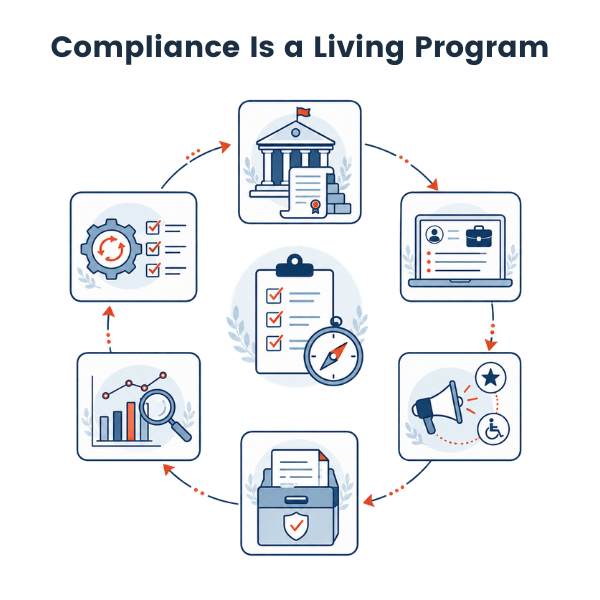
Federal contractor compliance should be treated as an ongoing program that requires regular review, documentation, updates, and continuous improvement.
Regulations change. Administrations change. Case law evolves. What was an acceptable practice two years ago may be interpreted differently today. Enforcement and priorities shift. State requirements expand. New technology introduces new risks that existing guidance hasn’t fully addressed.
The organizations that do this well are the ones that treat compliance as a discipline, not a deliverable—something that gets genuine attention year-round, not just when an audit notice arrives.
Identifying gaps in your compliance program is a sign of a mature operation, not a failure. The goal isn’t perfection on day one. The goal is continuous improvement, with the right internal and external partners, tools, and education to support you along the way.
Where to Start
If you’re not sure where your compliance program stands, work through these questions:
- Do your contracts meet the VEVRAA ($200,000 or more) or Section 503 (more than $20,000) thresholds? If yes, your nondiscrimination and affirmative action obligations are active.
- Do you have 50 or more employees and meet the applicable written AAP threshold, $200,000 or more for VEVRAA or more than $20,000 for Section 503? If yes, are your written AAPs being developed and updated annually? Are your covered open positions being listed at the appropriate state or local Employment Service Delivery System (ESDS) as required by VEVRAA, and have you provided the required federal contractor and priority referral information?
- Are you inviting applicants to voluntarily self-identify as protected veterans at the pre-offer stage and again following an offer as required by VEVRAA? If your outreach efforts are not effective, are you identifying and implementing alternative efforts?
- Have you updated your Section 503 processes to reflect the 2026 changes, including the elimination of mandatory disability self-identification, retirement of Form CC-305, removal of the five-year employee resurvey, elimination of the 7% utilization goal, and removal of the related applicant and employee data collection and analysis requirements?
- Are you conducting and documenting appropriate outreach and positive recruitment efforts for protected veterans and individuals with disabilities, and evaluating the effectiveness of those efforts annually? Do you have productive relationships with veterans’ service organizations and disability-serving partners?
- Do you maintain the required internal audit and reporting systems to measure the effectiveness of your Section 503 and VEVRAA AAPs, identify areas requiring remedial action, and document actions taken?
- Have you established and documented your annual VEVRAA protected veteran hiring benchmark?
- Can applicants with disabilities access and navigate your career site, request reasonable accommodations, and participate in your application and selection process accessibility-related barriers?
- Have you determined whether VETS-4212 reporting applies and, if so, completed the annual filing?
- Are you retaining required outreach, recruitment, veteran self-identification records, job listing, and other compliance records for the applicable retention periods (some states may require longer retention)? Are you separately reviewing and tracking state, local, and contractual affirmative action demographic data collection, reporting AI, pay transparency, and other requirements that may apply even when federal requirements have changed?
DirectEmployers Association exists specifically to support employers and federal contractors through this work—providing the technology, partnerships, education, and community connection that HR, compliance and talent acquisition teams need to comply with confidence. From VEVRAA-mandated job listing, to veteran and disability outreach through the Partner Relationship Manager (PRM), Local Job Distribution, and VocRehab+ platforms, to ongoing education and connections with industry subject matter experts, DirectEmployers helps build programs eliminate barriers to employment that are audit-ready and built to last (and evolve).
Employer and Federal contractor compliance is complex, but it is manageable when you approach it as an ongoing practice rather than an annual scramble. Start with your foundation. Identify your gaps. And build from there, with the right support behind you.
Footnotes
[1] Career sites should meet all requirements for not only the Americans with Disabilities Act (ADA) but also Web Content Accessibility Guidelines (WCAG) standards as well.
THIS COLUMN IS MEANT TO ASSIST IN A GENERAL UNDERSTANDING OF THE CURRENT LAW AND PRACTICE RELATING TO OFCCP. IT IS NOT TO BE REGARDED AS LEGAL ADVICE. COMPANIES OR INDIVIDUALS WITH PARTICULAR QUESTIONS SHOULD SEEK ADVICE OF COUNSEL.
Frequently Asked Questions About Federal Contractor HR Compliance Requirements

Let’s chat!
Fill out this form to indicate which solutions you’re interested in and we'll contact you shortly to schedule a demo.