
Key Takeaways
On June 4, 2026, Colorado Governor Jared Polis signed House Bill 26-1283, “Protections Regarding Seizures of Identification Documents,” into law. Effective June 3, 2026, the law prohibits employers from confiscating workers’ government-issued IDs and adds a written notice and signed acknowledgment requirement to the employment eligibility verification process. The law applies to all employers with workers performing work in Colorado—regardless of where the employer is headquartered or incorporated. Multi-state and federal contractor employers with a Colorado workforce need to update their I-9 workflows, develop compliant written notice forms, and train onboarding staff before the August effective date. Noncompliance carries criminal penalties, including misdemeanor exposure, and affected workers retain the right to pursue civil remedies.
End of summary box.
On June 3, 2026, Colorado Governor Jared Polis signed Protections Regarding Seizures of Identification Documents (House Bill 26-1283) into law, adding a new section to the Colorado Revised Statutes—C.R.S. § 8-2-124.5—that prohibits employers from demanding, confiscating, or permanently retaining a worker’s government-issued identification card. The law also creates a new procedural requirement that must be completed at the time of Form I-9 verification for any worker performing work in Colorado.
The effective date is June 3, 2026. Employers have a defined window to update their processes, and the steps involved—drafting notices, preparing translations, updating workflows, training staff—are operationally substantive.
What the Law Actually Requires
HB26-1283 creates two categories of employer obligations.
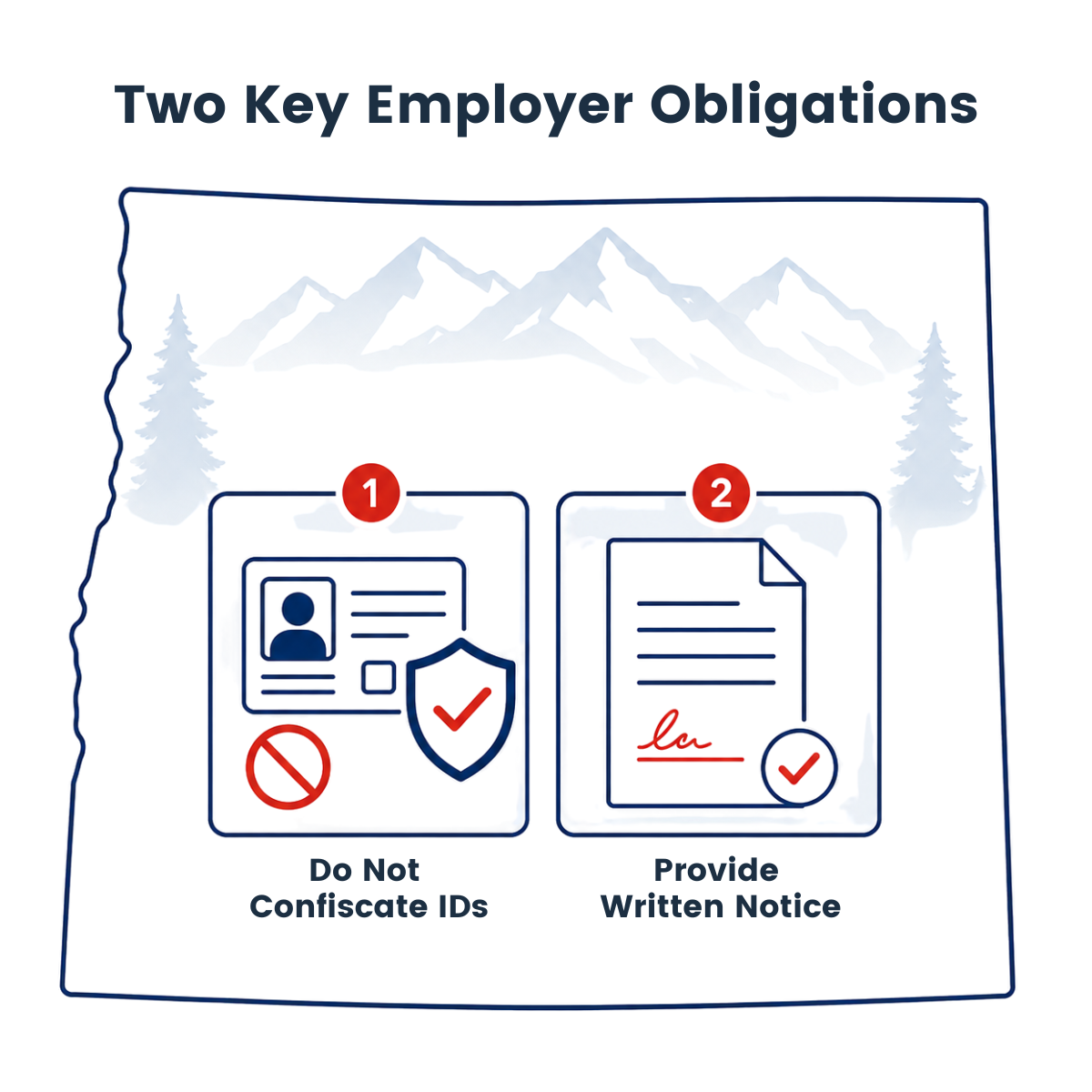 The prohibition on confiscating IDs. An employer, or any agent acting on the employer’s behalf, may not demand, confiscate, retain, or otherwise require any employee, applicant, migrant worker, or seasonal employee to surrender their government-issued identification card. The prohibition is broad and covers the full spectrum of workers—not just current employees.
The written notice and acknowledgment requirement. During the employment verification process, which for most employers occurs when completing Form I-9, employers must provide written notice that they may not confiscate or retain an individual’s government issued identification documents, except as permitted by law.
What Employers Are Still Permitted to Do
The law explicitly carves out several common and legally necessary employer practices. Employers may:
- Temporarily retain the physical ID for the purpose of completing Form I-9, for up to 10 hours.
- Retain a copy of the government-issued identification card in the employer’s employment records, if consistent with existing practices or workflows.
- Retain identification documents when required or permitted by state or federal law or regulation, including for employment eligibility verification purposes.
- Retain identification documents when doing so is performed pursuant to a signed judicial warrant.
The 10-hour temporary retention limit is worth underscoring. Employers should review any onboarding process that retains original identification documents beyond the statute’s 10-hour limit, including workflows that extend into the next business day. Employers whose I-9 processes span multiple days, or involve remote or multi-step onboarding workflows, should review those processes against this limit carefully.
The Penalties Are Not Trivial
Knowingly violating the ID confiscation prohibition is a Class 2 misdemeanor under Colorado law. The charge escalates to a bias-motivated crime—a Class 1 misdemeanor—if the violation is motivated by the individual’s race, national origin, or other protected characteristic, or if the employer threatens to provide the worker’s ID to federal immigration authorities.
Affected workers also retain the right to pursue civil remedies, including a court order compelling return of the document and recovery of damages. For federal contractors, this adds a layer of reputational and legal risk that extends well beyond a single HR misstep.
What This Means for Federal Contractors
Federal contractors employing workers in Colorado face the same obligations as any other covered employer under this law. A few dimensions deserve particular attention.
The federal I-9 process may be a trigger point for the new notice requirement. Any time a federal contractor completes a Form I-9 for a Colorado-based hire, the written notice and signed acknowledgment must be part of that workflow. Employers who use centralized or remote I-9 processing—common among large federal contractors with distributed workforces—will need to ensure their systems can flag Colorado hires and route them through the updated process.
The immigration enforcement climate also adds context worth acknowledging. The provision elevating a violation to a bias-motivated crime when an employer threatens to provide a worker’s ID to federal immigration authorities reflects a legislative intent to protect workers who may be particularly vulnerable to document confiscation as a coercive tool. Federal contractors should be aware that the intersection of I-9 compliance and immigration enforcement is precisely the space this law was designed to regulate—and that the criminal penalty escalation reflects that.
Finally, this law is not limited to Colorado-based employers. Any employer, regardless of where it is incorporated or headquartered, must comply with employees who perform work in Colorado. Multi-state employers should review their I-9 workflows to ensure Colorado-specific steps are triggered appropriately for Colorado hires.
What HR Teams Should Be Doing
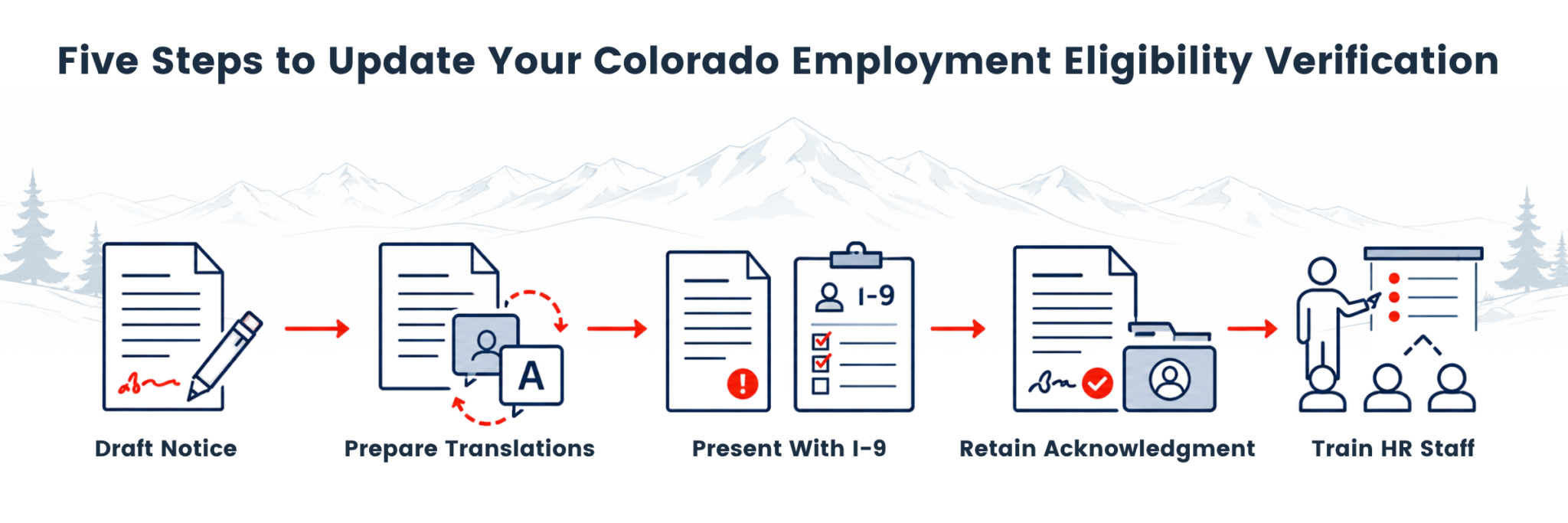
- Develop a written notice form: Draft a notice describing the ID confiscation prohibition and including a signature line for employee acknowledgment. Have it reviewed by employment counsel before deployment.
- Prepare translated versions: Identify the primary languages spoken by your Colorado workforce and prepare translated versions of the notice accordingly.
- Integrate the notice into your Employment Eligibility Verification workflow: The notice and acknowledgment should be presented and completed at the same time as the employment eligibility verification (typically the I- process) for any Colorado-based hire. Build it into your onboarding checklist as a required step, not an optional addendum.
- Update your recordkeeping practices: The signed acknowledgment must be in each Colorado employee’s employment file. Confirm that your recordkeeping system can accommodate this as a distinct document.
- The statute does not specifically state where this acknowledgment must be retained. Employers using electronic Form I-9 systems will likely maintain the acknowledgment within the electronic system. Employers using paper Form I-9s may either keep the acknowledgment with the Form I-9 (which must be stored separately from the employee’s personnel file) or retain only the acknowledgment in the employee’s personnel file. The Form I-9 itself must always be maintained separately from the employee’s personnel file.
- Train hiring managers and HR staff: Anyone involved in onboarding Colorado workers needs to understand the 10-hour temporary retention limit, the new notice obligation, and what constitutes a prohibited confiscation under the law.
- Review remote and centralized I-9 processes: If your organization uses a third-party I-9 platform or centralized HR function to process employment eligibility verifications, confirm that Colorado-specific steps can be triggered at the point of hire.
HB26-1283 is a targeted, operationally specific law—but its implications are real and its effective date is close. For federal contractors with Colorado operations, the compliance window between now and August 12 is the time to act: draft the notice, line up translations, update the I-9 workflow, and get your onboarding staff trained.
The penalty structure—including criminal misdemeanor exposure and civil remedies for affected workers—means this is not a law to deprioritize or address reactively. And because the law reaches any employer whose workers perform work in Colorado, multi-state contractors should be reviewing their workforce geography now rather than assuming the obligation doesn’t apply.
DirectEmployers will continue monitoring state-level developments affecting federal contractor HR compliance obligations and will continue to issue updates. Members with questions about I-9 workflow updates or state employment law compliance are encouraged to reach out to their DirectEmployers Membership Team, connect with peers in the DE Connect discussion forum, or attend an upcoming Member Office Hours sessions. To ensure you receive future compliance updates, subscribe to receive updates by visiting https://directemployers.org/subscribe.
Frequently Asked Questions About Topic
THIS COLUMN IS MEANT TO ASSIST IN A GENERAL UNDERSTANDING OF THE CURRENT LAW AND PRACTICE RELATING TO OFCCP. IT IS NOT TO BE REGARDED AS LEGAL ADVICE. COMPANIES OR INDIVIDUALS WITH PARTICULAR QUESTIONS SHOULD SEEK ADVICE OF COUNSEL.

Let’s chat!
Fill out this form to indicate which solutions you’re interested in and we'll contact you shortly to schedule a demo.