
Key Takeaways
On June 24, 2026, OIRA approved a three-year extension of the EEOC’s information collection authority under the Uniform Guidelines on Employee Selection Procedures (UGESP), keeping the requirement to collect and maintain applicant race, ethnicity, and sex data in force through June 30, 2029. This extension carries no changes to existing recordkeeping requirements—federal contractors should continue collecting voluntary applicant demographic self-identification data as part of their existing applicant flow recordkeeping practices. Critically, this approval does not conflict with the EEOC’s separate, pending proposal to rescind EEO-1 reporting requirements, as well as the DOJ’s recent opinion letter on disparate impact. UGESP recordkeeping is a distinct obligation rooted in Title VII, and it stands independent of EEO-1 reporting. Federal contractors should treat their applicant self-ID collection practices as fully in effect.
End of summary box.
The Office of Information and Regulatory Affairs (OIRA) approved an extension—without change—of the Equal Employment Opportunity Commission’s (EEOC) information collection (IC) under the Uniform Guidelines on Employee Selection Procedures (UGESP), 29 C.F.R. Part 1607. The approval was issued on June 24, 2026, and carries OMB Control Number 3046-0017 through a new expiration date of June 30, 2029.
The Information Collection Review (ICR) originated under the Biden administration, with the EEOC publishing its required Federal Register notice on October 29, 2024. No public comments were received during the 60-day comment period. The EEOC submitted the request and supporting statement to OIRA on January 6, 2025, and OIRA concluded its review under the current administration with an approval without change.
This is a routine renewal of an existing collection authority, not a new mandate. The underlying UGESP recordkeeping requirements have been in place since 1978 and were jointly issued by the EEOC, the Department of Labor, the Department of Justice, and the Office of Personnel Management under Title VII.
What UGESP Actually Requires
UGESP requires most employers (public, private, and federal contractors) to evaluate or assess (either works) the selection procedures they use to make employment decisions. Those procedures include interviews, application reviews, minimum qualifications, education and experience requirements, cognitive and personality assessments, skills and aptitude tests, physical ability tests, work samples, simulations, background screening criteria, performance evaluations used for promotion, and other selection devices or scoring that influence hiring, promotion, transfer, or other employment decisions. Employers must maintain records sufficient to evaluate whether these procedures result in adverse impact and provide documentation needed during agency investigations or litigation involving discrimination claims.
The EEOC’s renewal of the UGESP information collection reinforces an important distinction. UGESP is a recordkeeping requirement, not a routine reporting requirement. Employers are not required to periodically submit applicant flow or adverse impact data to a federal agency. Instead, they must maintain records sufficient to evaluate the impact of their selection procedures and make those records available upon request during an investigation or enforcement action. Notably, although Executive Order 11246 was rescinded and the OFCCP proposed removing its own incorporation of UGESP, the EEOC has not proposed rescinding the Guidelines or its associated information collection. For federal contractors, maintaining these records also supports compliance with contract oversight and other lawful requests for employment related information.
Contracting agencies may request employment related records in connection with contract administration, audits, investigations, responsibility determination, or other authorized oversight activities.
For federal contractors specifically, Office of Federal Contract Compliance Programs (OFCCP) has historically used applicant flow data—collected pursuant to UGESP—during compliance reviews to assess whether selection procedures are producing adverse impact against protected classes. The extension itself does not alter that longstanding role.
The burden estimates in the renewed collection reflect updated workforce and employment data: the EEOC now estimates 887,869 covered employers and approximately 1.85 billion job applications annually, with a total recordkeeping burden of roughly 15.4 million hours per year—down from the prior estimate of 16.6 million hours due to updated calculation methods, as cited in the UGESP supporting statement.
The Regulatory Tension Worth Acknowledging
Federal contractors are navigating real complexity right now. In May 2026, the EEOC submitted a proposed rule to OIRA that would rescind EEO-1, EEO-2, EEO-3, EEO-4, and EEO-5 reporting requirements entirely—a significant rollback of workforce demographic data reporting obligations that have been in place since 1966. That proposal is still under OIRA review.
At the same time, OIRA just approved an extension of UGESP’s information collection authority—a requirement that federal regulators continue to enforce under four agencies with Title VII as its operative legal foundation. Although Executive Order 11246 historically informed OFCCP’s application of the Uniform Guidelines, its rescission in January 2025 did not eliminate UGESP’s recordkeeping obligations. Title VII independently preserves those requirements, including the collection of demographic data necessary to evaluate adverse impact.
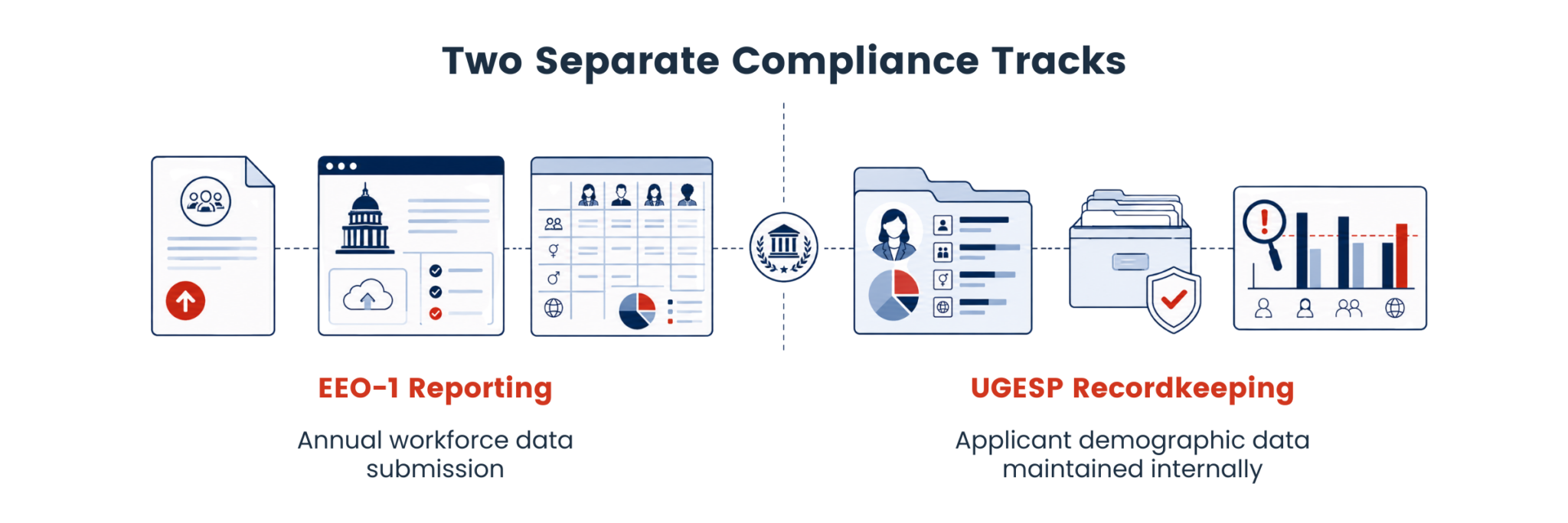
These two developments exist on separate regulatory tracks, and it’s important not to conflate them. EEO-1 reporting is an annual submission to a federal database typically mid-year. UGESP recordkeeping is an employer-maintained obligation to collect and retain demographic data, with no reporting requirement attached. OFCCP proposed rescinding its incorporation of UGESP as part of the Executive Order 11246 regulatory rollback, the agency expressly stated that doing so would not affect other agencies’ interpretation or application of the Guidelines. The EEOC has not proposed rescinding UGESP under Title VII.
In short: Title VII and the EEOC’s continuing adoption of the Uniform Guidelines remain in effect.
What This Means for Federal Contractors
Federal contractors should read this extension of UGESP as a clear signal to maintain current practices around applicant demographic data collection. The OIRA renewal confirms that the EEOC’s existing UGESP information collection authority remains in effect:
- Continue inviting applicants to voluntarily self-identify their race, ethnicity, and sex at the point of application.
- Maintain those records separately from employment applications and ensure they are not used in hiring decisions—self-ID is for recordkeeping compliance, not selection.
- Retain records consistent with the Uniform Guidelines on Employee Selection Procedures (UGESP). Employers with 100 or more employees should maintain job specific applicant flow and selection data sufficient to evaluate adverse impact and, where adverse impact exists, supporting validity documentation. Employers with fewer than 100 employees may use the simplified recordkeeping approach under 29 C.F.R. § 1607.15(A)(1).
- Do not interpret the EEO-1 rescission proposal as license to stop collecting demographic data. As we have covered previously, UGESP obligations are independent of EEO-1 reporting, and discontinuing applicant data collection would create material legal exposure under Title VII.
This OIRA approval is, in one sense, routine. It renews an information collection authority that has existed for nearly five decades, with no changes to what is required. But in the current regulatory environment—where contractors are simultaneously watching the EEOC propose to rescind EEO-1 reporting while OFCCP undergoes its third leadership change in just over a year—clarity matters.
The UGESP recordkeeping requirement is not going away. The data you collect under it is the foundation of adverse impact analysis, the backbone of OFCCP compliance reviews, and a resource EEOC draws on when investigating pattern-or-practice discrimination claims.
As always, DirectEmployers will continue monitoring the regulatory landscape and will issue updates as changes affect the regulatory landscape. Members with questions about applicant data collection practices or broader UGESP compliance obligations are encouraged to reach out to their DirectEmployers Membership Team, visit the discussion forum on DE Connect, or attend an upcoming Member Office Hours session, taking place on July 15th from 11:00 am – 12:00 pm ET. To ensure you receive future compliance updates, subscribe to receive updates by visiting https://directemployers.org/subscribe.
Frequently Asked Questions About Topic
THIS COLUMN IS MEANT TO ASSIST IN A GENERAL UNDERSTANDING OF THE CURRENT LAW AND PRACTICE RELATING TO OFCCP. IT IS NOT TO BE REGARDED AS LEGAL ADVICE. COMPANIES OR INDIVIDUALS WITH PARTICULAR QUESTIONS SHOULD SEEK ADVICE OF COUNSEL.

Let’s chat!
Fill out this form to indicate which solutions you’re interested in and we'll contact you shortly to schedule a demo.