
Key Takeaways
- OFCCP’s Final Rule on Section 503 is scheduled for publication in the Federal Register on August 21, 2026.
- The rule ends the requirement that federal contractors invite applicants and employees to self-identify as individuals with disabilities.
- It also ends the related data collection requirements and removes the 7% utilization goal. However, contractors that meet the applicable threshold must still comply with affirmative action plan obligations for individuals with disabilities.
- The rule is part of a larger package. It also rescinds the EO 11246 regulations and updates the VEVRAA regulations.
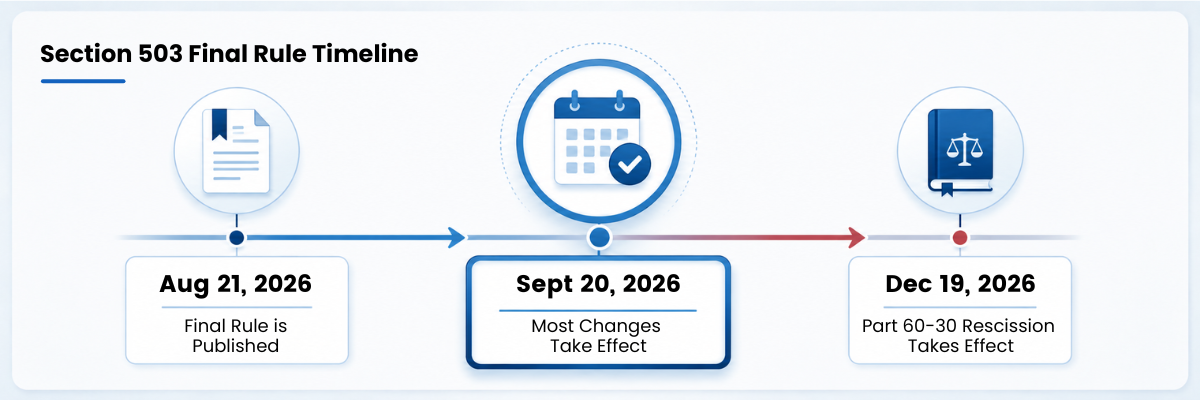
- Most changes take effect 30 days after publication, on September 20, 2026. One provision, the removal of 41 CFR part 60-30, doesn’t take effect until 120 days after publication, on December 19, 2026.
- Section 503’s core nondiscrimination and reasonable accommodation requirements are not changing.
End of summary box.
What Happened
On July 1, 2025, the U.S. Department of Labor’s Office of Federal Contract Compliance Programs (OFCCP) proposed major changes to its Section 503 regulations. The agency said the disability self-identification requirement at 41 CFR 60-741.42 and the utilization goal at 41 CFR 60-741.45 conflict with the Americans with Disabilities Act. OFCCP received 651 comments before the public comment period closed. The Final Rule keeps most of what was proposed.
Here’s what the Section 503 Final Rule does:
- Ends the disability self-identification requirement. Contractors no longer have to invite applicants or employees to self-identify as individuals with disabilities.
- Ends the related data collection. Contractors no longer have to document or maintain the disability-related computations required under 41 CFR 60-741.44(k).
- Removes the 7% utilization goal. Contractors no longer have to measure their workforce against the goal or run the utilization analysis under 41 CFR 60-741.45.
- Removes references to Executive Order 11246. OFCCP is moving the administrative proceeding procedures directly into the Section 503 regulations and getting rid of the now-duplicate 41 CFR part 60-30.
- Updates the coverage threshold. The basic Section 503 coverage threshold moves from $15,000 to $20,000, matching an inflation adjustment that already took effect in October 2025. The rule also fixes some typos and outdated website links.
- Keeps the Affirmative Action Program (AAP) requirement for individuals with disabilities in place.
- Contractors that meet the 50-employee/$50,000 threshold still have to develop and maintain a written affirmative action program, including outreach, recruitment, and the audit and reporting system under 41 CFR 60-741.44(h). They just won’t need disability self-ID data to meet it.
- In addition, 41 CFR § 60-741.44(c) still requires a review of physical and mental qualifications.
OFCCP is also adding new language at 41 CFR 60-741.44(l). It confirms that contractors don’t need quantitative data in the utilization analysis to assess whether their outreach efforts are working.
A Confusing Moment for Contractors
This Final Rule comes just five weeks after the Office of Management and Budget (OMB) renewed Form CC-305 through 2029. At the time, it looked like contractors would keep using the form for years to come.
This Final Rule changes that. OFCCP says it won’t keep the CC-305 form “in any manner,” since the rule removes the requirement to ask about disability status in the first place. Contractors can still ask voluntarily, as long as they’re following the Americans with Disabilities Act (ADA), but OFCCP will no longer require or provide a standard form for it. DirectEmployers will publish more guidance on what this means for CC-305 in practice once it becomes available.
What This Means for Your Organization
This Final Rule changes how you run your Section 503 program. It doesn’t change your underlying obligations. Here’s what to know:
- Put plans in place to remove self-ID prompts. The requirement goes away 30 days after publication, not immediately. OFCCP estimates it will take about 10 hours per company to update HR systems and remove the CC-305 process.
- The obligation to review personnel processes remains. Continue to review your recruitment, hiring, retention, and promotion practices, even though contractors are no longer required to track workforce data against the 7% utilization goal.
- Nondiscrimination and accommodation duties stay the same. The equal opportunity clause at 41 CFR 60-741.5 is still in effect. So are the reasonable accommodation requirements at 41 CFR 60-741.21(a)(6). This rule does not reduce your affirmative action or nondiscrimination obligations under Section 503.
- Outreach documentation is still required. If you meet the AAP threshold (50 or more employees and a contract of $50,000 or more), you still have to document your outreach efforts, measure effectiveness, and maintain an audit and reporting system. You just won’t need disability referral, applicant, or hire numbers to do it.
- Track two effective dates, not one. Most of the rule takes effect 30 days after publication, on September 20, 2026. This is the key date for the removal of, or need to conduct, self-identification and utilization goals. The enforcement provisions included in the rescission of 41 CFR part 60-30, however, take effect 120 days after publication, on December 19, 2026.
How DirectEmployers Advocated During the Comment Period
DirectEmployers surveyed its Members in the fall of 2025 to gauge reaction to OFCCP’s proposal before submitting formal comments to the agency on September 2, 2025. That survey found strong consensus among Members: most reported that collecting disability self-identification data, preparing the utilization analysis, and preparing the data collection analysis had led to real, positive changes in their outreach to individuals with disabilities. Most also said the added burden was minimal, since employers already collect and analyze similar data for protected veterans under the Vietnam Era Readjustment Assistance Act (VEVRAA).
Based on those findings, DirectEmployers’ comment letter urged OFCCP to preserve all three components in some form: continue permitting voluntary disability self-identification, continue allowing (with more flexibility) the utilization analysis, and continue allowing the data collection analysis. DirectEmployers also flagged a factual error in OFCCP’s proposal, correcting the agency’s assertion that a utilization goal requires applicants to disclose their specific medical condition. Form CC-305, DirectEmployers noted, never asks applicants to identify a condition, only whether they identify as an individual with a disability, and always offers the option not to answer.
While the Final Rule did not adopt DirectEmployers’ recommendations, DirectEmployers will keep breaking down what each change means for your compliance program and where our advocacy did, and didn’t, shape the outcome.
What to Do Next
Treat the next few weeks as a planning window. Talk to your HRIS and applicant tracking system providers about how self-ID prompts will be removed by September 20, 2026. Take a look at how you’ll assess outreach effectiveness without disability data. And keep December 19, 2026, the 41 CFR part 60-30 effective date, on a separate tracker from the rest of the rule. It’s important to note that covered employers should still prepare their 503 AAPs during their normal planning cycle.
If you have questions about how this Final Rule affects your Section 503 program, reach out to your DirectEmployers Membership Team, post in DE Connect to crowdsource answers from your peers., or join an upcoming Member Office Hours session.
THIS COLUMN IS MEANT TO ASSIST IN A GENERAL UNDERSTANDING OF THE CURRENT LAW AND PRACTICE RELATING TO OFCCP. IT IS NOT TO BE REGARDED AS LEGAL ADVICE. COMPANIES OR INDIVIDUALS WITH PARTICULAR QUESTIONS SHOULD SEEK ADVICE OF COUNSEL.

Let’s chat!
Fill out this form to indicate which solutions you’re interested in and we'll contact you shortly to schedule a demo.