
Key Takeaways
- Cost per click (CPC) tells you what you paid for traffic. Cost per applicant (CPA) tells you what you paid for a candidate, and only one of those numbers moves you toward a hire.
- The programmatic job advertising platform market is projected to grow from roughly $2.7 billion in 2026 to $5.7 billion by 2031, a signal that performance-based buying is becoming the industry standard, not a niche tactic.
- Employers who move from flat-fee job board postings to optimized programmatic advertising typically see cost per applicant drop 25–50%.
- Manual budget allocation reacts to last month’s data. Algorithmic allocation reacts to this morning’s data, and that gap compounds over the life of a campaign.
- Platforms built around full-funnel CPA reporting, like DE Amplify, give recruiters visibility that a click count alone can’t provide.
End of summary box.
Why This Metric Debate Matters Right Now
If you’ve ever looked at a job board invoice and asked, “What did we actually get for this,” you’ve already bumped into the core problem with cost per click. CPC tells you how many people showed up. It says nothing about how many of them applied, how many were qualified, or how many you hired.
That distinction used to be a rounding error. It isn’t anymore. Recruitment advertising is shifting from a media-buying mindset, pay for exposure and hope for results, to a performance mindset, where spend is tied to outcomes. Programmatic job advertising is the engine behind that shift, and it’s moving fast enough that treating it as optional is starting to cost real money.
What’s the Difference Between CPC and CPA in Recruitment Advertising?
Cost per click (CPC) is the amount an employer pays each time a job seeker clicks on a job ad, regardless of what happens after the click. Cost per applicant (CPA) is the total ad spend divided by the number of completed applications it generated, tying the cost directly to a measurable recruiting outcome.
Think of it in these terms:
- CPC measures curiosity: someone saw a headline, clicked, and may have bounced two seconds later.
- CPA measures intent: someone went through the trouble of applying.
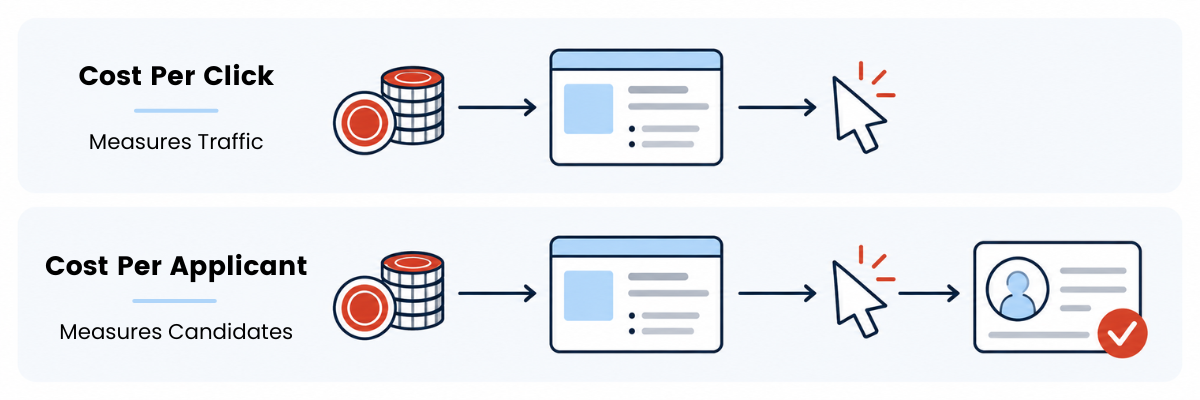
If your recruiting budget is meant to produce candidates, CPA is the number that reflects whether it’s working.
Why Cost Per Click Is Losing Ground
The flat-fee, pay-for-placement model that CPC pricing is built on doesn’t reward performance. A vendor gets paid whether your ad produces ten applicants or zero, so their incentive is to maximize impressions, not results.
That misalignment is one reason the market is moving toward performance-based, programmatic buying. Industry analysts project the programmatic job advertising platform market to grow from roughly $2.71 billion in 2026 to $5.70 billion by 2031, a compound annual growth rate of about 16%, well ahead of the broader recruitment advertising agency market’s high-single-digit growth over the same period. Employers aren’t just adding programmatic as one channel among many; they’re reallocating budget away from flat-fee placements and toward platforms that charge for outcomes instead of impressions. Your peers are increasingly buying candidates, not clicks, while flat-fee spend keeps producing the same click-volume reports it always has.
How Programmatic Job Advertising Shifts the Focus to Applicants
Programmatic job advertising is the automated buying and placement of job ads across a network of job boards, aggregators, and other channels, using real-time performance data to continuously reallocate budget toward the sources producing the best results.
A useful way to picture it: think about how a retargeting ad follows you around the web after you look at a pair of shoes, adjusting where and when it shows up based on your behavior. Programmatic job advertising works the same way, except the “conversion” it’s chasing is a completed application, not a purchase. Your open roles are pulled in through a data feed, distributed to the channels where qualified candidates for that role and location are actually active, and the algorithm shifts spend away from underperformers automatically.
That’s what separates programmatic from simply “posting to more sites.” Distribution alone doesn’t lower your cost per applicant. Continuous, automated reallocation does.
A Before-and-After Look at Manual vs. Automated Budget Allocation
Before: A recruiter sets a monthly budget across five job boards based on last quarter’s performance. Three weeks in, one board is quietly burning spend on clicks with almost no applications, but nobody notices until the monthly report, by which point most of the budget is gone.
After: The same budget runs through a programmatic platform. Within 48–72 hours, the system is already reading click volume and early application rates by source. By week two, spend has shifted toward the two channels producing qualified applicants at the lowest cost, without anyone manually adjusting a bid.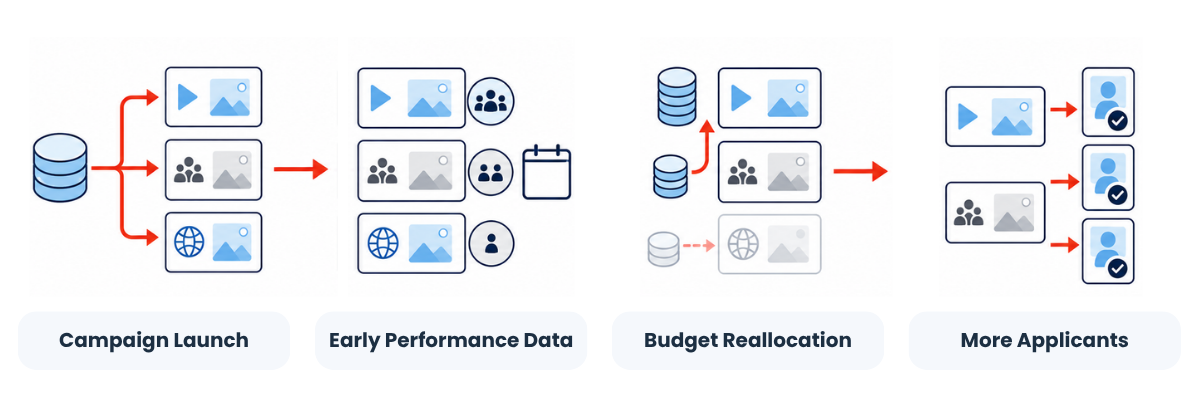
The dollar amount didn’t change. The outcome did, because the decision-making moved from monthly and manual to continuous and automated.
What to Look for in a Programmatic Job Advertising Platform
Not every “programmatic” platform delivers on that promise. Before you commit, look for real-time XML feed integration with your ATS, transparent full-funnel reporting that shows clicks, applications, and cost per applicant by channel, and a pricing model tied to outcomes rather than impressions.
DE Amplify, DirectEmployers’ programmatic advertising platform, was built around that exact set of priorities. It automates job distribution, reallocates budget in real time as performance data comes in, and reports cost per applicant by source, so recruiters see not just what they spent but what it produced. As a nonprofit consortium, DirectEmployers built its pricing model around reducing recruitment cost rather than maximizing ad spend, which is worth factoring in as you compare service offerings.
Cost per click will keep telling you how much traffic you bought. Cost per applicant tells you whether that traffic turned into candidates, and it’s the number more of the industry is optimizing for every year the programmatic market grows. If your reporting still stops at clicks, you’re measuring the wrong end of the funnel.
Ready to see what your cost per applicant could look like with a platform built for it? Talk to the DirectEmployers team about DE Amplify and how you can start optimizing for hires rather than clicks.

Let’s chat!
Fill out this form and we'll contact you shortly to schedule a demo.