
Key Takeaways
- GAO report GAO-26-107937, dated September 29, 2026, found that DOL has reduced its Section 503 oversight of federal contractors since January 2025.
- From fiscal years 2017 through 2025, 532 OFCCP audits found Section 503 violations.
- OFCCP’s workforce fell from 484 full-time equivalent staff in early fiscal year 2025 to 79 in the first quarter of fiscal year 2026.
- DOL agreed with six of GAO’s eight recommendations but said it has no plans at this time to resume Section 503 audits or AAP certifications.
- Section 503 nondiscrimination, reasonable accommodation, written AAP, and outreach obligations remain in effect for covered federal contractors.
End of summary box.
The Government Accountability Office (GAO) has told the Department of Labor (DOL) that it should restart compliance audits of federal contractors under Section 503 of the Rehabilitation Act of 1973. In a report dated September 29, 2026, and publicly released on October 6, Disability Employment: DOL Should Enhance Monitoring and Guidance for Federal Contractors (GAO-26-107937), GAO found that DOL has reduced its Section 503 oversight since January 2025 and issued eight recommendations to rebuild it.
For federal contractors, the report changes no legal requirement. It does put a congressional watchdog on record that Section 503 oversight should return, at a moment when contractors are still adjusting to a rewritten Section 503 rule.
What GAO Found
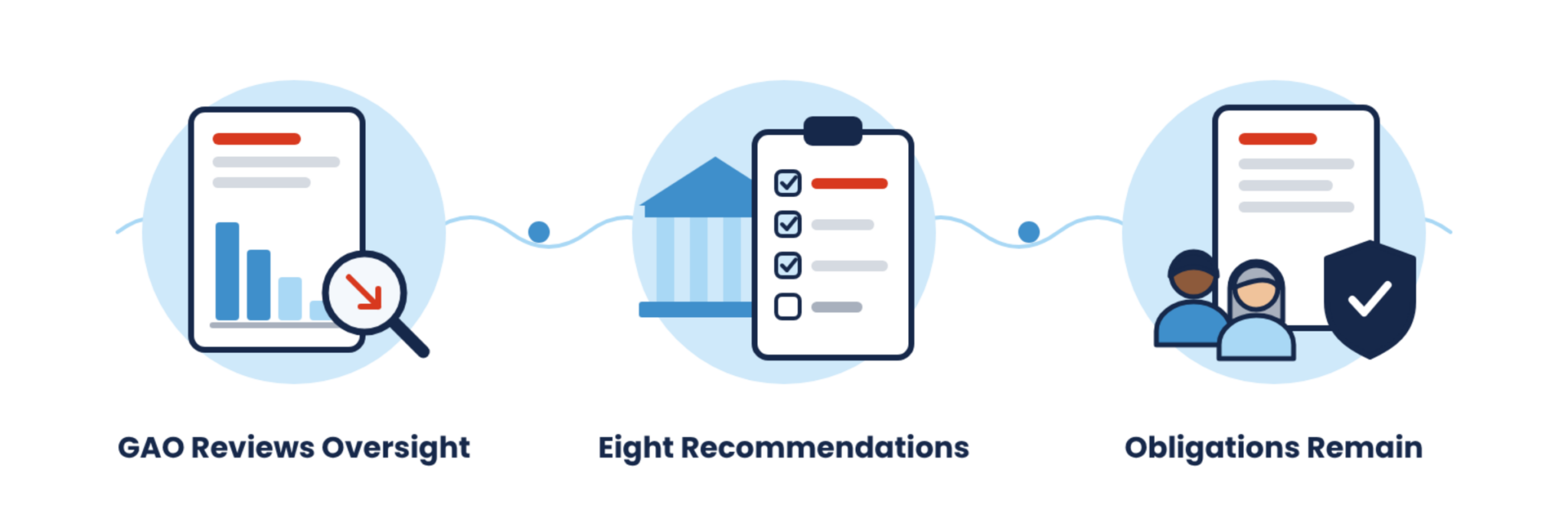
GAO reviewed how the Office of Federal Contract Compliance Programs (OFCCP) monitors contractors’ obligations to employ and advance qualified individuals with disabilities. Its central finding: DOL has suspended two key monitoring tools. One is the annual affirmative action program (AAP) certification contractors made through OFCCP’s Contractor Portal. The other is the audit of selected contractors.
GAO pointed to the agency’s own enforcement record to explain why that matters. OFCCP concluded 8,971 audits from fiscal years 2017 through 2025, and 532 of them found Section 503 violations. Without audits, GAO concluded, DOL has less assurance that contractors are supporting the employment of people with disabilities. Stakeholders also told GAO that contractors are confused about which requirements still apply.
The report also documents how much smaller OFCCP has become. The agency went from 484 full-time equivalent staff in the first quarter of fiscal year 2025 to 79 in the first quarter of fiscal year 2026, and from 50 field offices in January 2025 to six in April 2026. GAO found those reductions were not informed by strategic workforce planning.
Complaints are the one enforcement channel still operating. GAO found that OFCCP investigated 99 of the 3,063 Section 503 complaints it received from fiscal years 2021 through 2025, about 3 percent, and has not analyzed why the rest were closed or referred elsewhere.
GAO prepared the report at the request of Senators Bernard Sanders and Kirsten Gillibrand, drawing on OFCCP enforcement data, DOL human resources data, and interviews and discussion groups with DOL officials, contractor representatives, consultants, researchers, and disability organizations.
The Eight Recommendations
GAO directed all eight recommendations to the Secretary of Labor. In summary, OFCCP should:
- Resume collecting AAP certifications through the Contractor Portal or another mechanism
- Resume audits related to Section 503 compliance
- Analyze trends in why Section 503 complaints are closed or referred, and use the results to strengthen the complaints process
- Carry out strategic workforce planning in order to support its responsibilities and future needs
- Post resources on potential partner organizations, including regional ones, that can help contractors recruit employees with disabilities
- Add a reasonable accommodations section to its website
- Publish resources on how to assess outreach and recruitment efforts
- Post a list of best practices for Section 503 compliance
Recommendations five through eight reflect what GAO heard from the contractor community. Stakeholders described difficulty with outreach and recruiting, retaining and advancing employees with disabilities, and demonstrating compliance. GAO also noted that OFCCP had removed its partner organization database, sample AAP, and best practices list from its website.
How DOL Responded
DOL neither agreed nor disagreed with recommendations one and two. In a September 10, 2026 letter signed by OFCCP Director Kenneth J. Wolfe, the department said OFCCP has no plans to resume AAP certifications or audits at this time, and that it continues to enforce Section 503 by investigating complaints. GAO responded that both tools remain important and that DOL should resume them as soon as possible.
DOL agreed with recommendations three through eight and tied most of its commitments to fiscal year 2027. Those include a state-by-state directory of referral organizations, a consolidated reasonable accommodations section, an updated best practices list, workforce planning for OFCCP, and updated information on meeting the outreach assessment requirement.
GAO recommendations are not binding. DOL decides whether and when to act on them, and GAO tracks the status of each one publicly over time.
A Report That Lands in an Unsettled Environment
The timing matters. On August 21, 2026, OFCCP published a final rule, effective September 21, 2026, that removed the invitation to self-identify as an individual with a disability, discontinued Form CC-305, and eliminated the 7% utilization goal along with the related data collection requirements. That rule followed OMB’s July approval extending Form CC-305 through 2029, which we covered in our earlier post on the CC-305 extension.
So contractors are now reading two signals at once. DOL has reduced both the quantitative requirements of Section 503 and its own monitoring activity. GAO, reporting to Congress, has concluded that monitoring should increase and that contractors need more guidance.
What This Means for Federal Contractors
What has not changed: Section 503 and its implementing regulations at 41 CFR part 60-741 remain in effect. Covered contractors must still:
- Refrain from discriminating on the basis of disability
- Provide reasonable accommodations
- Maintain a written Section 503 AAP if they have 50 or more employees and a contract of at least $50,000
- Continue outreach and recruitment of qualified individuals with disabilities, and assess the effectiveness of those efforts annually under 41 CFR 60-741.44(f)(3)
What has changed: Since September 21, 2026, contractors are no longer required to invite disability self-identification, use Form CC-305, or measure against the 7% utilization goal.
What is paused: OFCCP is not conducting Section 503 audits, and AAP certification is not open. Complaint investigations resumed in July 2025 and continue. A pause in enforcement activity is an agency choice that can be reversed. It is not a change in the law.
In practice, HR and TA teams should keep Section 503 AAPs current, document outreach and recruitment efforts, and maintain a consistent, well-recorded reasonable accommodation process. Those are the same areas GAO’s stakeholders flagged as hardest to demonstrate in a review, and they are the records a future audit would request.
Staying Ahead of What Comes Next
There is no comment period or filing deadline tied to this report. The items to watch are the compliance resources DOL committed to post in fiscal year 2027, the outcome of its ongoing review of OFCCP compliance activities, and any announcement on enforcement priorities, audits, or AAP certification.
DirectEmployers will continue tracking DOL’s response and will alert Members when there is a substantive change to report. Members with questions about Section 503 obligations can reach out to their DirectEmployers Membership Team, connect with peers in DE Connect, or join monthly Office Hours to talk with an HR compliance expert.
THIS COLUMN IS MEANT TO ASSIST IN A GENERAL UNDERSTANDING OF THE CURRENT LAW AND PRACTICE RELATING TO OFCCP. IT IS NOT TO BE REGARDED AS LEGAL ADVICE. COMPANIES OR INDIVIDUALS WITH PARTICULAR QUESTIONS SHOULD SEEK ADVICE OF COUNSEL.

Let’s chat!
Fill out this form to indicate which solutions you’re interested in and we'll contact you shortly to schedule a demo.
