
Key Takeaways
- The U.S. Department of Labor (DOL) has finalized a new rule for deciding who is an employee and who is an independent contractor under the Fair Labor Standards Act (FLSA).
- The rule rescinds the 2024 independent contractor rule and restores a streamlined test built on two core factors: control over the work and the opportunity for profit or loss.
- For the first time, the same analysis also applies under the Family and Medical Leave Act (FMLA) and the Migrant and Seasonal Agricultural Worker Protection Act (MSPA).
- The rule does not change classification under the Internal Revenue Code or the National Labor Relations Act, and it does not preempt stricter state laws such as ABC tests.
- Publication in the Federal Register is expected soon. Watch for the effective date, which will occur 60 days after the publication date.
End of summary box.
The Department of Labor (DOL) has finalized its long-awaited independent contractor rule, closing out a rulemaking that began with a proposal in February 2026. Secretary of Labor Keith Sonderling announced the rule at a two-hour event at DOL headquarters on November 19th, describing it as the end of more than a decade of “regulatory ping-pong” over worker classification.
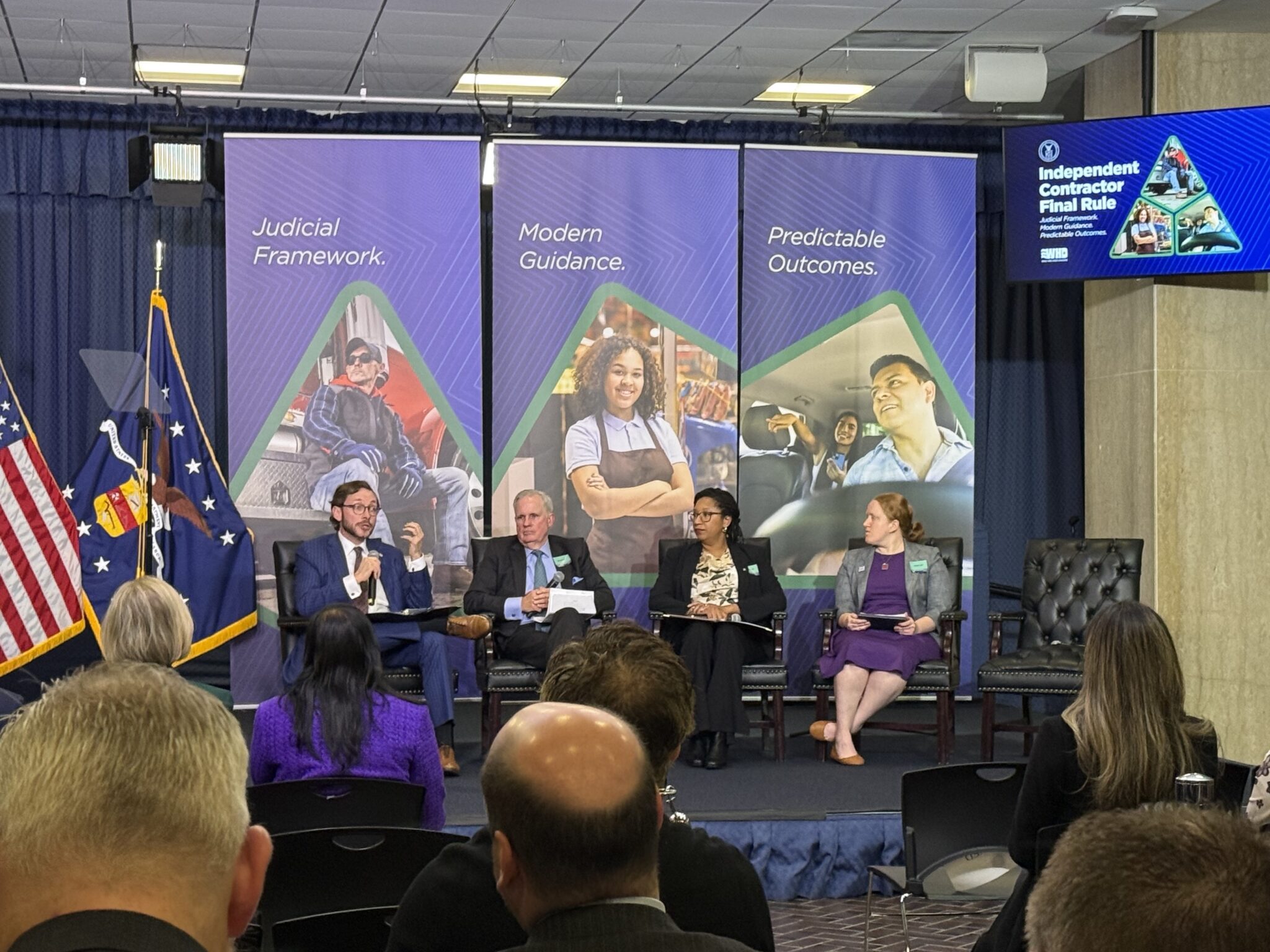
Solicitor of Labor Jonathan Berry led a panel discussion on worker classification. View all 19 event photos on Flickr.
For federal contractors, the rule matters well beyond the gig economy. It shapes how Wage and Hour Division (WHD) investigators will evaluate freelancers, consultants, contingent recruiters, and other non-employee talent, and it now carries over into Family and Medical Leave Act (FMLA) and Migrant and Seasonal Agricultural Worker Protection Act (MSPA). Here is what changed and what it means for your HR and Talent Acquisition teams.
What the Final Rule Does
 According to WHD Administrator Andrew Rogers, the rule does three things:
- Rescinds the 2024 rule. The Biden-era rule used six equally weighted factors plus a catch-all for “additional factors.” DOL stopped enforcing it on May 1, 2025.
- Restores a streamlined analysis similar to the 2021 rule from the first Trump administration, with modifications and enhancements.
- Extends the analysis to the FMLA and MSPA, because both statutes incorporate the FLSA’s scope of employment.
The rule keeps the long-standing “economic reality” test. A worker who is economically dependent on a business for work is an employee. A worker who is in business for themselves is an independent contractor.
The Two Core Factors and Three Supporting Factors
The rule identifies five factors, with two carrying the most weight:
- Nature and degree of control over the work. This points toward contractor status when the worker controls key aspects such as scheduling, choosing projects, or working for others. It points toward employee status when the business controls the schedule or workload or requires the worker to work exclusively for it.
- Opportunity for profit or loss based on the worker’s initiative, investment, or both. A worker who can only earn more by working faster or longer leans toward employee status.
When both core factors point the same way, the rule says there is a substantial likelihood that this is the correct classification.
Three other factors may also be considered, though DOL describes them as less probative and sometimes not probative at all: the skill required for the work, the permanence of the working relationship, and whether the work is part of an integrated unit of production. Additional factors count only to the extent they show whether the worker is in business for themselves.
Two other features stand out for compliance teams:
- Actual practice over paper rights. What the parties actually do matters more than what a contract says is theoretically possible.
- Fourteen worked examples. The 2021 rule had six. The new examples cover delivery and truck drivers, construction workers, roofers, farm workers, freelance journalists, and digital platform workers, with some added in response to public comments.
How Enforcement Will Work
DOL leaders were careful to frame the rule as neutral. Solicitor of Labor Jonathan Berry put it plainly: “The purpose of the rule is to get the classification right. It’s not favoring either status.”
Berry also noted that employees cannot waive FLSA protections. Where a company labels workers as contractors but controls their work and offers no real opportunity for profit or loss, DOL said it will continue pursuing violations and back wages.
WHD Deputy Administrator Dieera Fitzgerald said the two core factors will let investigators get to the heart of the question more efficiently. She added that investigators will coordinate with the Solicitor’s Office early when an employer disputes a preliminary finding of misclassification.
What Has Not Changed
The rule narrows its reach on purpose. It does not change:
- Classification tests under the Internal Revenue Code or the National Labor Relations Act
- State or local classification laws, including ABC tests in states such as California and New Jersey
As panelist David Fortney of Fortney & Scott noted, multistate employers will still need to calibrate state by state, and ABC tests vary from one state to the next.
What This Means for Federal Contractors
Federal contractors engage contract talent in many forms: project consultants, contract recruiters, subject matter experts, and seasonal or surge support. Classification determines who receives minimum wage and overtime protections, who counts toward FMLA coverage and eligibility, and which workers appear in your personnel records.
In practice, the rule gives HR and TA teams a clearer starting point. It also raises the importance of making sure day-to-day practice matches the contract. An agreement that grants a consultant full schedule control means little if a hiring manager sets their hours every week.

Keep in mind that a worker’s status under this rule does not settle their status under every law. Tax, labor relations, and state requirements follow their own standards.
Recommended Next Steps
- Inventory your independent contractor relationships and test each against the two core factors.
- Compare actual practice to contract terms, especially schedules, exclusivity, and how pay is set.
- Review the 14 examples in the rule for scenarios that resemble your workforce.
- Brief hiring managers and TA leaders on how their direction of contract workers can affect classification.
- Map state requirements for every location where contractors work, including remote workers.
- Use WHD’s resources. Fact Sheet #13 is available now on the WHD website, with updated eLaws tools, a small entity compliance guide, and Field Operations Handbook guidance to follow. DOL also encouraged employers to request opinion letters on unresolved questions.
Looking Ahead
The Final Rule will be published in the Federal Register in the coming days, and the effective date will follow 60 days from that publication. Given the history of this rule, from the 2021 rule’s delay and withdrawal to the 2024 rule’s non-enforcement, contractors should also watch for legal challenges and for congressional efforts to make the standard permanent.
DirectEmployers will continue tracking this rule through publication and implementation so Members can stay ahead of changes that affect their compliance posture. Subscribe to Compliance News for updates as new guidance is released, ask questions of your peers in DE Connect, or join the monthly Office Hours for additional insights and conversation.
THIS COLUMN IS MEANT TO ASSIST IN A GENERAL UNDERSTANDING OF THE CURRENT LAW AND PRACTICE RELATING TO OFCCP. IT IS NOT TO BE REGARDED AS LEGAL ADVICE. COMPANIES OR INDIVIDUALS WITH PARTICULAR QUESTIONS SHOULD SEEK ADVICE OF COUNSEL.

Let’s chat!
Looking for help with your federal contractor compliance efforts? Share your contact information, and our team will reach out to discuss how DirectEmployers can support you.