Key Takeaways
The final day of DEAMcon26 delivered a high-density roadmap for navigating the intersection of talent acquisition, AI, and federal compliance. Key highlights included Brian Fink’s demonstration of free Google Custom Search Engines to bypass expensive sourcing tools, and a warning from SonicJobs that employers must integrate with ChatGPT now to avoid ceding the next generation of job search to third-party aggregators. On the legal front, experts from DLA Piper, K&L Gates, Roffman Horvitz, and Silberman Law underscored that “bias-free” AI vendor claims rarely meet legal statistical standards, urging employers to conduct privileged pay equity audits and maintain rigorous ATS candidate records as regulatory scrutiny from the EEOC and OFCCP intensifies.
The Home Stretch Delivered–Winding Down a Whirlwind Conference
April 17th marked the close of the conference, but this year’s sessions had a specific gravitational pull. The coffee hits differently, the room is a little smaller, and the people still in their seats by Friday morning are the ones who showed up for the work, not the schedule. At DEAMcon26, that gravitational pull held. Four sessions—spanning talent sourcing, pay equity compliance, the future of job search, and a forward-looking legal synthesis that sent attendees home with more on their to-do lists than they’d arrived with—made the final morning in Indianapolis as dense and actionable as anything that had come before it.
Is Search Relevant? Brian Fink Says Yes—and It’s Still Free
 Brian Fink, Managing Partner at The ReWork Group and powerhouse former recruiter at X, McAfee and others, opened day three with a session that was equal parts classroom, stand-up comedy, and live demo—and walked out having given every talent acquisition lead in the room a suite of sourcing tools that cost exactly nothing. His thesis: search is not dead, it’s just been ceded to LinkedIn and Indeed by practitioners who stopped being curious, and you can take it back right now, on your phone, even.
The demonstration centered on Google’s Custom Search Engine (CSE) tool, which any Gmail user can build to scrape publicly available data from any combination of websites—LinkedIn, Instagram, TikTok (even without an account!), niche professional communities—filtered by geography, language, and refinements built from Boolean strings. Fink built one live on stage titled “DEAMcon 2026,” adding refinements for email addresses, underrepresented groups (filtered by professional association language rather than protected characteristics), open-to-work signals, and female leadership language. The total cost: free. The audience reaction when search results populated: audible.
His sourcing pitch for Instagram was equally concrete. “I can type, ‘site:Instagram.com “@gmail.com” job engineer’ and pull out all the Java engineers who have posted their email address on Instagram. Instead of coming to them and saying hey, check your LinkedIn, I can say hey, I love what you are doing in Bali—do you have a minute to talk?” He wasn’t dismissing AI. He was situating it honestly: the paid AI tools returned one neonatal nurse profile when asked. His custom search engine returned dozens, with contact information, for free.
The room’s one burning question—can we drop LinkedIn?—got a characteristically direct answer. Job slots are now inundated with AI-generated applications; LinkedIn’s own verification layer is a tacit admission that the volume problem is real. The value, if it exists, is narrowing. “It is not a Louis Vuitton bag,” Fink said. “The price keeps going up and the scarcity thing—I don’t buy it.”
Pay Equity Is Not Optional, and Never Was

Meredith Gregston of DLA Piper and Craig Leen of K&L Gates shifted the focus to pay equity, one that served as both a history lesson and forward strategy for a regulatory landscape that has shifted dramatically in form but not at all in underlying legal obligation.
The foundation hasn’t moved: the Equal Pay Act of 1963 prohibits wage discrimination based on sex for substantially equal work. Title VII adds disparate treatment, disparate impact, and protected classes well beyond sex. What has changed is the enforcement architecture around those laws, and the stakes attached to ignoring them. Leen was characteristically precise, reminding attendees that, “This is still the area of greatest latent liability for American employers.” The deemphasis on disparate impact from the current EEOC doesn’t eliminate the risk—EEOC Chair Andrea Lucas acknowledged the agency dropped exactly one case because of the deemphasis, and the statistical analyses that identify disparate impact also identify disparate treatment pattern-and-practice. The methodology doesn’t change; the legal theory used to pursue it does.
Gregston walked through the state law matrix, an intricate patchwork of protected categories, comparator definitions, compensation definitions, and affirmative defenses that varies enough to make a one-size-fits-all compliance approach genuinely impossible. Colorado and California remain the most restrictive benchmarks, yet New Jersey and Massachusetts are closing the gap. For multistate employers, the practical answer is to adopt the most restrictive standard everywhere, document the decision, and build a regular annual cadence of compensation analysis. “If you are really risk-averse,” Gregston said, “those analyses look very different than a company just doing a quick compliance check.”
Leen’s False Claims Act tie-in completed the circuit that had been building across three days: employers who sign government contracts certifying compliance with federal antidiscrimination law—including the Equal Pay Act—and who cannot demonstrate they have assessed their compensation practices are exposed to the same deliberate ignorance standard that applies to DEI certification. “You absolutely should be doing this under privilege,” he said. “And the world has changed, this is not going to go away. You need to have comprehensive compensation analysis programs in place even more now.”
Two moments from the Q&A crystallized the operational stakes. First, pay transparency: putting language in an offer letter that says compensation is confidential is a violation of the National Labor Relations Act, not just state pay transparency statutes, and has been since the 1980s. “Bless your heart if you think you can still do that,” Gregston said. Second, on the question of whether Colorado’s stance that remote job postings trigger pay transparency obligations regardless of location is enforceable: both panelists were skeptical anyone would litigate it, but neither would recommend testing that hypothesis.
Your Jobs Belong in ChatGPT: Here’s Why Today Is Already Late

Mikhil Raja, CEO of SonicJobs, and James Winfrey, Director of Enterprise Partnerships, delivered the session most likely to change what someone authorizes in their next budget cycle. Their argument was structural, historical, and urgent in equal measure.
100 million Americans use ChatGPT every week. Globally, it’s now 900 million weekly users, a number that was 800 million when the SonicJobs team finalized their slides the previous Saturday. It has grown to this scale five times faster than Google did at its peak. And here is the thing that should focus every talent acquisition leader in the room: the mistake employers made with Google—ceding the default search result to Indeed for fifteen years and paying billions of dollars to buy back traffic to their own jobs—is about to happen again, right now, and the window to be first is measured in months, not years.
The mechanism SonicJobs has built with OpenAI is a ChatGPT app that allows employers to be the direct, branded answer when candidates search for jobs, explicitly (searching “show me pharmacy jobs five miles from CVS Health”) or implicitly (searching for jobs generally, where default answers are trained on prior explicit behavior). The difference from Google is the incentive structure: ChatGPT’s revenue is subscription-based, not click-based, which means it actively wants brands engaging early and deeply to drive outcome quality for users. “They want to engage the brands as early as possible,” Raja said. “They want people not just to have clicks but to have actual answers and outcomes.”
The week of DEAMcon26 itself was the product’s public coming-out: US Secret Service live, Johns Hopkins Hospitals live, Spectrum and ChristianaCare and Great Clips launching the following week. The compliance question—what data is captured?—was answered directly. Only public job description data flows into the platform; candidates are routed to the employer’s career site for application; no personally identifiable information (PII) is captured. For federal contractors with elevated security concerns, the apply-on-ChatGPT functionality is optional; brand presence and implicit search indexing still apply.
The internal sell, for those facing skeptical CFOs and team leaders, was perhaps the most useful moment. Ask your children how often they use ChatGPT versus Google. Then calculate your Indeed spend over the last fifteen years and project it forward unchanged. “If I were going to advise you not to do anything,” Raja said, “your search is going to go to someone else. And that someone else is Indeed.”
Charting the Course: The Closing Session Nobody Wanted to End

Josh Roffman and Alissa Horvitz of Roffman Horvitz, PLC, and Mickey Silberman of Silberman Law PC, took the final session and used it the way three experienced practitioners use forty-five minutes of earned attention: they synthesized three days of conference content into a set of forward-looking obligations nobody in the room could claim not to have heard.
On AI, Silberman surfaced the gap that will define employer liability for years: the 4/5ths rule that most AI vendors use to claim their tools are “bias free” is practically superseded by the two-standard-deviation statistical significance test that courts and enforcement agencies apply. “You will have big numbers,” Silberman said. “You will have not two or three standard deviations. You will have five, six, seven, nine, ten.” The tool may show females performing at 95% of the male rate and still fail the legal standard by thirty standard deviations. The vendor doesn’t tell you this. You need legal in the room before procurement, not after.
One line from the session will likely travel well beyond Indianapolis: “It is bias free because it only has adverse impact against whites.” That was Silberman describing an actual vendor response he received. “That seventeen million from IBM,” he said, “will be pennies on the dollar of what is coming.” The room went quiet.
On DEI program auditing, the “stop and swap” test was offered as a practical heuristic: if you replace the group in question with the traditional majority group and the result feels obviously unlawful, your current program carries meaningful risk. Diverse slates are clearly out. Programs and events limited to a single protected group—including otherwise well-intentioned events like female-only leadership retreats, as EEOC’s recent Coca-Cola distributor suit illustrated—require redesign, not removal. The reframe is that diversity as a concept survives; it just needs to mean breadth of background, perspective, education, and experience rather than protected category headcount.
On VEVRAA and Section 503, Roffman was unambiguous: the written assessment of outreach effectiveness is still required, regardless of what OFCCP is or isn’t auditing right now.
Congressional budget cycles have continued to fund the agency, and the Office of Civil Rights within the Department of Labor (DOL) will carry that compliance function forward regardless of what it’s named (See the proposed Budget for the U.S. Government for Fiscal Year 2027 for more information). Midterm elections later this year may accelerate the enforcement posture significantly.
And on data analytics, Horvitz made the final practical appeal of the conference: do not drop candidate dispositions from your ATS. “I am begging you as a lawyer,” she said, “When the EEOC—the same EEOC that has nominally deemphasized disparate impact—requests all applicant data for all Illinois locations of a food service company, as it did two weeks before this conference, your organization’s ability to defend itself is entirely dependent on the quality of its contemporaneous records.”
DEAMcon26 began with a 25-year origin story and ended with a forward-facing action list that runs at least twelve items deep. The regulatory environment will keep evolving. AI will keep accelerating. The talent market will keep demanding authenticity at scale. What this community has, and what two and a half days in Indianapolis made visible again—is the institutional knowledge, the peer relationships, and the collective will to navigate all of it together. Watch our conference highlight reel below to relive the hype!
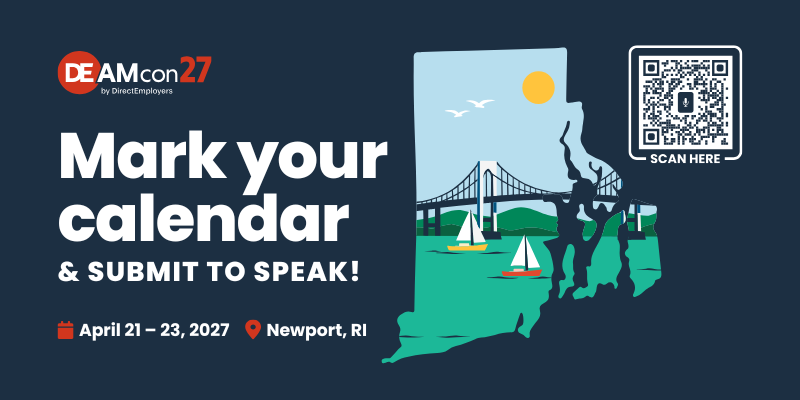
As a closing note of the conference, attendees learned that next year’s event will be held in Newport, Rhode Island, April 21-23, 2027. If you’re ready to share your successes, learning moments, and growth in compliance, talent acquisition or even AI-readiness as related to HR, we’re all ears! Submit your proposals to speak, running now through August 15th!
Continue Reading