
Key Takeaways
Day 1 of DEAMcon26 kicked off DirectEmployers’ 25th-anniversary celebration by navigating a high-stakes regulatory transition, highlighting a pivot from traditional OFCCP oversight to DOJ-led enforcement under the False Claims Act—underscored by the recent $17 million IBM settlement. Key takeaways focused on the magnification risks of AI, emphasizing that employers remain fully liable for automated decisions. Strategic shifts discussed include moving from “DEI” toward broader anti-discrimination frameworks to ensure legal defensibility, reclaiming career sites as the primary home base for recruitment, and evolving veteran and disability initiatives from simple commitments into intentional, strategy-backed programs. The day concluded with a call to reject “imitation as a race to the middle,” urging HR leaders to embrace creative disruption in a volatile compliance and talent landscape.
“That Idea, Radical in Its Simplicity”: Opening the 25th Anniversary Celebration
There’s a specific kind of energy that fills a room when people realize they are part of something that has actually lasted. Not just survived—lasted. When 185 Members, partners, and subject matter experts filed into the general session hall at The Westin Indianapolis on Wednesday, April 15th, that energy was palpable. This was DEAMcon26, and the start of DirectEmployers 25th anniversary celebration. From the opening remarks to a keynote that had the room engaged and then inspired to think differently, day one delivered exactly what this community has come to expect: urgency, candor, and the kind of peer-to-peer and industry expert insights you can’t get anywhere else.
Managing Director and Board Advisor Tom Eckhart and newly appointed Executive Director Jeff Gill welcomed attendees to Indianapolis—homebase, as Eckhart noted with warmth, of the Colts, the Pacers, the Indiana Fever, the Indianapolis 500, and most importantly, DirectEmployers Association.
The room was invited to sit with the significance of the milestone. “25 years,” Eckhart said. “Take a moment and let that land.” What began in 2001 as a consortium of 14 forward-thinking employers who believed they could do talent acquisition better together—not as competitors, not in silos—has grown into one of the most trusted HR consortiums in the country, with more than 1,100 members and millions of job connections facilitated through the National Labor Exchange (NLx) since 2007.
An origin story video (view the full length video here) featuring the voices of DirectEmployers’ founding employees drew heartfelt applause and a touching nod to the founding visionary, William O. Warren. But the applause wasn’t simply nostalgia—it was a handoff. “You are not just Members of an Association,” Gill told the room. “You are part of a movement that improved the American workforce in ways that are real, measurable, and lasting.” He outlined four strategic priorities for the next chapter: smarter compliance infrastructure, a relaunched talent acquisition focus through the new DE Amplify solution, AI tools that actually work for practitioners, and a community built for what’s next.
The Wage & Hour Division Fireside Chat: Clarity, Candor, & a Camp Counselor Origin Story
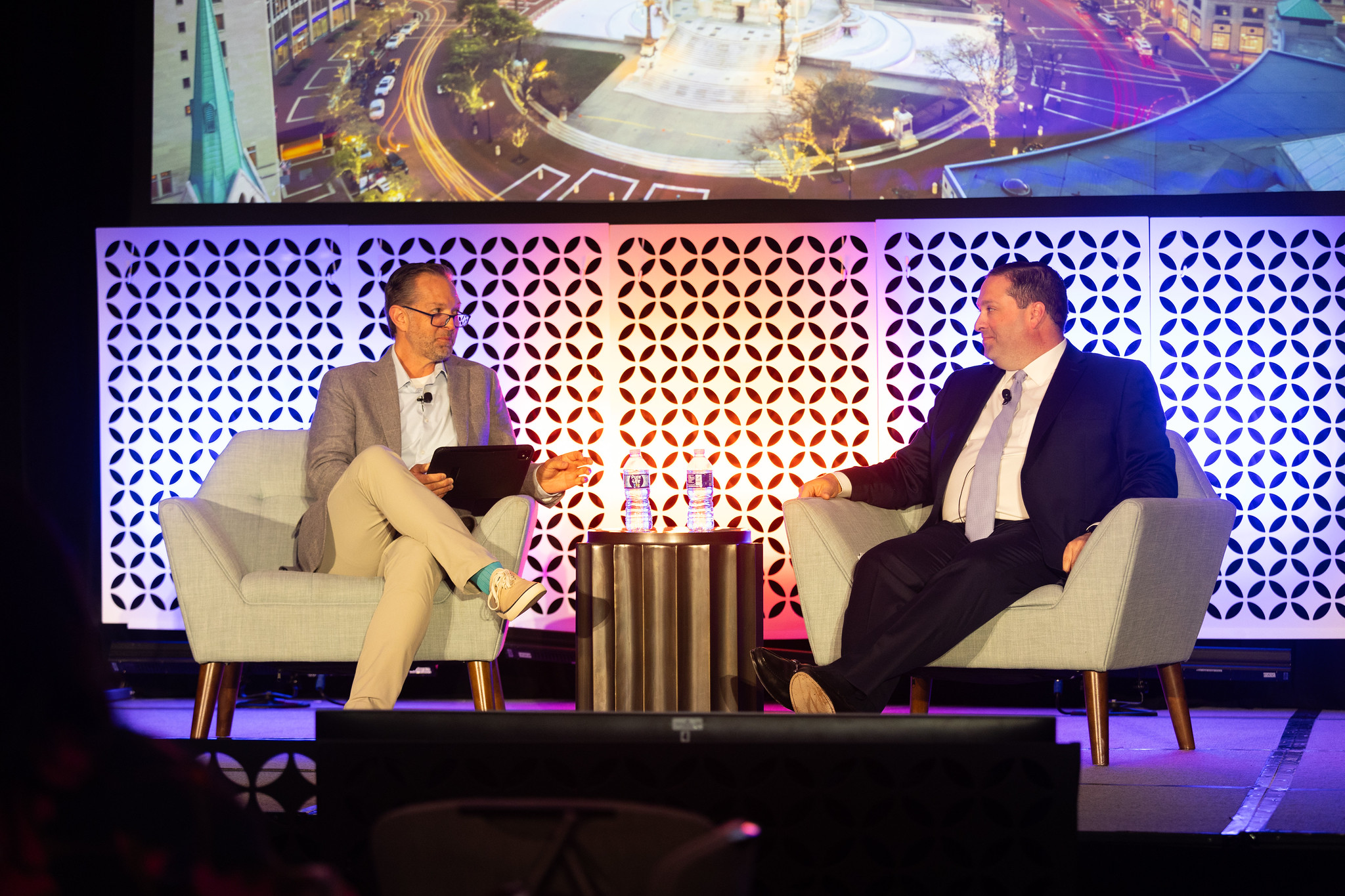 Few moments on day one matched the intimacy of the fireside chat with Andrew B. Rogers, the 20th Administrator of the Department of Labor’s Wage and Hour Division (WHD)—confirmed just last October. His backstory set the tone: as a teenager at a Maine sleep-away camp in the mid-1990s, earning $500 for a ninety-hour workweek, Rogers didn’t grumble. He looked up the law. “I found section 213(a)(3),” he told the audience, “because that’s the answer—camp counselors aren’t covered by the minimum wage.”
The substance that followed was equally sharp. Rogers walked through WHD’s newly proposed independent contractor classification rule—a two-factor framework built around employer control and opportunity for profit or loss, with three supporting factors—encouraging attendees to submit comments before the April 28th deadline. On AI, his framing was memorable and precise: “AI is a magnification tool. If you don’t have good stuff to magnify, you are going to be multiplying and making a much bigger issue of something problematic.” He was unambiguous that existing law—FLSA, FMLA, and ADA—applies fully to AI-assisted decisions. “Using AI is not some magical shield that says, well, I didn’t make the decision, the AI did. You used the AI. So, you will be responsible for it.”
His closing advice to the room: communicate. “Where we see a lot of employers go wrong is they are either too siloed, one group doesn’t know what the other is doing… making sure your communications are effective and appropriately structured—you’ll be in a much better spot to deal with the changing regulatory environment.”
OFCCP in the Second Trump Administration: A Former Director Speaks Candidly—and Announces Something Bigger
If the fireside chat set the regulatory tone for the day, former OFCCP Director and K&L Gates Partner Craig Leen’s general session on OFCCP landed with a weight that went well beyond the agenda. Before he got into substance, Leen shared that he had been nominated for a federal judicial position the day before—a moment that drew immediate applause from an audience that has known him as one of the most respected voices in this space for nearly a decade.
That news also shaped his delivery. “It has caused me to be more reflective,” he said. “About how to achieve equal employment opportunity—a goal that everyone shares. That’s bipartisan. And it should be.”
Leen traced the arc from his first tenure as OFCCP Director under the first Trump Administration—where he championed the CERT principles of Certainty, Efficiency, Recognition, and Transparency—through the enforcement-focused Biden years, and into the dramatically changed landscape of 2026. He was measured but candid: when EO 14173 rescinded Executive Order 11246 on day one of the second Trump Administration, it ended not just an affirmative action framework but OFCCP as an active enforcement engine. “OFCCP went dormant for a time.” The scheduling list was placed in abeyance, then closed.
Today, OFCCP is enforcing Section 503 and VEVRAA complaints. That’s essentially it. The agency’s budget has been zeroed out in the President’s proposal—twice—though Congress has continued to fund it near fully. Leen’s read: the money is likely being diverted internally, and no new audit lists or compliance officer hiring should be expected.

But his most pointed message wasn’t about what OFCCP is not doing. It was about what replaced it. “The biggest change is the False Claims Act. And that has been a bigger change than I think we all realize.” The $17 million IBM settlement—announced just the prior week—crystallized the shift. “When I was OFCCP director, the highest recovery we ever had was about $10 million. Yet two weeks ago, you get a settlement from the Department of Justice for $17 million. And the implication that there’s more to come.”
The enforcement mechanism has changed from a known, navigable agency process to something far less predictable: DOJ, contracting agencies, and whistleblowers, each empowered by the newly issued EO 14398’s legally defensible definition of unlawful DEI—essentially, disparate treatment in employment based on race or ethnicity. “You really can’t fight the Executive Branch on this issue,” Leen said, not as a political endorsement but as a pragmatic reality. “Your businesspeople are going to say: we don’t need a finding, or even an allegation in a public forum—we need to settle.”
His actionable guidance was specific and worth capturing directly: Keep your Section 503 and VEVRAA programs, and invest more in them, not less. Replace your 11246 AAP with an anti-discrimination program—one that includes all employees, all races, both sexes. “The key point,” he repeated several times, “is that you have to include white employees and men. That is what makes a program defensible.” Do your pay equity analysis. Conduct a DEI audit under privilege. Have documentation ready. “If the DOJ comes calling, you give that to them.” And stop calling your programs “DEI.” The term, he said plainly, is politically fraught—use “anti-discrimination” or “equality” framing instead.
He closed on a note that was forward-looking in the truest sense: “The one point that remains the same across administrations is anti-discrimination. Anchor onto that. Whatever you do now will be helpful to you in the future.”
AI in the Workplace: Legal Frameworks, Statistical Realities, and That Switch You Didn’t Know Was On
 The general session on AI in HR—led by a power panel of Michelle Duncan and Krystal Welland of Silberman Law PC, and Fred Melkey of Emerson Electric—was structured deliberately as a mock client-attorney conversation. Melkey played the compliance leader whose VP of Talent Acquisition has already bought an AI screening tool and wants to turn it on next week. Duncan’s response: “I can’t tell you how many clients have said the tool has already been turned on, or it needs to be turned on tomorrow.”
She mapped the federal legal framework—Title VII, the ADEA, and the ADA—as the primary lenses for evaluating AI employment tools, noting that the absence of a single federal AI law doesn’t mean the absence of risk. State and local law adds significant complexity: New York City’s Local Law 144 requires bias audits for automated employment decision tools and mandates public disclosure of results. Welland brought the statistical reality: correlation between recruiter and AI tool decisions on years of experience runs near 0.9, but drops to 0.2–0.3 when assessing relevant skills. “Nobody really agrees,” she said—including panels of human recruiters.
The afternoon’s AI concurrent added a practical edge: Tony Kaylin of the American Society of Employers (ASE) and Brian Marentette of Berkshire Associates opened with a question that captured the room’s unease perfectly. “How many of you have had AI turned on and didn’t know it?” The collective uncertainty was its own answer.
Talent Acquisition: Storytelling, Career Sites, & the Home Base You Own
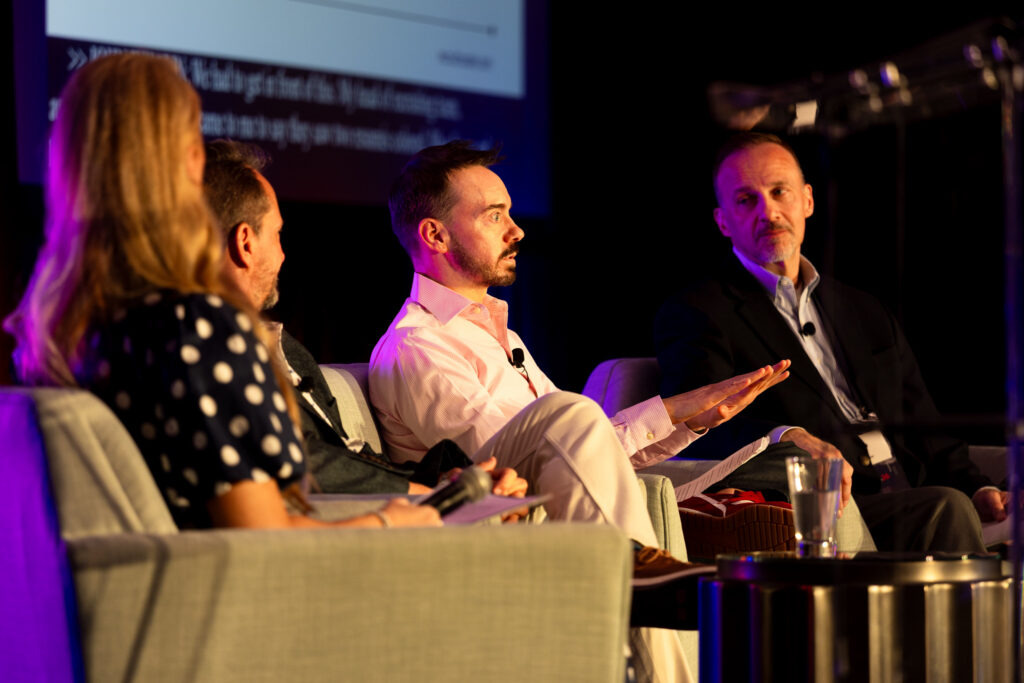
Two afternoon sessions reoriented the day’s conversation from compliance to connection. Heather Hoffman and John Ritter of Recruit Rooster moderated a candid exchange with John Whalin of the American Heart Association and Jonathan Liepe of Colorado Springs Utilities on what effective recruitment marketing actually looks like. Whalin was direct: “Job boards are dead. Everything is done through social.” The challenge now isn’t volume—it’s fit. Seth Flater and Steven Apostolidis of Recruit Rooster later reinforced a counterintuitive finding: 67% of candidates still visit a career site before applying, even as Indeed works to keep them on-platform. “Your career site must be your home base,” Apostolidis said, “because at the end of the day, that’s the thing you control.”
Veteran & Disability Inclusion: Strategy Before Commitments
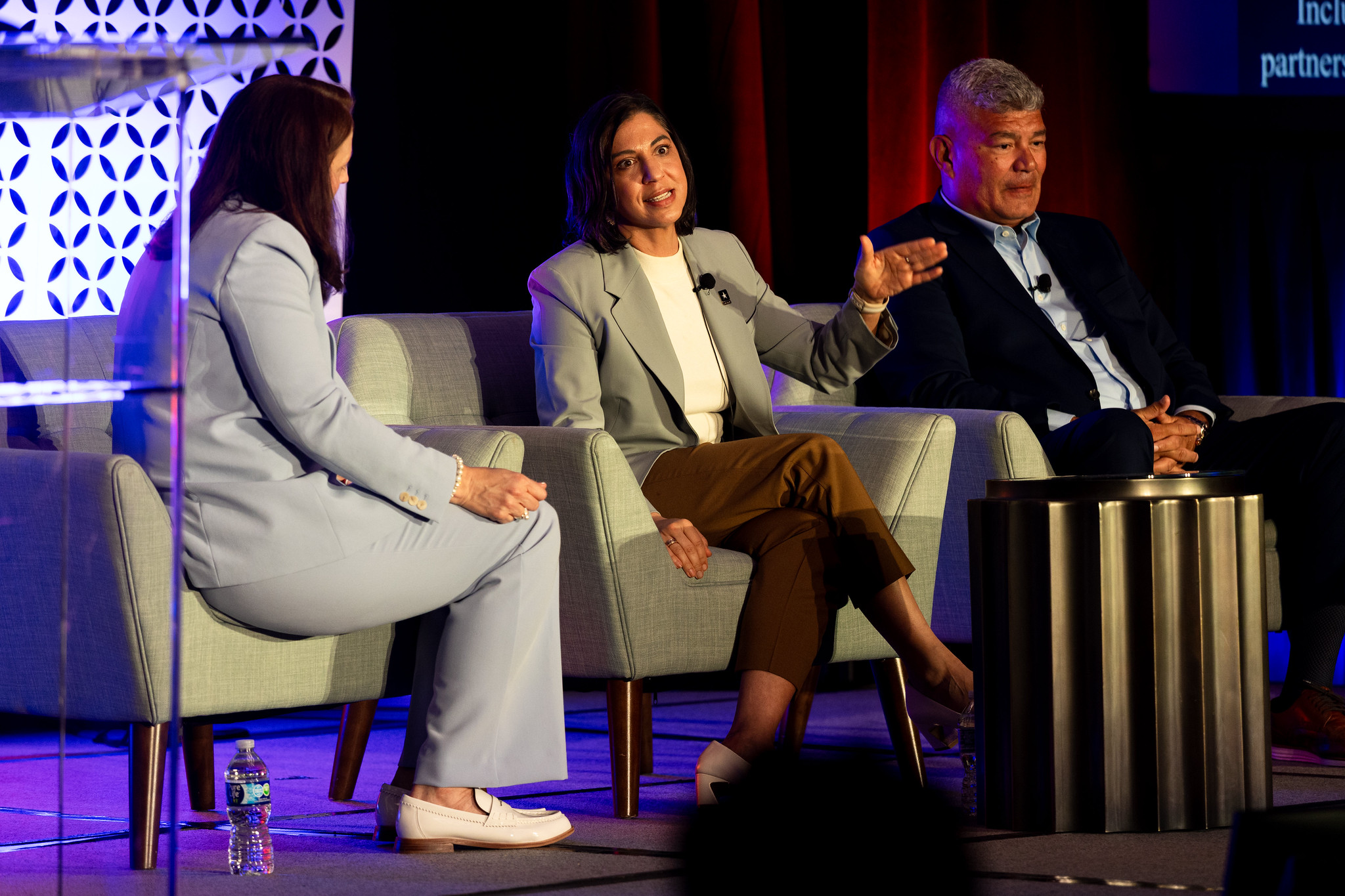 The afternoon brought two panels that grounded the day’s compliance discussions in human terms. Panelist Tiffany Daugherty of Johnson & Johnson was blunt about where veteran hiring programs fail: “We made public commitments in 2010. We meant them. But we had no dedicated team, strategy, or office.” Chuck Bunch of FourBlock and Leslie Coffey of American Corporate Partners (ACP) reinforced the retention dimension: hiring veterans without career development pathways leads to early departures and misalignment.
Later, the Eskenazi Health Gregory S. Fehribach Center team brought Indianapolis’s own story of inclusive employment—540 internships, 266 students, a model for what intentional disability inclusion looks like in practice.
A Year Into EO 14173: What the IBM Settlement Actually Means
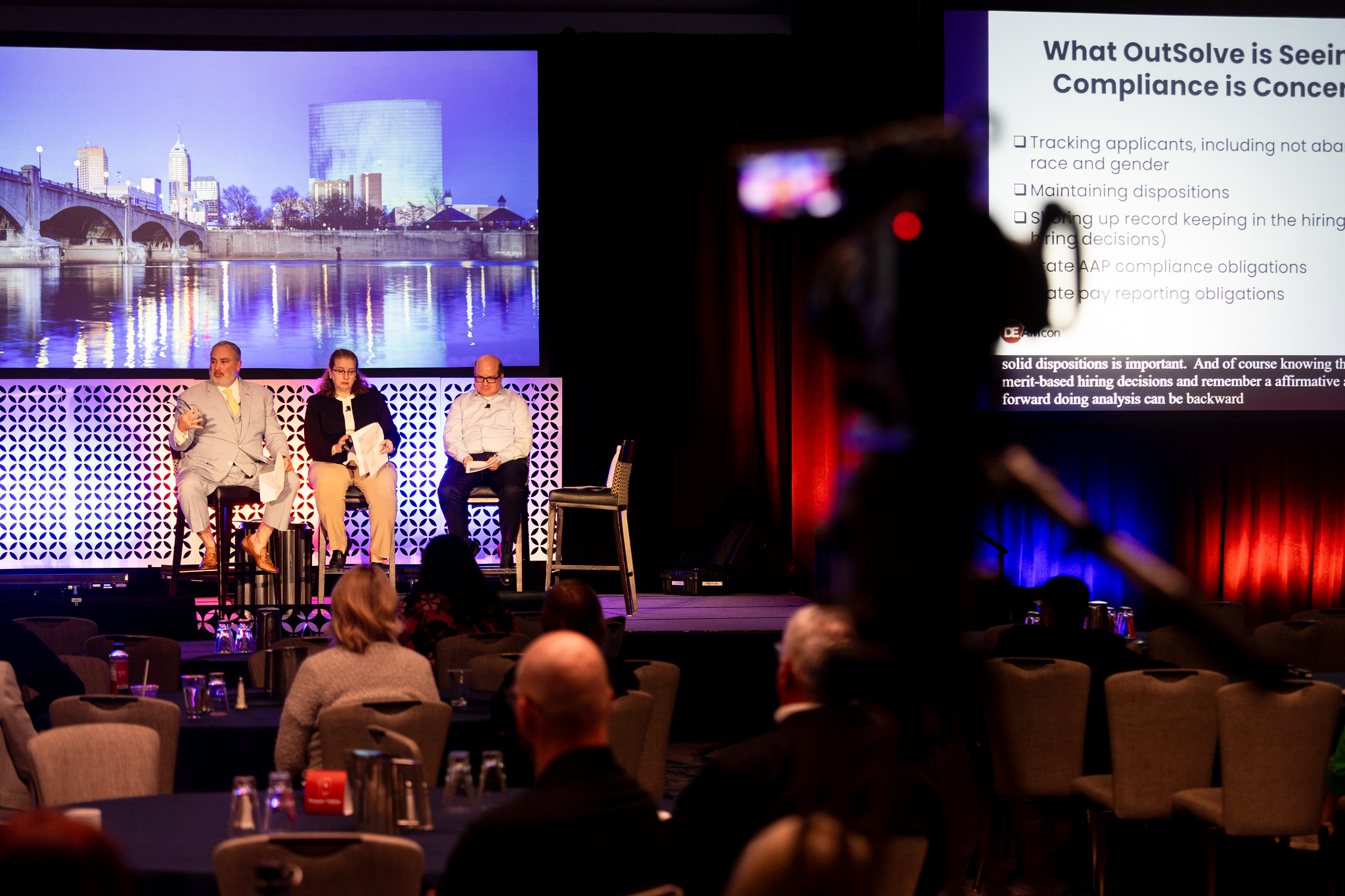 The afternoon general session on executive order enforcement—led by Joshua Roffman, Alissa Horvitz of Roffman Horvitz, PLC, and Jeremy Mancheski of OutSolve—arrived with fresh urgency. The IBM settlement, announced the prior week for $17 million, named recruitment practices explicitly. Roffman’s framing was succinct: “14398 is not aggressive. It is legally defensible language because they cannot enforce any of this if they don’t have an executive order.” The four pillars of the IBM case—demographic-tied compensation, altered interview criteria, race and sex-based demographic goals, and programs limited by race or sex—were dissected as a practical reading guide. “If you want to know what we have learned about these audits, read the IBM settlement.”
A Final Challenge to ‘Do Different Things Differently’
Tucker Bryant, nationally renowned poet and San Francisco-based creative provocateur, closed day one with something the room didn’t see coming. And that, it turned out, was the entire point.
Bryant’s thesis was deceptively simple: the biggest risk in this moment of rapid change—AI, compliance uncertainty, shifting talent markets—isn’t falling behind. It’s becoming indistinguishable. “Imitation is a race to the middle,” he said. “It is a race to average.”
He structured the keynote around three principles. The first, look twice: the distance between you and a breakthrough idea is often just the decision to stop and reconsider what you’ve already dismissed. He illustrated it with the story of YKK—the Japanese manufacturer that looked twice at the zipper, the most overlooked commodity in the garment industry, and now makes nearly half of all zippers worn on earth.
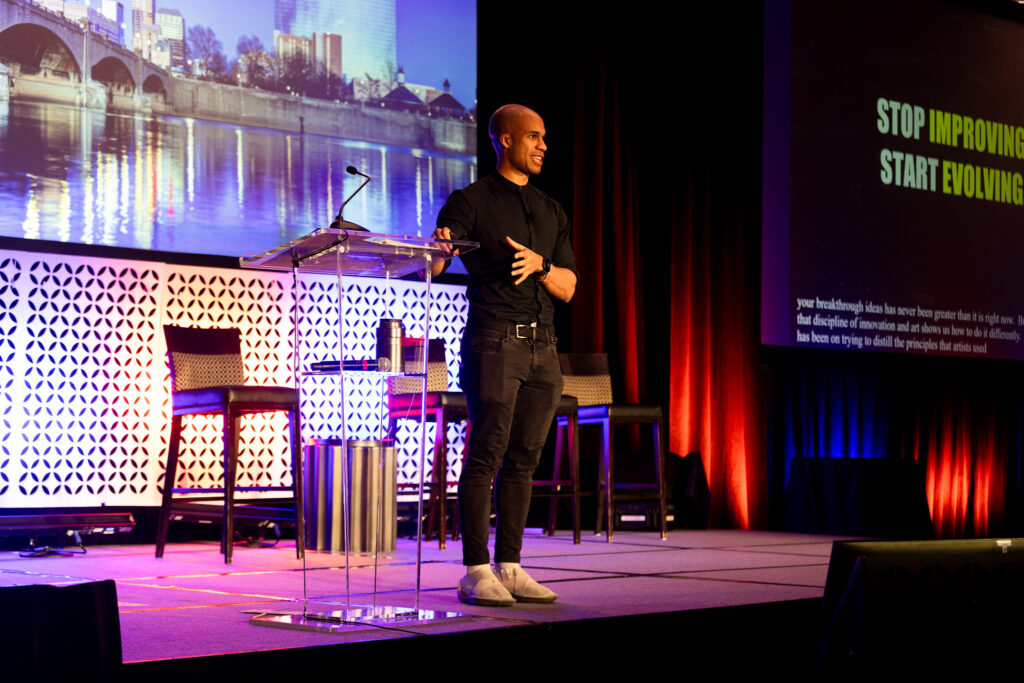
The second principle, write by erasing, was the most personal and the most powerful. Bryant shared his recovery from opioid addiction, and the counselor who asked him not to list reasons to quit—but to list everything his addiction did for him. From that letter, he crafted an erasure poem, stripping the language down to what was actually true. “Familiarity is a universal addiction that tricks us into feeling safe,” he told the room. “It stops us realizing how much we lose when we hold onto the things we know best.” He drew a direct line to the workplace: what are you holding onto—a workflow, a strategy, a tool—not because it’s still working, but because you’ve held onto it so long it’s all you can see?
The third principle, make it real, culminated in a story about taking twenty strangers to the San Francisco airport, having the group collectively design a trip, and sending the winner—Carson—on two days to Manila on a same-day flight, with a sealed envelope containing a poem, included. “Intentions achieve nothing,” Bryant said. “Artifacts change everything.”
His closing act was itself an illustration. He invited a volunteer from the audience to open an envelope on stage and read what was inside. She opened it, laughed, and turned it around: no poem. Just a $250 flight credit and a card reading “Enjoy this recognition of you doing different things differently.” The room erupted.
Bryant’s final poem, the one actually given to Carson before departure, landed the day’s theme perfectly:
“When routine drags like a run-on sentence, let your best laid plans start. Each day some untamed thought nudges you towards unlikely horizons. Let it. There is fortune in saying yes before you know where yes will take you.”
Silver Anniversary–Golden Experience: An Indy-Exclusive Off-Site Social Event
Inspired and fired up, attendees quickly switched from learning to competition mode as they headed to The Hangar for a 25th-anniversary celebration that proved Indianapolis wasn’t just a backdrop–it’s part of the experience. From the legendary Indy 500 to Olympic-level competition, Indiana has always been a place where people come together to push their best. That same was brought to the evening event, filled with games, food, and connection—all in a relaxed atmosphere representing the vibe and spirit of the Circle City!

Day one of DEAMcon26 didn’t ease into its 25-year milestone. It acknowledged it and turned immediately forward. OFCCP and federal contractor oversight is transforming in ways that demand new compliance architecture. AI is already in your systems, whether you know it or not. The talent market is rewarding authenticity over broadcast. And a poet from San Francisco reminded 185 HR professionals that the most important moves—in art and in work—begin the moment you stop doing different things the same old way.
Stay tuned for the day two recap focused on a deep dive on AI-enhanced candidate fraud, EEO enforcement priorities, and a keynote on performing under pressure.
Continue Reading