
Key Takeaways
- Federal contractor and subcontractor compliance obligations don’t vary by company size. Any covered contractor or subcontractor—regardless of headcount—is subject to the same VEVRAA and Section 503 requirements as large enterprises.
- VEVRAA requires covered contractors to list almost all job openings with the appropriate Employment Service Delivery System (ESDS), often accessed through the local American Job Center, tied to job location, for the required posting duration.
- OFCCP’s August 2026 Final Rules eliminated the Section 503 7% utilization goal, the associated utilization analysis, and the mandatory Form CC-305 disability self-identification requirement, effective September 21, 2026. Section 503’s core nondiscrimination, reasonable accommodation, affirmative action outreach, and recordkeeping obligations remain in place.
- VEVRAA’s hiring benchmark and affirmative action program requirements were not eliminated by the 2026 rulemaking, and remain active obligations for covered contractors.
- Smaller and mid-sized contractors face the same audit risk as large enterprises, but typically lack dedicated compliance staff to track a shifting regulatory landscape manually.
- DirectEmployers offers three product tiers built for different contractor sizes: Enterprise (unlimited job listings), Professional (averaging under 50 job listings/month, with à la carte add-ons), and Essentials (self-serve purchases of 1, 3, or 5 jobs for lower-volume hiring).
- VEVRAA-compliant job listing and OFCCP compliance reporting are included at every tier, not just in the enterprise-level product.
End of summary box.
If your responsibilities include EEO compliance for a smaller or mid-sized federal contractor or subcontractor, you’ve probably had this thought while evaluating vendors: this tool looks built for a company ten times our size.
You’re not wrong to notice it. A lot of HR compliance technology in this space is designed with enterprise procurement in mind—long onboarding cycles, feature sets built around dedicated HR compliance departments, and pricing that assumes a headcount far larger than yours. But here’s the problem with that evaluation: the regulations don’t scale down just because your company does.
The Compliance Burden Is the Same, Regardless of Company Size
The Office of Federal Contract Compliance Programs (OFCCP) doesn’t grade on a curve for contractor size. If your company holds a covered federal contract or subcontract above the applicable threshold—whether you’re the prime contractor or a subcontractor—you’re subject to the same core obligations as a Fortune 500 defense contractor:
- VEVRAA obligations for protected veterans, including mandatory job listing requirements with the appropriate Employment Service Delivery System, a hiring benchmark, outreach and recruitment obligations, and an affirmative action program
- Section 503 obligations for individuals with disabilities, including nondiscrimination, reasonable accommodation, outreach and recruitment obligations, recordkeeping, and an affirmative action program
- Audit risk, since OFCCP selects contractors for compliance evaluations without regard to company size
It’s worth noting that this regulatory landscape shifted meaningfully in 2025. Executive Order 11246’s implementing regulations, which had required written affirmative action programs addressing race, sex, religion, and national origin, were formally rescinded. And OFCCP’s August 2026 Final Rule narrowed Section 503 specifically, eliminating the 7% utilization goal, the related utilization analysis, and the requirement to invite applicants and employees to self-identify as individuals with disabilities. VEVRAA’s substantive protected veteran requirements, including its hiring benchmark and affirmative action program obligation, were not part of that rollback. For contractors trying to keep pace, that’s exactly the kind of distinction—what changed, what didn’t, and what the new effective dates are—that’s easy to get wrong without dedicated compliance staff watching the Federal Register.
A 40-employee subcontractor and a 40,000-employee prime contractor are reading from the same regulatory playbook. What differs is capacity. Large enterprises typically have dedicated HR compliance teams, in-house and external counsel, and HR systems built specifically to track affirmative action data. Smaller contractors are often asking one HR generalist, the CFO, or the owner, handling compliance alongside a dozen other responsibilities.
That resource gap is real. It’s also exactly the gap DirectEmployers built its solution tiers to close.
VEVRAA and Section 503: Where Smaller Contractors Face the Most Exposure
VEVRAA and Section 503 compliance deserve particular attention here, because the mechanics of these mandates trip up smaller contractors in specific, predictable ways.
Vietnam Era Veterans Readjustment Assistance Act (VEVRAA)
VEVRAA requires covered contractors to list almost all job openings with the appropriate Employment Service Delivery System (ESDS), often accessed through the local American Job Center, so veterans get priority referral access. This isn’t a “post it and veterans will come” requirement. The requirement is that jobs have to be listed with the appropriate employment service delivery system (ESDS) or American Job center, tied to the job’s actual location, and provide priority veteran referral. For a contractor managing this manually across multiple locations and states, it’s easy to have listings lapse, route incorrectly, or go unlisted entirely—any of which becomes a problem the moment an audit letter arrives.
Section 503 of Rehabilitation Act
Section 503 compliance looks different than it did a year ago. OFCCP’s August 2026 Final Rule eliminated the requirement to invite applicants and employees to self-identify as individuals with disabilities, retired Form CC-305, and removed the 7% utilization goal along with the utilization analysis tied to it. What remains—and what contractors are still required to do—is the substance of the obligation: nondiscrimination in employment practices, reasonable accommodation, ongoing affirmative action programs which include outreach and recruitment toward disability-focused sources, and recordkeeping that would hold up under an audit. Enterprise employers often have the internal bandwidth to track which obligations changed and adjust their HR compliance program accordingly. Smaller contractors usually don’t have someone whose job it is to monitor the Federal Register, which means the tooling either keeps them current or they find out the hard way, during an audit, that their program is built around requirements that no longer exist.
Under-resourced HR compliance isn’t a smaller violation in OFCCP’s eyes. A missed VEVRAA listing or an undocumented Section 503 outreach effort or reasonable accommodation carries the same audit exposure whether you have 30 employees or 30,000. The obligation is identical. What’s different is whether you have a system in place that makes meeting it, and keeping pace with what it currently requires, feasible without a dedicated team.
DirectEmployers Built for This to Help Scale Efforts
This is the core misunderstanding worth correcting: DirectEmployers’ solutions aren’t an enterprise product that smaller contractors are permitted to use. The product lineup is structured around three distinct contractor segments, each built for a different scale of hiring activity and compliance capacity.
Enterprise (Membership) is designed for contractors with unlimited job listing needs. Typically organizations correspond with high-volume hiring and complex, multi-location compliance requirements.
Professional (DE Client) is built for smaller to medium-sized federal contractors, generally averaging fewer than 50 job listings a month. This tier delivers VEVRAA-compliant listing and job syndication as its foundation, with à la carte options available for contractors who want to add capabilities without paying for an enterprise-scale package.
Essentials exists specifically for federal contractors with lower hiring volume who are still fully covered by VEVRAA’s job listing mandate. It’s a self-serve model, with the purchase of job listings available in increments of 1, 3, or 5—built for the reality that a company posting a handful of openings a year has exactly the same listing obligation as one posting thousands, without exactly the same budget or staffing to manage it.
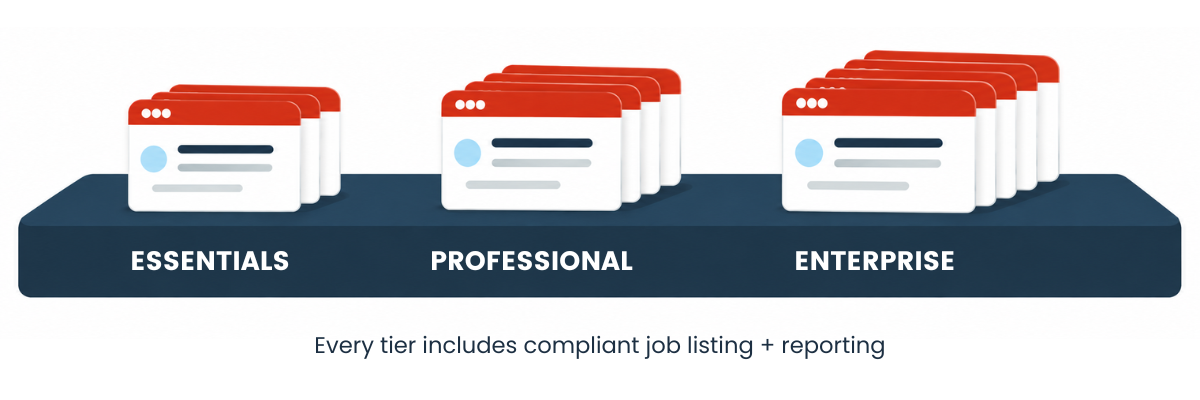
View the full details on how each tier’s capabilities scale are outlined on the DirectEmployers solutions page.
Addressing the Assumption Directly: “This Isn’t Priced or Designed for Us”
It’s a reasonable assumption to walk in with, given how much HR compliance technology in adjacent spaces is priced for enterprise budgets. But it doesn’t hold up against how DirectEmployers has structured its offering.
DE Client is the product behind that Professional offering, built as scalable HR compliance for small to medium-sized contractors averaging 50 or fewer job listings a month. This solution offers access to the same core VEVRAA compliance and job syndication that DirectEmployers’ 1,100+ Members rely on, at a cost structured for their scale rather than an enterprise budget. Why? Because those same small and mid-sized contractors carry the same regulatory obligations as a Fortune 500 Member, just without a Fortune 500 budget to meet them. The inclusions scale to match the contractor’s hiring volume, but the underlying delivery and reporting are built to the same compliance standard the obligations demand.
The Essentials tier is explicitly self-serve, which removes the sales-cycle and onboarding overhead that often makes enterprise tools impractical for smaller teams. The Professional tier’s à la carte add-on structure means a mid-sized contractor pays for the specific compliance capabilities—including partner relationship management, local job distribution, standard microsite, virtual and remote job mapping, amongst other things–that their hiring volume and audit risk actually justify, rather than absorbing the full enterprise feature set by default.
What This Means When You’re Evaluating Solutions
If you’re a HR compliance manager, a few questions are worth asking directly in any RFP or demo:
- Does the vendor have a product tier structured around your actual job listing volume, or are you being sold enterprise capacity you won’t use?
- Does VEVRAA-compliant job listing and OFCCP compliance reporting come standard at your tier, or only in add-on packages priced for larger budgets?
- Does a tool exist that supports outreach management requirements under VEVRAA and Section 503?
Smaller and mid-sized federal contractors and subcontractors carry the same regulatory obligations as their largest peers, with a fraction of the internal resources to meet them. That gap is the reason a tiered approach to compliance obligations exists, to support the entire federal contract community. And the reason that DirectEmployers Association came into play–as a cost-effective measure promoting community, collaboration, and education along the way.

Let’s chat!
Fill out this form to indicate which solutions you’re interested in and we'll contact you shortly to schedule a demo.