
Key Takeaways
- The foundation hasn’t changed. DirectEmployers’ virtual event HR Compliance Foundations: A Federal Contractor’s Guide to Getting It Right had one clear message for federal contractor compliance: the rules keep changing, but the foundation hasn’t.
- Disability self-ID is optional, but affirmative action isn’t gone. The Section 503 Final Rules (effective September 21) no longer require disability self-ID. Affirmative action for protected veterans and individuals with disabilities remains.
- The biggest risks have shifted. The False Claims Act, state attorneys general enforcing disparate impact, and private plaintiffs now pose more risk than routine OFCCP audits.
- Keep your data, and protect it. PJ Rossi (Forté HR Advisors) and Mickey Silberman and Michelle Duncan (Silberman Law) urged contractors to keep collecting applicant data, keep disposition codes on, audit I-9s, and run privileged pay equity and adverse impact analyses.
- Replace the CC-305 now. Take down the old form and weight options for building your own voluntary self-ID language with the guidance of in-house or external counsel.
- Give HR a seat at the AI table. HR compliance should weigh in on every AI tool that scores, ranks or recommends people throughout the hiring cycle.
- Five next steps: Inventory your obligations, your data, your ATS and your AI, then test whether you can defend one real employment decision.
End of summary box.
No Slides, No Script: Three Experts Talking Shop
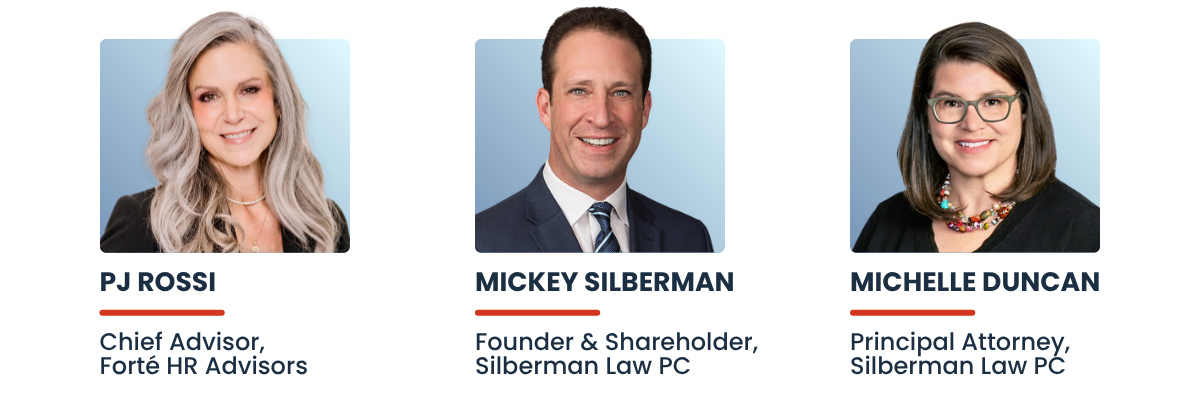
On Wednesday, September 23, DirectEmployers hosted HR Compliance Foundations: A Federal Contractor’s Guide to Getting It Right, featuring five back-to-back sessions built around conversation instead of slide decks. PJ Rossi of Forté HR Advisors, a former DirectEmployers Member now HR compliance and AI consultant, joined attorneys Mickey Silberman and Michelle Duncan of Silberman Law PC. As Duncan put it: “It’s so refreshing to be able to have folks listen in on a conversation between people who are thinking about these issues and talking about these issues on a daily basis.”
That conversation started, fittingly, with the big picture.
Foundation 1: The Shifting Legal Landscape
Silberman set the tone with an image that stuck all day. “When the pendulum swings that far to one side, it doesn’t swing back to the bottom in the middle,” he said, adding “…there’s going to be more whiplash over the coming years.”
The latest regulatory change occurred September 21, 2026, when the Section 503 Final Rule stopped requiring federal contractors and subcontractors to ask for disability status—pre, post, at the 5-year mark. Asking isn’t off-limits, though: the EEOC still allows it, some states still require it, and as the hosts noted, veteran self-ID, location-based plans and effectiveness reviews all remain.
If that sounds murky, Duncan agreed. “We’re living in a very gray space right now,” she said, and the risk has shifted along with the rules. The DOJ is now using the False Claims Act to test the compliance certifications contractors sign, and “the settlements from OFCCP pale in comparison.” Meanwhile, 14 state attorneys general have pledged to keep enforcing disparate impact.
With so much uncertainty, some employers may be tempted to stop collecting data altogether. The panel pushed back stating, “Your best evidence to defend against a claim of discrimination is your data,” Duncan said. Silberman agreed, with one condition: “Track data, folks…Build guardrails around it.”
Foundation 2: Build a Compliant Hiring & Employment Process
With the landscape mapped out, the second session turned to what contractors can do about it. Rossi admitted the to-do list is long and suggested picking your top five priorities to start: “How do you eat an elephant? One bite at a time.”
A good first bite centered around clearing up a common misconception. Affirmative action isn’t gone; only the race and gender requirements under Executive Order 11246 were rescinded. What does that mean? Affirmative Action Programs (AAPs) still remain for covered contractors under VEVRAA and Section 503, with “36 out of the 40” Section 503 components also in play. Signing a federal contract without current plans creates False Claims Act exposure. For example, fines or penalties on a $10 million contract, Silberman noted, the government “can demand up to $30 million.”
From there, the panel moved to what applicants actually see. Remove the now discontinued Form CC-305, OFCCP pay transparency language EEO/AAP commitment statement, and EO 11246 references, but keep required EEO policy statements, equal opportunity employer (EOE) taglines, and accommodation processes and contact.
Postings are the easy part. Harder self-ID decisions are coming, possibly for race and gender too, and Silberman cautioned that dropping self-ID usually means “creating more exposure for yourself.”
The session closed where Duncan has seen accommodation requests “left on the vine to wither and die.” The fix, the panel agreed, is to document the process, track outcomes and test every accommodation request channel to ensure no barriers to employment exist.
Foundation 3: Get Your Data & Practices Right
If Foundation 2 was about process, Foundation 3 was about the records that prove it. Silberman sees I-9 noncompliance rates of 40% to 50%, but proactive self-audits work. Duncan shared two that cut estimated fine risk from $11.6 million to $0.6 million and from $27.7 million to $7.3 million.
The same logic applies to disposition codes, which Duncan called “your best business record in defense of your fair and non-discriminatory hiring process.” Rossi shared as a former practitioner: “Just the mere thought of not doing disposition codes gives me heartburn.” Keep them useful by matching requisitions to postings and keeping codes business related. Or, in Rossi’s line of the day: “Garbage in means basically garbage out… Except for when you’re talking about HR compliance, because garbage out then becomes Exhibit A.”
Good records matter even more because the False Claims Act isn’t going away. Silberman pointed to a contractor’s recent $25 million settlement, and Duncan, a former DOL litigator, said past administrations “are kicking themselves for not coming up with this idea.”
The same proactive thinking applies to pay. About 16 or 17 states now require pay ranges in job advertisements, and Duncan recommends periodic EEO pay equity analyses under privilege. In Massachusetts for example, Silberman added, a good faith analysis works like “a get out of jail free card.”
Foundation 4: Prepare for What’s Next with AI
Next, the panel looked ahead at the topic taking over board rooms, cubicles, and home offices across the country—artificial intelligence (AI) and its use in hiring processes. “AI isn’t something that’s coming, right? It’s already here,” Duncan said, which is why HR compliance teams “need a seat at the table when we’re making decisions about what tools to use.”
Rossi suggested starting every AI conversation with one question: “Tell me what you’re solving for.” AI can save HR real time, but the risk rises when AI scores, ranks or recommends people based upon unknown or unchecked criteria. In those cases, people should be able to request accommodations, correct their data and get a human review, and the results must be explainable.
That’s why vendor answers matter. When Rossi asked how one red-yellow-green scoring model worked, the reply was, “That’s proprietary.” Internal tools need scrutiny too, as Duncan showed with an HR chatbot that told an employee, “We don’t pay overtime. We provide compensatory time off.”
Her takeaway turned risk into opportunity: “You are in a position to become your organization’s expert in issue spotting.”
Foundation 5: Put It Into Practice
The final session brought everything together. For Silberman, the answer to constant change isn’t a longer rulebook. “It’s a mindset shift,” he said. Contractors who find and fix gaps before a claim or audit does will be ready “whichever way the wind is blowing.”
Rossi turned that mindset into five, helpful steps:
- Inventory your obligations: federal, state, local and contractual.
- Inventory your data: what you collect, why and who uses it.
- Make sure your ATS is fit for purpose. Assess by testing the applicant and employee experience.
- Inventory your AI: the tools, where they fit, and who owns them.
- Test your defensibility by reconstructing one employment decision.
Not surprisingly, the Q&A circled back to the most urgent task at present: replacing Form CC-305. Duncan was clear the old disability self-ID form has to go, since “the statement in the form is no longer correct.” In its place, she recommends a simple, voluntary form with three choices that explains why you’re asking. Still working on it? A memo to file documenting your plan and timeline shows good faith. Rossi also suggested transparency is key, “tell people why you’re asking for the information, what you’re going to do with it, who will have access to it, and how it will be protected. Make it clear that participation is voluntary and no adverse treatment for choosing not to respond, and that the information won’t be used to make employment decisions. Ultimately, the purpose should be about identifying and removing barriers to equal employment opportunity for individuals with disabilities.
Keep the Conversation Going
If the HR Compliance Foundations virtual event proved anything, it’s that federal contractor compliance isn’t about chasing every rule change. It’s about building a foundation that holds up no matter which way the pendulum swings. The regulatory environment will keep shifting, but the fundamentals won’t: know your obligations, protect your data, document your decisions, and bring HR into every AI conversation. The good news? You don’t have to figure it out alone. Here’s how to keep building:
- Register for the October 14 Virtual Event | AI in Talent Acquisition Playbook: Hits, Misses & Compliance Strategies with Michelle Duncan and PJ Rossi
- Watch all five recordings in DE Connect
- Cover all your bases and subscribe to receive compliance alerts from DirectEmployers and Silberman Law
- Connect with PJ Rossi, Mickey Silberman, and Michelle Duncan on LinkedIn
- RSVP to Attend Member Office Hours
THIS COLUMN IS MEANT TO ASSIST IN A GENERAL UNDERSTANDING OF THE CURRENT LAW AND PRACTICE RELATING TO OFCCP. IT IS NOT TO BE REGARDED AS LEGAL ADVICE. COMPANIES OR INDIVIDUALS WITH PARTICULAR QUESTIONS SHOULD SEEK ADVICE OF COUNSEL.

Let’s chat!
Fill out this form to indicate which solutions you’re interested in and we'll contact you shortly to schedule a demo.