
Originally published March 9, 2026. Updated September 21, 2026.
Key Takeaways
- Section 503 of the Rehabilitation Act still requires covered federal contractors and subcontractors to take affirmative action in employing and advancing qualified individuals with disabilities, and it still prohibits disability discrimination.
- Recent rulemaking has significantly changed how contractors demonstrate compliance, though the Section 503 Affirmative Action Program itself remains in place.
- Contractors should continue to focus on removing barriers, reviewing personnel processes and job qualifications, providing reasonable accommodations, conducting meaningful outreach and positive recruitment, maintaining accessible employment processes, training personnel who make or influence employment decisions, and evaluating the effectiveness of their outreach and affirmative action efforts.
- Effective September 21, 2026, contractors will no longer be required to: solicit disability self-identification, use Form CC-305, conduct applicant and hire disability data analysis, or measure their workforce against the former 7% utilization goal.

What is Section 503?
Section 503 of the Rehabilitation Act is a federal law that prohibits government contractors and subcontractors from discriminating against individuals with disabilities in employment. It also requires covered contractors to take affirmative action to employ and advance qualified individuals with disabilities.
Unlike the former Executive Order 11246 affirmative action program, Section 503 was not rescinded. Its statutory affirmative action requirement and implementing regulations remain in effect, subject to the changes made of the 2026 Final Rule.
Who is Covered Under Section 503?
Office of Federal Contract Compliance Programs (OFCCP) enforces Section 503, but disability-related employment practices may also fall under the jurisdiction of the EEOC and other federal, state, and local enforcement agencies and applies to any business that:
- Holds a federal contract or subcontract of $20,000 or more, OR
- Holds a federal contract or subcontract of $50,000 or more and has 50 or more employees–triggering the written Affirmative Action Program (AAP) requirement
It’s important to note that coverage flows through the supply chain. This means if your organization is a subcontractor providing goods or services to a prime contractor performing work on a federal contract, you are subject to Section 503 even if you have no direct contract with the federal government.
Additional Context: A covered contractor is any employer meeting the thresholds above. A qualified individual with a disability means a person who, with or without reasonable accommodation, can perform the essential functions of the job.
While the anti-discrimination portion is straightforward, the affirmative action component is where many HR professionals face complexity. It requires proactive steps to ensure that qualified individuals with disabilities have equal access to employment opportunities.
Key Requirements for Section 503 Compliance
Section 503 compliance continues to require proactive affirmative action. However, contractors should no longer rely on disability self-identification percentages or utilization analysis as the primary measure of compliance.
The current framework focuses more directly on employment practices, barriers, outreach, accessibility, accommodations, and the effectiveness of the contractor’s affirmative action efforts.

Written Affirmative Action Program (AAP)
Covered contractors must continue to develop and maintain a written Section 503 affirmative action program (AAP) and update it annually.
The AAP should address the contractor’s remaining affirmative action obligations for individuals with disabilities, including personnel processes, job qualification standards, reasonable accommodation, anti-harassment procedures, outreach and positive recruitment, internal dissemination, responsibility for implementation, training, and an audit and reporting system.
Contractor Obligations No Longer Required/Eliminated as Part of the Section 503 Final Rule, Effective September 21, 2026:
- Invite applicants to self-identify pre-offer
- Invite individuals to self-identify post-offerResurvey employees every five years
- Provide the interim employee self-identification reminder
- Use OFCCP Form CC-305
- Apply a 7% disability utilization goal to job groups or the workforce
- Compare disability representation against the 7% goal
- Conduct the former utilization analysis
- Develop action-oriented programs based on failure to meet the 7% utilization goal
Practitioner Tip: Organizations with separate state or local affirmative action requirements should evaluate those obligations and applicable ADA requirements before changing disability data collection practices.
Review Physical and Mental Job Qualifications
Contractors must continue to periodically review physical and mental job qualification standards by examining job descriptions and requirements to determine whether any could screen out individuals with disabilities and, if so, whether those requirements are job-related and consistent with business necessity. This includes considering whether standards such as lifting, standing, driving, mobility, scheduling, or other similar factors are truly essential to the position.
Recruitment and Outreach Records
Contractors should continue to periodically review personnel processes to ensure individuals with disabilities receive meaningful consideration for employment and advancement, which is increasingly important under the revised Section 503 framework. This includes examining recruiting, applications, assessments, interviewing, hiring, promotion, training and other employment processes for unnecessary barriers to qualified individuals with disabilities. Skills-based barrier analysis is one method contractors can use to meet their affirmative action obligations without collecting individual disability-status data.
Contractors should also engage in recruitment and outreach efforts to disability-serving organizations, such as local vocational rehabilitation agencies or disability-focused communities.
- Documentation is Key: You must keep records of outreach activity for three years.
- Annual Outreach Assessment: Each year, you must evaluate the effectiveness of these efforts. If an organization isn’t sending qualified candidates your way, you should seek and establish relationships with new disability partners.
DirectEmployers Members: As part of Membership, you have access to VocRehab+ that allows connection to hundreds of vocational rehabilitation counselors across the nation, as well as our in-house Partnerships team for additional connection, support, and guidance. In addition, Members have access to the Partner Relationship Manager (PRM)—an outreach management tool that allows you to connect with disability-supporting organizations and employment networks, record conversations, and assess partnerships—all from one tool.
Accessible Recruiting and Application Processes
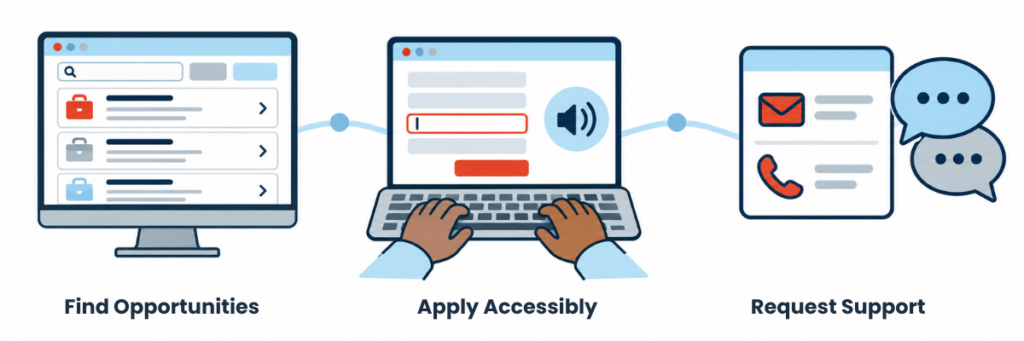
Accessibility should be an important component of a contractor’s Section 503 compliance strategy. Contractors should evaluate whether online applications, assessments, career sites, and other hiring technology are accessible to applicants who use screen readers, voice-to-text tools, keyboard navigation, and other assistive technologies, and should provide applicants with clear information about how to request a reasonable accommodation during the application and hiring process. These alternative application methods and accommodation contact processes should then be periodically tested to ensure they work as intended.
Reasonable Accommodations
Contractors must continue providing reasonable accommodation to qualified applicants and employees with disabilities when required by law, and should maintain an effective process for receiving and responding to accommodation requests. Any medical and disability information gathered through this process must be handled consistent with applicable confidentiality requirements.
Training
Personnel involved in recruitment, screening, selection, promotion, disciplinary, and related employment processes should be trained on EEO obligations and, as appropriate, the organization’s Section 503 affirmative action commitments, and this training should be documented as part of the Section 503 AAP.
Equal Opportunity Employment (EOE) Tagline and Notices
Contractors must also continue providing required equal employment opportunity notices to applicants and employees in accessible and understandable formats. Ensure your job listings (or advertisements) include an equal opportunity employment (EOE) tagline stating that you are an equal opportunity employer and specifically mention that you do not discriminate based on disability.
DirectEmployers Members: Access the Member-Exclusive Compliance Tip Sheet, which shares how to craft an EOE tagline that complies with VEVRAA, Section 503 and other legal requirements.
Demonstrating Section 503 Compliance
Section 503 compliance goes beyond maintaining a written AAP. Contractors should be prepared to demonstrate how their affirmative action commitments are actively implemented and effectively in practice. Key compliance practices and supporting documentation include:
- Equal Employment Opportunity Policy Statement and Tagline addressing disability nondiscrimination and affirmative action.
- Review of Personnel Processes to ensure qualified individuals with disabilities receive appropriate consideration for employment and advancement.
- Review of Physical and Mental Qualifications periodically to identify qualifications that may screen out individuals with disabilities and ensure they are job-related and consistent with business necessity.
- Reasonable Accommodation Procedures and Practices consistent with Section 503 and the ADA.
- Anti-Harassment Policy and Procedures addressing harassment based on disability.
- External Outreach and Positive Recruitment reasonably designed to recruit qualified individuals with disabilities. Outreach activities must be documented and records retained for three years.
- Internal Dissemination of the EEO Policy so employees understand the contractor’s commitment and obligations.
- Responsibility for Implementation assigned to an official with authority and resources to administer the AAP.
- Training for personnel involved in recruiting, screening, selection, promotion, discipline, and related employment decisions regarding Section 503 EEO and affirmative action obligations.
- Audit and Reporting System to measure implementation and effectiveness, identify deficiencies, and support corrective action. OFCCP specifically confirms that contractors must document the design and implementation of this system.
Digital Accessibility
Contractors should evaluate career sites, online applications, assessments, and recruiting technologies for accessibility barriers. While Section 503 does not mandate a specific Web Content Accessibility Guidelines (WCAG) standard, WCAG provides a recognized framework for evaluating digital accessibility.
Ensure applicants using assistive technology can access job postings, complete applications and assessments, and request reasonable accommodations or alternative application methods.
Moving Beyond Basic Compliance
While meeting the letter of the law protects your company from legal risk, the most successful federal contractors view Section 503 as simply a starting point to a more inclusive and skilled workforce representative of all individuals in the workforce. By fostering a disability-inclusive culture, creating an accessible digital environment for job seekers, and continuing to nurture those efforts after hiring through employee resource groups (ERGs) or accommodations, you naturally improve employee engagement and retention.
Navigating the complexities of Section 503 doesn’t have to be a solo endeavor. DirectEmployers Association provides a comprehensive solution that bridges the gap between regulatory requirements and meaningful recruitment outcomes. We help you move beyond check-the-box compliance by facilitating deep, authentic connections with Vocational Rehabilitation (VR) counselors nationwide through VocRehab+, while our in-house ADA-certified trainer infuses expert, hands-on knowledge and guidance to support your pursuit of creating a disability-inclusive workplace.

Let’s chat!
Fill out this form to indicate which solutions you’re interested in and we'll contact you shortly to schedule a demo.