
Key Takeaways
On June 4, 2026, the House Appropriations Committee released its FY2027 Labor, Health and Human Services, Education, and Related Agencies (LHHS) Appropriations Bill, with a subcommittee markup underway as of June 5th. The bill proposes to eliminate all funding for OFCCP—codifying President Trump’s Executive Order 14173 into appropriations law—and would reduce the Department of Labor’s overall discretionary budget by $3.7 billion (27%) from FY2026 enacted levels. The Wage and Hour Division (WHD) faces a $25 million funding cut, and OSHA enforcement funding would be reduced by $52 million. It’s important to remember, this is a legislative proposal, not enacted law. Current federal contractor compliance obligations under OFCCP, VEVRAA, Section 503, the FLSA, Davis-Bacon Act, and all active contract requirements remain fully in force today and should not be wound down in anticipation of legislation that has not yet passed.
End of summary box.
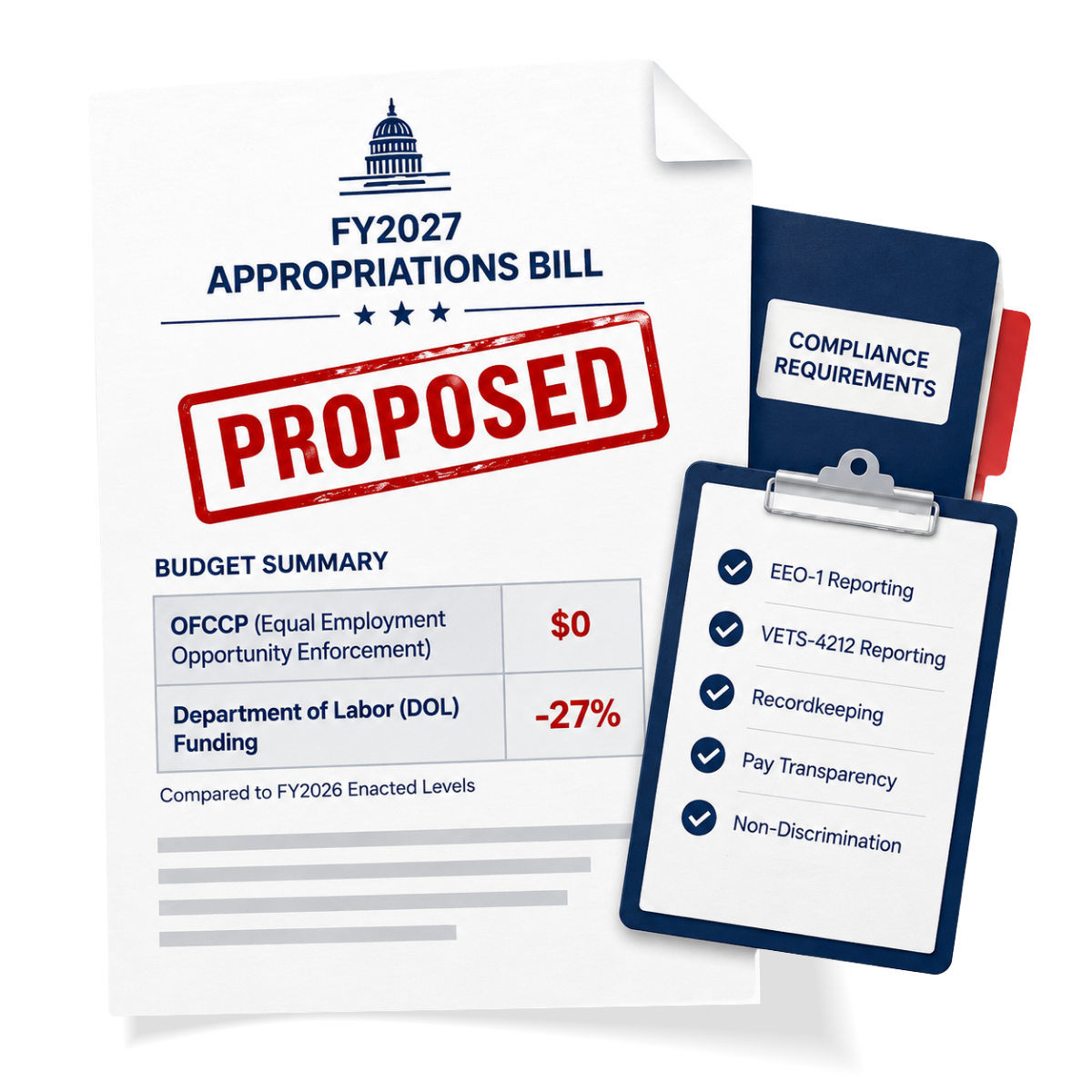
The FY2027 Appropriations Bill shows a reduction of 27% of the Department of Labor (DOL) funding, with $0 allotted toward the Office of Federal Contract Compliance Programs (OFCCP).
On June 4, 2026, The House Appropriations Committee’s subcommittee markup of the FY2027 Labor, Health and Human Services, Education, and Related Agencies (LHHS) Appropriations Bill represents the next significant legislative development in what has been an evolving federal contractor compliance landscape since early 2025. For HR compliance and talent acquisition professionals who have been navigating Affirmative Action Program (AAP) obligations, OFCCP audits, and the broader restructuring of the Department of Labor, this bill is worth monitoring closely—even as existing obligations remain unchanged today.
Here is a breakdown of the bill’s key provisions, what they mean for federal contractors, and the action steps your organization should take now.
Key Provisions at a Glance
- Office of Federal Contract Compliance Programs (OFCCP): Elimination; The bill zeroes out all funding for the OFCCP, codifying President Trump’s Executive Order 14173 into appropriations law. This is consistent with actions already underway administratively, but congressional elimination would make reinstatement significantly more difficult for future administrations.
- Wage and Hour Division (WHD): ~$25M reduction; The bill matches the Administration’s budget request with a $25 million decrease to the WHD, which is responsible for enforcing FLSA, the Davis-Bacon Act, and other federal wage laws applicable to contractors.
- Occupational Safety and Health Administration (OSHA): ~$52M reduction; Occupational safety enforcement funding is reduced, though core inspection and enforcement functions are expected to continue at a reduced capacity.
- Total Department of Labor (DOL): Reduction of ~$3.7 billion (27%); The DOL’s overall discretionary funding drops from the FY2026 enacted level, reflecting a broad restructuring of the agency’s footprint.
Office of Federal Contractor Compliance Programs (OFCCP): Funding Eliminated
The bill’s most significant provision for federal contractors is the complete zeroing out of OFCCP’s budget, a step beyond the administrative and executive actions that have already substantially curtailed the agency’s operations over the past year.
Since January 2025, the OFCCP has undergone significant operational changes, including staff reductions and a series of leadership transitions, most recently the appointment of Kenneth J. Wolfe as OFCCP Director. Those changes have been administrative in nature. Congressional elimination via the appropriations process is a qualitatively different action: it would codify into law the removal of the agency that Congress itself created, making reinstatement by a future administration significantly more difficult.
Federal Contractor Takeaway: Do not interpret this proposal as a reason to wind down your Affirmative Action Programs. OFCCP’s audit authority under Section 503 of the Rehabilitation Act and the Vietnam Era Veterans Readjustment Assistance Act (VEVRAA) remains in place under current law, and your active contracts contain compliance obligations that are independent of OFCCP’s operational status. The appropriate posture is to continue maintaining your AAPs for veterans and individuals with disabilities, recordkeeping, and self-identification processes as required.
Wage and Hour Division (WHD): A $25M Reduction
The bill matches the Administration’s previously announced budget request with a $25 million reduction to the WHD. The WHD is the agency responsible for enforcing the Fair Labor Standards Act (FLSA), the Davis-Bacon Act, the Service Contract Act, and related federal wage requirements—all of which apply directly to federal contractors and their subcontractors.
While the reduction is notable, WHD enforcement activity has continued at a substantial pace in 2025 and 2026. The agency recently released a new series of FLSA Opinion Letters (FLSA2026-5 through FLSA2026-8) covering dual-role employee classification, overtime bonus calculations, meal break compensability, and timekeeping rounding practices—a clear signal that compliance assistance and enforcement remain active agency priorities regardless of budget pressure.
Federal Contractor Takeaway: A reduced WHD budget does not equate to reduced enforcement risk. Federal contractors with Davis-Bacon or Service Contract Act obligations on active projects should continue auditing their wage determinations, certified payroll submissions, and fringe benefit calculations as normal.
Occupational Safety and Health Administration (OSHA): Reduced Capacity, Continued Obligations
The bill proposes a $52 million reduction to OSHA’s enforcement budget. The subcommittee summary indicates that core inspection and enforcement functions are expected to continue, albeit at a reduced capacity. Federal contractors in industries with significant workplace safety obligations—construction, manufacturing, healthcare, and logistics, among others—should not interpret a funding reduction as a meaningful reduction in compliance exposure.
Federal Contractor Takeaway: Maintain your existing OSHA compliance programs, incident reporting procedures, and training schedules. State-plan OSHA programs, which govern a significant share of the workforce in many states, are separately funded and largely unaffected by this federal proposal.
What this Means for Federal Contractors Now
Continue maintaining your AAPs focused on veterans and individuals with disabilities, VEVRAA and Section 503 obligations, and recordkeeping as required under current law and any active contracts. Do not wind down compliance programs based on proposed—but not enacted—legislation.
In addition, the EEOC presents a parallel dynamic worth noting. The EEOC has requested increased funding for FY2027, yet its resources remain subject to the same congressional appropriations process described above. Employers should not interpret budget uncertainty—at the EEOC or anywhere across the DOL—as reduced enforcement risk. The EEOC remains an active enforcement agency with continued focus on systemic discrimination, workplace harassment, pay equity, and the use of artificial intelligence in employment decisions. The underlying obligations under federal equal employment opportunity laws are unchanged regardless of how the appropriations process resolves. Now is an opportune time for organizations to assess their hiring, promotion, and pay practices, review AI-assisted employment tools for disparate impact exposure, and ensure governance frameworks are positioned to withstand scrutiny, whether or not agency budgets contract in FY2027.
For Members who have been navigating the EEO landscape, this bill represents the next step in what has been an evolving regulatory environment since January 2025. DirectEmployers has been tracking these developments closely and will provide updated guidance as the legislative process advances. As always, Members with questions are encouraged to reach out to their DirectEmployers Membership Team, utilize the peer discussion forum in in the DE Connect discussion forum, or attend upcoming Member Office Hours for real-time HR compliance insights and support.
THIS COLUMN IS MEANT TO ASSIST IN A GENERAL UNDERSTANDING OF THE CURRENT LAW AND PRACTICE RELATING TO OFCCP. IT IS NOT TO BE REGARDED AS LEGAL ADVICE. COMPANIES OR INDIVIDUALS WITH PARTICULAR QUESTIONS SHOULD SEEK ADVICE OF COUNSEL.

Let’s chat!
Fill out this form to indicate which solutions you’re interested in and we'll contact you shortly to schedule a demo.