
Key Takeaways
- On October 16, 2026, the EEOC sent the Office of Information and Regulatory Affairs (OIRA) a final rule (RIN 3046-AB43) that would rescind the interpretive portions of its version of the Uniform Guidelines on Employee Selection Procedures (UGESP), 29 CFR part 1607, and the associated appendix.
- The EEOC’s regulatory agenda projects final action in November 2026 and an effective date in January 2027. The rule text is not yet public.
- UGESP recordkeeping, including applicant demographic data, is the subject of a separate, earlier-stage proposal (RIN 3046-AB45) that has not been issued for public comment.
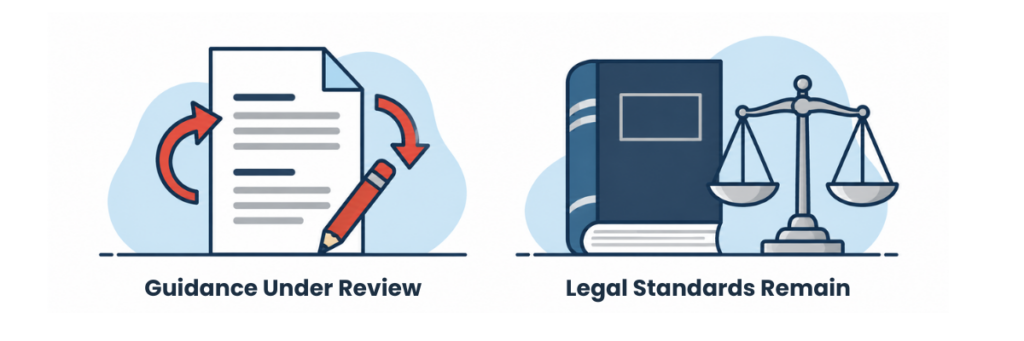
- Disparate impact liability comes from Title VII itself. Rescinding the guidelines would remove the federal roadmap for defending a selection procedure while leaving the statutory standard in place.
- Until a Final Rule is published in the Federal Register and takes effect, current obligations remain unchanged.
End of summary box.
The federal government’s core guidance on employment decisions, selection procedures, testing and validating hiring tools is one step closer to being withdrawn. On October 16, 2026, the Equal Employment Opportunity Commission (EEOC) asked the Office of Information and Regulatory Affairs (OIRA) to review a final rule rescinding the interpretive portions of the Uniform Guidelines on Employee Selection Procedures (UGESP) at 29 CFR part 1607. For federal contractors, the timing stands out. The Office of Federal Contract Compliance Programs’ (OFCCP) own version of UGESP at 41 CFR part 60-3 comes off the books on October 26, 2026, when the Department of Labor’s final rule rescinding the Executive Order 11246 regulations takes effect. After that date, the EEOC’s codification will be the one that matters most for private employers, including federal contractors, which is why this rule warrants close attention.
What the EEOC Sent to OIRA
The Uniform Guidelines on Employee Selection Procedures (UGESP) has guided employers on selection procedures since the EEOC, the Department of Labor, the Department of Justice, and the Civil Service Commission adopted it in 1978. It applies to tests and other selection procedures used to make employment decisions. When a procedure has adverse impact, UGESP directs the employer to validate it and retain the validation documentation.
According to the Unified Agenda entry, the EEOC is rescinding the “interpretive rulemaking portions” of UGESP and its appendix. The abstract notes that UGESP predates the 1991 amendments to the Civil Rights Act of 1964. The entry is designated deregulatory under Executive Order 14192 and appears for the first time on the agenda at the final rule stage, with no proposed rule stage listed. The EEOC followed a similar path in June, when it rescinded its 1979 affirmative action guidelines through a final interpretive rule without notice and comment.
Because the rule text is not yet public, its exact scope is unconfirmed. The interpretive portions likely include UGESP’s guidance on identifying adverse impact, such as the four-fifths rule and its standards for validating tests and other selection procedures.
How We Got Here
This rule caps a year of coordinated federal action on disparate impact and selection procedures:
- June 9, 2026: The DOJ’s Office of Legal Counsel issued an opinion concluding that UGESP rests on an unconstitutional reading of Title VII to the extent it supports liability based on disparate effects alone.
- June 24, 2026: OIRA extended the EEOC’s UGESP information collection through 2029, without change.
- July 31, 2026: The Office of Personnel Management’s interim final rule removing UGESP references from federal civil service regulations took effect.
- August 21, 2026: OFCCP published final rules rescinding the EO 11246 regulations, including 41 CFR part 60-3, and revising Section 503.
When we covered the June renewal, the EEOC had not proposed rescinding UGESP. That has now changed, and the EEOC is expected to discontinue the UGESP information collection once the final rule takes effect.
What Changes & What Doesn’t
The legal standard stays. Under Title VII, an employer whose selection procedure causes a disparate impact must still show it is “job-related for the position in question and consistent with business necessity” (42 U.S.C. 2000e-2(k)(1)(A)(i)). Private plaintiffs can still bring these claims, and courts may continue to find UGESP’s validation principles persuasive. Professional standards, including the Society for Industrial and Organizational Psychology’s Principles, are unaffected.
Recordkeeping is on a separate track. The proposal to rescind UGESP’s recordkeeping requirements, including retention of validation documentation and applicant data by race, sex, and ethnicity, has not been published for comment. Paired with the EEOC’s pending proposal to rescind EEO-1 reporting, it could remove the primary federal mandate to collect applicant demographic data. Employers would still be subject to the general records retention rule at 29 CFR 1602.14 and to Section 709(c) of Title VII.
State requirements are moving the other way. Fourteen state attorneys general have issued joint guidance affirming that disparate impact liability remains enforceable. New Jersey has adopted rules addressing automated employment decision tools, and Illinois will codify disparate impact liability in employment effective June 1, 2027.
Section 503 and VEVRAA obligations continue. Contractor obligations under VEVRAA, including applicant and hire data under 41 CFR 60-300.44(k), are not affected by this rule.
What This Means for Federal Contractors
No action is required today, but this is a good time to take stock including:
- ☐ Inventory selection tools and procedures in use and identify which have existing validation studies.
- ☐ Check whether AI vendor contracts, bias audits, or validation reports rely on UGESP measures such as the four-fifths rule.
- ☐ Flag internal policies, training materials, and affirmative action documents that cite UGESP or 41 CFR part 60-3.

- ☐ Keep current applicant self-identification and recordkeeping practices in place while the recordkeeping proposal remains unissued.
- ☐ Consider developing a proactive strategy to determine how your organization will demonstrate how your selection tools and procedures are business related and nondiscriminatory.
- ☐ Before changing selection and retention practices, consult counsel about litigation exposure risk, and consider conducting adverse impact analyses under privilege.

Staying Ahead of What Comes Next
The next milestones to watch are OIRA clearance, a Commission vote, Federal Register publication, and the projected January 2027 effective date. Watch also for the recordkeeping proposal (RIN 3046-AB45) and its comment period, which is where federal contractors will have an opportunity to weigh in.
DirectEmployers will continue tracking each step and will report on the final rule text as soon as it is public. Members with questions are encouraged to contact their Membership Team, connect with peers in the DE Connect discussion forum, or attend upcoming Member Office Hours. To receive future compliance updates, subscribe to receive email or text alerts.
THIS COLUMN IS MEANT TO ASSIST IN A GENERAL UNDERSTANDING OF THE CURRENT LAW AND PRACTICE RELATING TO OFCCP. IT IS NOT TO BE REGARDED AS LEGAL ADVICE. COMPANIES OR INDIVIDUALS WITH PARTICULAR QUESTIONS SHOULD SEEK ADVICE OF COUNSEL.

Let’s chat!
Fill out this form to indicate which solutions you’re interested in and we'll contact you shortly to schedule a demo.